

A personal loan is a lump sum of money you borrow from a bank, credit union, or online lender and repay in fixed monthly payments over a set period, usually with interest. Most personal loans are unsecured, which means you do not pledge property such as a car or house as collateral.
Because the payments and payoff date are fixed in advance, a personal loan is often easier to budget for than a revolving balance that changes from month to month.
Quick Answer: A personal loan gives you a fixed amount once, and you repay it in equal installments over a set term. Your total cost depends mainly on the interest rate, the loan term, and fees such as an origination fee. Compare offers by APR and total cost of repayment — not by the monthly payment alone.
Key Takeaways
- A personal loan is repaid in fixed monthly installments over a set term, commonly two to seven years.
- APR is the most useful single number for comparing offers because it reflects the interest rate plus certain fees.
- Fees vary by lender. An origination fee, a late fee, and a prepayment penalty can each change your real cost.
- A longer term lowers the monthly payment but usually increases the total interest you pay.
- No lender can guarantee approval or a specific rate before reviewing your application. Treat advertised rates as examples, not promises.
How a Personal Loan Works
The basic steps are the same with most lenders:
- You apply and state how much you want to borrow. The lender reviews your credit history, income, and existing debts.
- You receive an offer stating the approved amount, interest rate, APR, term, monthly payment, and any fees.
- The money is paid to you, often by deposit to a bank account. If an origination fee applies, it may be deducted first, so you receive less than the amount you borrowed (see our guide to personal loan origination fees).
- You repay in monthly installments. Each payment covers interest for that month plus part of the principal balance.
- The loan closes when the balance reaches zero, either at the end of the term or earlier if you pay it off ahead of schedule.
Unlike a credit card, a personal loan does not reopen as you repay it. Once the balance is paid, the account is closed.
The Main Costs to Understand
Interest and APR
Interest is the main cost of borrowing. The interest rate is used to calculate interest on your balance, while the APR (annual percentage rate) expresses the cost of credit as a yearly rate and includes certain fees in addition to interest. That is why the APR on a loan with fees is usually higher than its interest rate. Our separate guide explains
what affects the rate you receive in more detail.
Origination fees
Some lenders charge an origination fee for processing the loan, often expressed as a percentage of the loan amount and deducted from the money you receive. Not every lender charges one, and the amount varies, so it should always be checked in the offer, not assumed.
Late fees and other charges
If a payment is late or a payment is returned for insufficient funds, additional fees may apply under the loan agreement. These charges do not appear in the advertised rate, so they are easy to overlook when comparing offers.
Prepayment penalties
Some loans charge a fee if you pay off the balance early. Many do not. Because paying early is one of the main ways to save interest, check this term before you sign — our guide to paying off a personal loan early walks through the math.
Common Personal Loan Terms
| Term | What it means |
|---|---|
| Principal | The amount you borrow and must repay, before interest and fees. |
| Interest rate | The percentage used to calculate interest on your outstanding balance. |
| APR | The cost of credit as a yearly rate, including interest and certain fees. |
| Term | The repayment period, such as 36 or 60 months. |
| Origination fee | A fee some lenders deduct from the loan amount or charge for processing. |
| Collateral | Property pledged to secure a loan, which the lender may claim if you default. |
| Secured loan | A loan backed by collateral. |
| Unsecured loan | A loan with no collateral pledged. |
| Prepayment penalty | A fee some lenders charge for paying a loan off early. |
| Fixed rate | An interest rate that stays the same for the whole term. |
Secured and Unsecured Personal Loans
Most personal loans are unsecured, so approval depends mainly on your credit profile and income rather than on property you own. A secured loan is backed by collateral, which can change both the cost and the risk: if you cannot repay, the lender may be able to take the collateral. Choosing between the two involves more than the rate, so read our comparison of
secured vs. unsecured loans before deciding.
Worked Example: What a Loan Really Costs
The example below is hypothetical and uses round figures for illustration only. It is not a rate quote or an offer.
Suppose you borrow $12,000 at a fixed interest rate of 11.5% for 48 months, with no fees.
- Monthly payment: $313.07
- Total of 48 payments: $15,027.27
- Total interest paid: $3,027.27
Notice what the example shows. You receive $12,000 but repay $15,027.27. The $3,027.27 difference is the price of borrowing over four years. If the same loan had a longer term, the monthly payment would fall, but the total interest would rise, because the balance would stay outstanding for more months. You can test your own figures with our personal loan calculator.
What Lenders Usually Review
Lenders generally look at several factors together rather than any single one:
- Credit history and scores — your record of borrowing and repaying.
- Income and employment — whether your income appears stable enough to support the payment.
- Existing debts — how much of your income already goes to debt payments.
- The amount and term requested — larger amounts and longer terms can be assessed differently.
- Collateral, if the loan is secured.
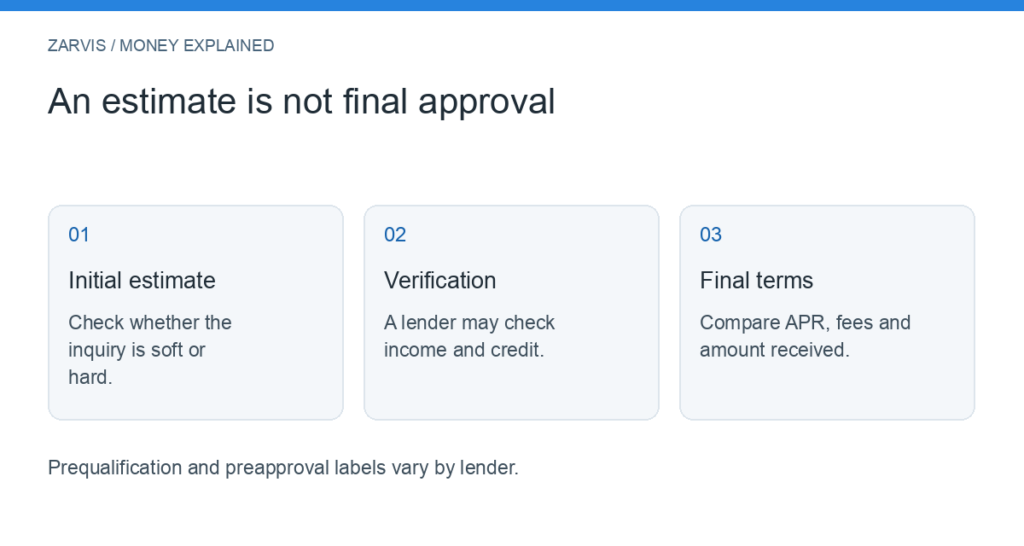
Meeting one lender’s criteria does not guarantee another lender will make the same offer, and a prequalification estimate is not a final approval.
Questions to Ask Before You Borrow
- What is the APR, and is the rate fixed or variable?
- What is the total amount I will repay over the full term?
- Is there an origination fee, and will it be deducted from the money I receive?
- Is there a prepayment penalty if I pay extra or pay the loan off early?
- What are the late fee and returned-payment fee?
- When is the payment due each month, and can I change the due date?
- Does the monthly payment fit my budget if my income drops for a month?
- What happens if I miss a payment — when is it reported and what fees apply?
Write the answers down for each offer. Comparing two or three written offers side by side is far more reliable than comparing advertised rates.
How to Compare Offers Fairly
Compare the same amount and the same term across lenders, then check:
- APR
- Total cost of repayment (monthly payment × number of payments, plus any fees not deducted upfront)
- Fees: origination, late, and prepayment
- Whether the rate is fixed for the full term
A lower monthly payment is not automatically a better loan. It often just means a longer term and more interest overall.
Before you turn a quote into an application
Use our personal loan prequalification checklist to ask whether the initial inquiry is soft or hard and what the quoted terms exclude. An estimate is not a promise of approval or a final APR.
Then calculate debt-to-income using consistent monthly figures, and separately test the payment against your take-home cash-flow budget. A lender’s eligibility calculation is not the same as what you can comfortably afford.
Personal Loan FAQs
What is a personal loan used for?
People commonly use personal loans for debt consolidation, home repairs, medical bills, or other large one-time expenses. The permitted uses vary by lender, and some lenders restrict certain uses, so check the loan agreement.
How is a personal loan different from a credit card?
A personal loan is paid once as a lump sum and repaid in fixed installments over a set term. A credit card is revolving credit: you can borrow again as you repay, the balance can vary, and there is no fixed payoff date unless you set one yourself.
Does applying for a personal loan affect my credit?
It can. A lender may make a hard inquiry on your credit report when you formally apply, and inquiries can affect scores. Checking your own reports or using a prequalification tool that uses a soft inquiry generally does not have the same effect. The loan itself, once opened, also becomes part of your credit history.
Can I get a personal loan with a low credit score?
Some lenders accept applicants with lower scores, but the rate and fees offered may be higher and the amount smaller. No lender is required to approve an application, and no rate can be guaranteed in advance.
How much should I borrow?
Borrow based on the actual expense and on a payment that fits your budget with room to spare, rather than the maximum amount offered. Borrowing more than you need increases the interest you pay even if the rate is the same.
Bottom Line
A personal loan is a fixed-amount, fixed-schedule way to borrow. Its real cost is set by the APR, the term, and the fees in the agreement — not by the advertised rate or the monthly payment alone. Read the full offer, ask the questions above, compare total cost across lenders, and use a personal loan calculator to check the numbers before you sign.
Editorial Note
Zarvis provides general educational information only, not personalized financial, legal, or tax advice. Loan rates, fees, eligibility rules, and terms vary by lender and can change. Nothing in this article guarantees approval, a specific rate, or a specific outcome. Verify all terms directly with the lender before borrowing, and consider speaking with a qualified professional about your own situation.
Sources
- Consumer Financial Protection Bureau — consumer guidance on loans, APR, and credit: consumerfinance.gov
- Federal Trade Commission — consumer advice on credit and loans: consumer.ftc.gov
- Board of Governors of the Federal Reserve System — consumer information on credit: federalreserve.gov

Pingback: Interest Rate on a Personal Loan: Best Guide — $15,000 at 9% vs 20% Costs $2,896 More - Zarvis | US Personal Finance & Credit Guides
Pingback: Origination Fee on a Personal Loan: Best Way to Calculate — a $500 Fee on a $10,000 Loan - Zarvis | US Personal Finance & Credit Guides
Pingback: Pay Off a Personal Loan Early: Best Way to Save $1,519 and Finish 17 Months Sooner - Zarvis | US Personal Finance & Credit Guides
Pingback: Secured vs Unsecured Loan: Best Comparison — an $8,000 Example Saves $967 - Zarvis | US Personal Finance & Credit Guides