
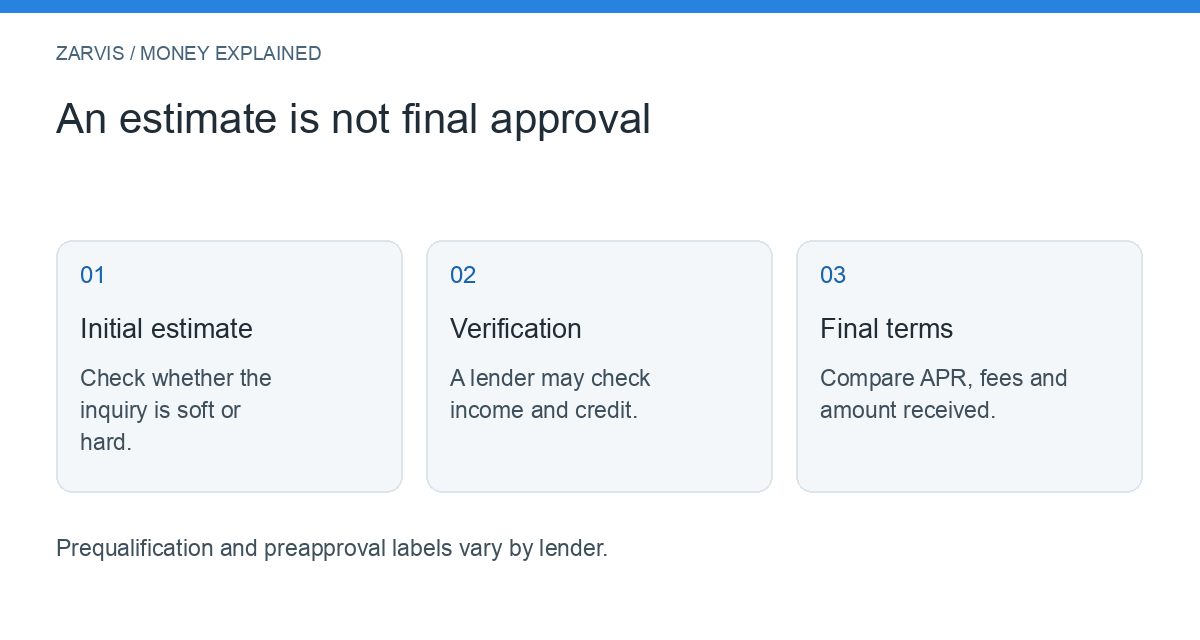
Personal loan prequalification usually gives you an early estimate of the amount, rate, and term you might qualify for. Preapproval may involve a closer review. But lenders sometimes use the labels interchangeably, so the wording alone does not tell you whether a hard credit inquiry will occur or whether the terms are final.
Before entering your information, ask what the lender will check, whether the step affects your credit, and what still needs to happen before funding.
That is more useful than treating “preapproved” as a guarantee.
Understand the personal loan prequalification process
Experian’s personal loan prequalification guide explains that prequalification generally uses a soft inquiry and does not guarantee approval. It also notes that preapproval can involve a hard inquiry and that some lenders use the terms interchangeably.
| Stage | What it may provide | What still needs checking |
|---|---|---|
| Prequalification | An estimate based on initial information | Credit-check type, assumptions, and whether the rate can change |
| Preapproval | A more detailed or condition-based assessment | Remaining verification, expiration, and any hard inquiry |
| Final application and offer | A decision and specific proposed loan terms | Fees, repayment schedule, disclosures, and acceptance conditions |
This table describes common patterns, not a rule that every lender follows. Read the notice immediately before you authorize a credit check. If the language is unclear, ask the lender directly.
Our soft inquiry vs. hard inquiry guide explains why that distinction matters.
Prepare for personal loan prequalification
You may be asked about your identity, income, housing costs, requested loan amount, employment, and intended use of the money. A later application may require documents supporting those details.
Use accurate figures and a trusted lender website. Do not send Social Security numbers, bank credentials, or identity documents to a random comparison-service email address.
An early estimate can change if verified information differs, your circumstances change, or the lender’s conditions are not met. Avoid taking on a new obligation based only on a prequalification screen.
Compare money received, not only money borrowed
An origination fee can reduce the cash deposited into your account. For instance, a hypothetical $10,000 loan with a 5% fee deducted from the proceeds would deliver $9,500 before any other adjustments.
If you need exactly $10,000 to pay a bill, that difference matters. Borrowing more to cover it increases the obligation, and lender policies may not allow you to choose any amount you want.
Read our personal loan origination fee guide before comparing two offers that advertise the same principal.
Put the offers on the same page
Record the proposed amount financed, cash you would receive, APR, loan term, monthly payment, total scheduled repayment, and relevant fees. Also note any rate discount conditions, such as autopay.
Compare similar amounts and terms where possible. A lower payment over more months does not necessarily mean a lower total cost.
APR is useful for comparing borrowing costs, but it does not replace reading the agreement. Our personal loan APR guide explains the difference between APR and an advertised interest rate.
Use the personal loan calculator to explore a payment scenario, then compare its assumptions with the lender’s actual disclosures. Do not enter an APR that includes fees as though it were necessarily the contractual interest rate for an amortization calculation.
Ask these questions before the formal application
- Will this particular step use a soft or hard credit inquiry?
- What information remains unverified?
- Is the quoted rate fixed or variable, and can it change before acceptance?
- Is there an origination fee, and how is it collected?
- How much cash would actually be disbursed?
- When does the estimate or conditional offer expire?
- Are there restrictions on the use of funds?
- Are early payments allowed without a penalty?
Save the answers and the disclosures you relied on. A marketing email is not a substitute for the final loan agreement.
What if you do not prequalify?
Do not assume that repeatedly submitting full applications will solve the problem. First check the explanation offered, review your credit information for errors, and reassess the amount and payment you can afford.
A different lender may use different criteria, but approval is never guaranteed. Be especially cautious about anyone promising approval in exchange for an upfront payment or asking you to misstate your income.
Keep each personal loan prequalification result with the date and assumptions attached. Compare the final offer with that earlier result instead of relying on memory or a headline rate.
Before accepting the final offer
Read the final terms again even if you liked the earlier estimate. Check the payment date against your income schedule and consider whether you could still manage the payment during a difficult month.
Prequalification is a shopping tool. It is not a commitment to borrow, a guaranteed rate, or proof that a loan fits your budget.
This is general US financial education, not individualized borrowing or credit advice. Lender requirements and terms vary.
Reading a prequalification offer without rushing
Can I rely on the monthly payment shown in an estimate?
Use it as a starting point, not a commitment. Check the assumed loan amount, repayment term, APR, and whether fees reduce the cash you receive. If any of those change during underwriting, the payment or overall cost may change too. Read the final loan agreement rather than treating an email estimate as the contract.
Does a soft inquiry mean the whole process avoids a hard inquiry?
No. An initial eligibility check and a final application can use different credit checks. Before continuing, ask which step authorizes a hard inquiry and review the consent language. If the lender’s explanation is unclear, pause. The label “prequalified” by itself does not establish what the next button will authorize.
What should I compare if several lenders respond?
Keep the requested amount and repayment term consistent where possible. Then compare APR, origination fees, amount received, total payments, and any prepayment terms. A lower advertised rate for a different term is not a like-for-like comparison. Also check whether an optional product has been added to the quoted cost.
What documents should I prepare?
Lenders may request identity, address, income, employment, and existing debt information. Requirements differ, so use the lender’s actual checklist and a secure submission method. Verify that you are dealing with the intended business before sending sensitive documents. Providing paperwork does not guarantee approval; underwriting and final verification still determine the available terms.


Pingback: Personal Loan Calculator: Best Way to Estimate Payments — $10,000 at 10% Costs $1,616 in Interest - Zarvis | US Personal Finance & Credit Guides