
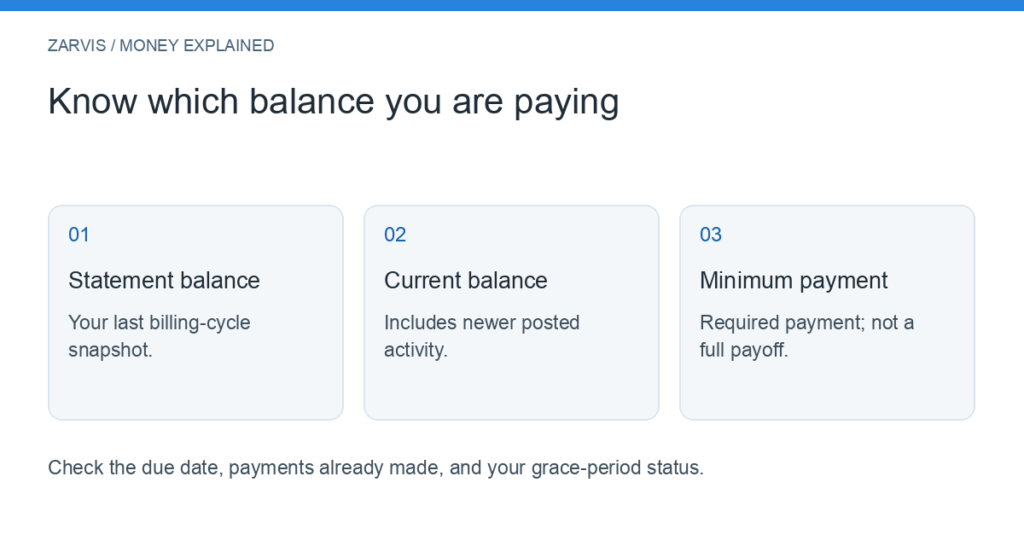
Statement Balance vs Current Balance: 3 Helpful Payment Rules
Statement balance vs current balance: compare billing dates, payment choices, and minimum payments with examples and important grace-period limits.
Understand how US credit cards work before comparing costs or planning a payment. Start with utilization, then learn how interest, fees, and minimum payments affect your balance.
These guides explain concepts and trade-offs; they do not promise approval, a specific credit score, or personalized financial advice. Check your card agreement for the terms that apply to you.
Statement balance vs current balance: compare billing dates, payment choices, and minimum payments with examples and important grace-period limits.

Credit card interest is the price you pay for carrying a balance past its due date. Your issuer calculates it […]

A balance transfer credit card lets you move a balance from another card — usually for a transfer fee — […]

A cash advance is a short-term cash loan taken against your credit card’s credit line — at an ATM, at […]

A credit card annual fee is a once-a-year charge for holding a card, billed whether you use the card heavily, […]

A credit card minimum payment is the smallest amount you must pay by the due date to keep the account […]

A credit inquiry is a record that someone requested information from your credit report. The difference between a soft inquiry […]

How to improve your credit score without risky shortcuts comes down to the inputs scoring models actually use: pay every […]

The highest credit score on the models most consumers and lenders use is 850. Base FICO Scores and current VantageScore […]

A credit score is a three-digit number, most commonly from 300 to 850, that summarizes information in your credit report […]