
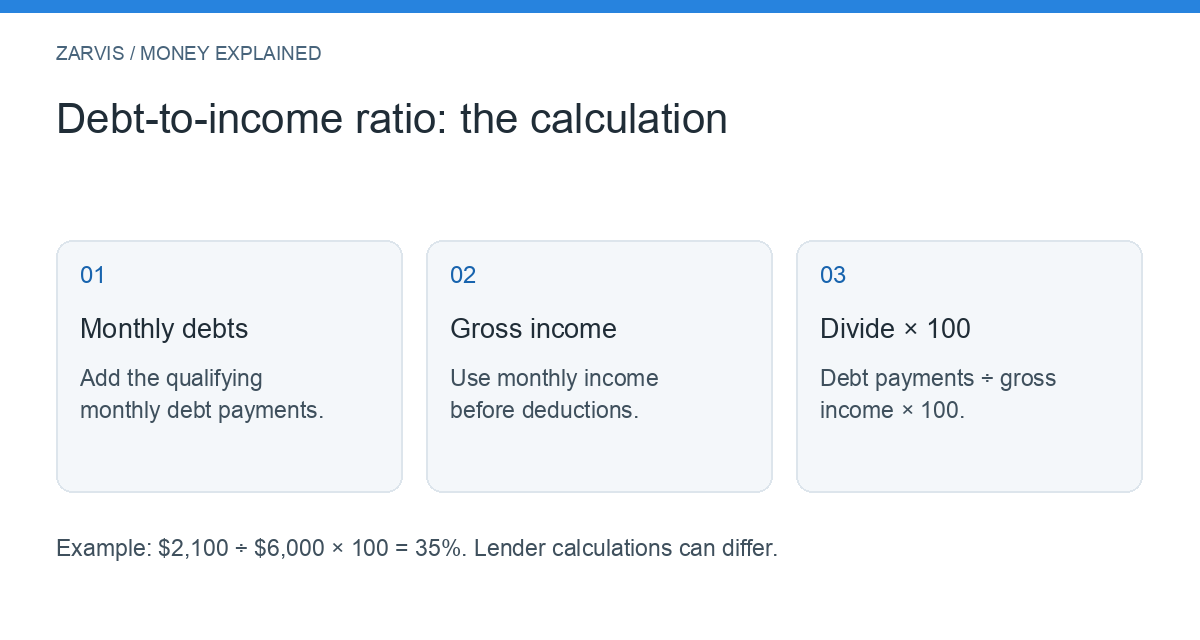
To calculate your debt-to-income ratio, divide your total monthly debt payments by your gross monthly income, then multiply by 100.
DTI = monthly debt payments ÷ gross monthly income × 100
For example, $2,100 in monthly debt payments divided by $6,000 in gross monthly income gives a DTI of 35%.
This guide is a worked calculation and fill-in worksheet, not a loan-approval tool. Lenders may calculate qualifying income and obligations differently for different products.
What your debt-to-income ratio measures—and leaves out
DTI compares required debt payments with income before taxes and other deductions. The Consumer Financial Protection Bureau defines the ratio this way and notes that different lenders and loan products have different limits.
It is one part of a lending assessment. It does not measure your savings, show every living expense, or guarantee that a payment will be comfortable.
A household with high childcare or medical costs can have a modest DTI and little spare cash. Always run a separate take-home-pay budget.
Step 1: Collect the monthly obligations
Use current statements rather than guessing. For an initial estimate, list required payments on loans and credit cards, along with the applicable housing payment.
For a homeowner, the housing figure may need to include principal, interest, taxes, insurance, and other required housing charges. A lender assessing a new mortgage will generally evaluate the proposed housing payment under its own rules.
Rent, support obligations, student loans, deferred payments, joint debts, and other commitments can require product-specific treatment. Ask the lender which items it includes rather than assuming every DTI calculator uses the same definition.
Do not add an entire $5,000 credit card balance as though it were a $5,000 monthly payment. Use the monthly obligation required by the relevant calculation. Likewise, avoid counting the same housing payment twice.
Our debt payoff tracker guide can help you gather balances, minimum payments, and due dates in one place.
Step 2: Use gross income consistently
Gross income is generally income before taxes and deductions—not the amount deposited into your checking account.
For a simple salary example, $72,000 a year divided by 12 equals $6,000 gross per month. If you are paid $2,000 every two weeks, multiplying by 26 and dividing by 12 gives approximately $4,333.33 a month. Twice-monthly pay follows a different schedule: 24 payments a year.
Variable wages, self-employment, bonuses, and other income can require averaging and documentation. Do not treat gross business revenue as automatically equivalent to a lender’s qualifying income. Ask what the lender will accept.
If gross monthly income is zero or unknown, do not divide by zero or report a reassuring percentage. Resolve the income figure first.
Step 3: Calculate your debt-to-income ratio
Here is a hypothetical homeowner’s worksheet:
| Input | Monthly amount |
|---|---|
| Applicable housing payment | $1,500 |
| Auto loan | $300 |
| Student loan obligation used for this example | $180 |
| Credit card minimum payments | $120 |
| Total monthly obligations | $2,100 |
| Gross monthly income | $6,000 |
The calculation is $2,100 ÷ $6,000 × 100 = 35%.
If a proposed personal loan adds a $300 monthly payment and does not replace an existing obligation, the illustrative total becomes $2,400. At the same income, $2,400 ÷ $6,000 × 100 = 40%.
These examples are not approval thresholds. They assume all listed inputs are accepted as shown. A consolidation transaction needs separate treatment: do not remove an old obligation until you know how the lender accounts for debts being paid off.
Use our personal loan calculator or auto loan calculator to explore a potential payment, then check it against actual lender terms.
A worksheet you can copy
- Monthly obligations included in this estimate: $____
- Gross monthly income used: $____
- Obligations ÷ income: ____
- Result × 100: ____%
- Proposed new payment, if relevant: $____
- Revised ratio under the same assumptions: ____%
Label whether you are estimating your current position or a proposed borrowing scenario. Keep the underlying statements so you can update the calculation when a payment changes.
Save the inputs alongside your debt-to-income ratio, not just the final percentage. That makes it easier to spot whether a changed result comes from a different payment, a new income assumption, or a calculation mistake.
Why a “good” DTI is not one universal number
Loan programs and lenders use different criteria. A ratio that meets one lender’s requirement may not meet another’s, and meeting a DTI limit is not a promise of approval.
Credit history, income verification, assets, collateral, and other factors may also matter. Be cautious about a website presenting a single DTI cutoff as a rule for every US loan.
For your own budget, switch back to take-home income. If take-home pay is $4,500 and the obligations in our example total $2,100, $2,400 remains before groceries, utilities not already counted, childcare, savings, and other living costs. That is the affordability conversation DTI cannot finish.
Our monthly budget guide can help you make that second check.
This calculator guide provides general US financial education. It is not underwriting, a lending decision, or individualized financial advice.
Checking the inputs before using your DTI result
Should I use take-home pay?
The usual debt-to-income calculation uses gross income before taxes and other deductions. A lender may apply its own rules for qualifying income, especially for self-employment, bonuses, or variable earnings. A household affordability check is different: use actual take-home cash when planning groceries, utilities, and other spending. Mixing those two measures produces a misleading result.
Do all household expenses go in the numerator?
No. DTI focuses on qualifying debt obligations rather than every living expense. But an expense excluded from a lender’s ratio can still make a loan difficult to afford. Keep a separate budget for utilities, food, transport, insurance, and other essentials. A low ratio does not mean those costs disappear or that extra borrowing is automatically sensible.
Can I compare my result with any online cutoff?
Use published thresholds only in the context of the relevant lender and loan program. Different products can use different qualifying rules, and approval can depend on credit history, assets, collateral, and other factors. Your calculation is a screening tool, not an approval decision. Check how the specific lender defines the numbers before relying on the comparison.
How should I test a possible new loan?
Add its estimated monthly payment to the debt total and recalculate, using consistent monthly figures. Then do a second check against your take-home budget, including costs the ratio excludes. If the payment is only an estimate, label the result provisional. Recalculate with the final terms before making a commitment.


Pingback: Credit Utilization Ratio: Formula and 5 Ways to Lower It