

A personal loan interest rate is the percentage a lender charges on your outstanding balance, expressed as a yearly rate. It is the single biggest factor in what a loan costs, but it is not set by one rule. Each lender weighs your credit history, income, debts, and the loan’s amount and term, then assigns a rate based on how risky the loan appears. Two people borrowing the same amount on the same day can receive very different rates.
Quick Answer: Your personal loan interest rate mainly reflects how a lender views your likelihood of repaying: credit history, income stability, existing debt, loan size, and term all matter. A lower rate can save thousands over the life of a loan, which is why comparing the APR of real offers matters more than comparing advertised starting rates.
Key Takeaways
- The interest rate calculates interest on your balance; the APR also includes certain fees, so APR is the better comparison number.
- Credit history is usually the largest influence on the rate a lender offers.
- Longer terms may carry higher rates and always give interest more time to add up.
- An origination fee can make a loan with a lower interest rate cost more overall than a loan with a higher rate and no fee.
- Advertised rates usually apply only to the most qualified applicants. No rate is guaranteed before a lender reviews your application.
Interest Rate vs. APR
These two numbers are often confused:
| Interest rate | APR | |
|---|---|---|
| What it covers | Interest on the balance only | Interest plus certain fees, such as an origination fee |
| Used to calculate | Your monthly payment | The overall cost of credit as a yearly rate |
| Best for | Checking the payment math | Comparing one loan offer against another |
If two offers have the same interest rate but one charges an origination fee, the loan with the fee will have a higher APR and a higher total cost. Our guide to personal loan origination fees shows exactly how that fee changes the numbers.
Fixed and Variable Rates
Most personal loans carry a fixed rate: the rate and the monthly payment stay the same for the entire term, which makes budgeting straightforward.
A variable rate can change when an underlying index rate changes. The starting rate may be lower, but the payment can rise later. If you consider a variable-rate loan, check how often the rate can change, how much it can increase at one time, and whether there is a maximum cap.
What Affects the Rate You Receive
Credit history and scores
Lenders use your credit history to judge how reliably you have repaid in the past. A record of on-time payments and moderate balances generally supports a lower rate. Missed payments, defaults, or very high card balances usually point the other way. There is no single score that guarantees a particular rate; each lender sets its own criteria.
Income and existing debt
Lenders compare the new payment with your income and with the payments you already owe. If a large share of your income already goes to debt, a lender may offer a smaller amount, a higher rate, or decline the application.
Loan amount and term
The size and length of the loan change the lender’s risk. Shorter terms are often offered at lower rates than longer terms, and they also reduce total interest because the balance is repaid sooner. A longer term lowers the monthly payment, but interest is charged for more months.
Whether the loan is secured
A loan backed by collateral can carry a lower rate than an unsecured loan of the same size, because the lender has property it may claim if you default. That lower price comes with a direct risk to you, which our comparison of secured vs. unsecured loans explains.
The lender itself
Banks, credit unions, and online lenders price risk differently and run different promotions. That is why the same applicant can receive noticeably different offers, and why getting more than one written offer is worthwhile.
Autopay and relationship discounts
Some lenders reduce the rate slightly if you agree to automatic payments or already hold accounts with them. Check whether a quoted rate assumes such a discount, and what happens to the rate if autopay is cancelled.
Worked Example: What a Rate Difference Costs
This example is hypothetical, uses round figures for illustration only, and is not a rate quote.
Suppose two borrowers each take a $15,000 loan for 36 months with no fees. One receives a rate of 9% and the other 20%.
| Borrower A: 9% | Borrower B: 20% | |
|---|---|---|
| Loan amount | $15,000 | $15,000 |
| Term | 36 months | 36 months |
| Monthly payment | $477.00 | $557.45 |
| Total repaid | $17,171.86 | $20,068.34 |
| Total interest | $2,171.86 | $5,068.34 |
The higher rate adds $80.45 to every monthly payment and $2,896.48 in extra interest over three years — for the same $15,000. This is why a small-sounding rate difference deserves attention, and why improving the factors above before applying can be worth real money. Try your own amounts with our personal loan calculator.
How to Compare Rates Properly
- Compare APR, not just the interest rate. APR captures fees the interest rate leaves out.
- Use the same amount and term for every quote, or the comparison is meaningless.
- Check the total cost of repayment, not only the monthly payment.
- Ask whether the rate is fixed for the full term.
- Confirm which fees are included and which are not, especially origination and prepayment charges. Our pillar guide, Personal Loans Explained, lists the questions to ask.
Can You Improve the Rate You Are Offered?
There is no instant fix, but the factors lenders review point to the practical steps:
- Pay bills on time and reduce card balances before applying, so your recent history and utilization look steadier.
- Avoid opening several new credit accounts in a short period before a loan application.
- Choose a shorter term if the payment still fits your budget.
- Borrow only what you need; a smaller request may be assessed more favourably.
- Compare offers from more than one type of lender, including a credit union if you are a member.
If you plan to pay the loan off ahead of schedule, also confirm there is no prepayment penalty — see paying off a personal loan early.
Personal Loan Interest Rate FAQs
Why was my rate higher than the advertised rate?
Advertised rates usually show the lowest rate offered, available only to applicants who meet the lender’s strongest criteria. Your actual rate is set after the lender reviews your credit, income, debts, and the term you chose.
Is a lower interest rate always the better loan?
Not always. A loan with a slightly higher rate but no origination fee can cost less overall than a lower-rate loan with a large fee. Compare APR and the total cost of repayment to decide.
Does checking my rate affect my credit score?
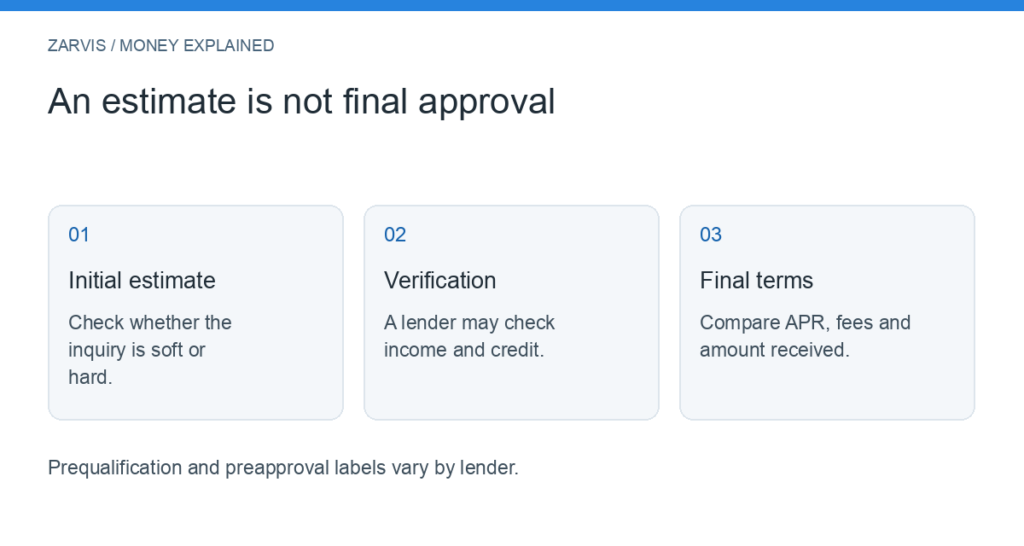
It depends on the type of check. A prequalification that uses a soft inquiry does not affect scores in the way a hard inquiry from a formal application can. Ask the lender which type of inquiry it will make before you proceed.
Can my rate change after I take the loan?
On a fixed-rate loan, no — the rate is set for the term. On a variable-rate loan, yes — the rate and payment can move when the index it is tied to changes. Your loan agreement states which type you have.
Does a shorter term always mean a lower rate?
Often, but not always. Lenders frequently price shorter terms lower, and a shorter term always reduces the months over which interest accrues. The trade-off is a higher monthly payment, which must still fit your budget.
Bottom Line
Your personal loan interest rate is a price set by how a lender reads your credit history, income, debts, and loan terms. Small rate differences add up to large cost differences, as the example above shows. Compare real offers by APR and total cost, check the fees behind each rate, and never treat an advertised rate as the rate you will receive.
Editorial Note
Zarvis provides general educational information only, not personalized financial, legal, or tax advice. Rates in this article are clearly labelled hypothetical examples, not current lender offers. Actual rates, fees, and eligibility vary by lender and applicant and can change at any time. Nothing here guarantees approval or a specific rate. Verify all terms directly with the lender before borrowing.
Sources
- Consumer Financial Protection Bureau — consumer guidance on loans, APR, and credit: consumerfinance.gov
- Federal Trade Commission — consumer advice on credit and loans: consumer.ftc.gov
- Board of Governors of the Federal Reserve System — consumer information on credit and interest rates: federalreserve.gov

Pingback: Secured vs Unsecured Loan: Best Comparison — an $8,000 Example Saves $967 - Zarvis | US Personal Finance & Credit Guides
Pingback: Origination Fee on a Personal Loan: Best Way to Calculate — a $500 Fee on a $10,000 Loan - Zarvis | US Personal Finance & Credit Guides