A personal loan calculator estimates the monthly payment, total interest, and total cost of a fixed-rate personal loan from four inputs: how much you borrow, the annual interest rate, the repayment term in months, and any origination fee.
It lets you compare loan offers — and test different amounts and terms — before you apply, using the same amortization math lenders use for fixed-rate installment loans.
Enter your numbers in the personal loan calculator below. Your entries stay in your browser; this calculator makes no external requests.
Monthly payment: —
Total interest: —
Total cost (interest + origination fee): —
Total of all payments: —
Amount you receive after fee: —
Quick Answer
For a $10,000 loan at 10% annual interest rate repaid over 36 months, the monthly payment is about $322.67 , total interest is about $1,616.19 , and the total of all payments is about $11,616.19 . Add a 3% origination fee and you would pay a $300 fee, receive $9,700, and face a total borrowing cost — interest plus fee — of about $1,916.19.
Use the personal loan calculator above with your own offer's numbers before you sign anything.
Key Takeaways
- The monthly payment depends on three things: the amount, the annual interest rate, and the term. A longer term lowers the payment but almost always raises total interest.
- Total borrowing cost, including applicable fees, gives a fuller picture than the monthly payment alone.
- An origination fee reduces the cash you actually receive while you still repay the full loan amount, so compare offers in the personal loan calculator on total cost, not on the payment alone.
- Before borrowing, check that the payment fits your written budget — our monthly budget template shows how to test it line by line.
How to Use This Personal Loan Calculator
- Enter the loan amount — the full amount you would borrow, before any fee is deducted.
- Enter the annual interest rate used to calculate payments, not a fee-inclusive APR. The calculator divides the rate by 12 and by 100 to get the monthly decimal rate. If your offer only shows APR, ask the lender for the interest rate and payment schedule before adding a separate fee here.
- Enter the term in months — for example, 36 for a three-year loan or 60 for a five-year loan.
- Enter the origination fee percentage, if the lender charges one. Leave it at zero if there is no fee.
- Select Calculate and review all five results together: the payment you must afford each month, the total interest, the total cost of borrowing, the total of all payments, and the amount you would actually receive after the fee.
Try at least three versions of any real loan in the personal loan calculator: the offer as quoted, the same loan with a shorter term, and a smaller amount. The differences in total interest are often larger than people expect, and they are the strongest argument for borrowing less or repaying faster when you can.
How the Personal Loan Math Works
For a fixed-rate loan with monthly payments, the standard amortization formula is:
M = P × r × (1 + r)^n ÷ ((1 + r)^n − 1)
Here, P is the loan amount, r is the monthly rate (the annual rate divided by 12 and by 100), and n is the number of monthly payments. Each month, interest is charged on the remaining balance, and the rest of your payment reduces principal. As the balance falls, the interest portion generally declines and the principal portion rises.
Early payments are not necessarily mostly interest; the split depends on the rate and term. That is why extra payments made early in the term save the most interest — they cut the balance on which all future interest is calculated.
If the rate were 0%, the formula simplifies to the amount divided by the number of months, and total interest is zero. The origination fee does not change the payment itself in this calculator, because the fee is assumed to be deducted from the amount disbursed: you borrow the full amount, repay the full amount, but receive the amount minus the fee in your account.
Worked Example
Consider a $10,000 personal loan at 10% annual interest rate with a 36-month term and a 3% origination fee.
- Monthly rate: 10% ÷ 12 ÷ 100 = 0.008333
- Monthly payment: $10,000 × 0.008333 × (1.008333)^36 ÷ ((1.008333)^36 − 1) = $322.67
- Total of all payments: the unrounded monthly payment × 36 ≈ $11,616.19
- Total interest: $11,616.19 − $10,000 = $1,616.19
- Origination fee: 3% of $10,000 = $300
- Amount you receive: $10,000 − $300 = $9,700
- Total cost of borrowing: $1,616.19 interest + $300 fee = $1,916.19
Now compare a longer term. The same $10,000 at 10% over 60 months would cut the payment to about $212.47 — roughly $110 less per month — but total interest would rise to about $2,748.23, roughly $1,132 more than the 36-month loan. Neither choice is automatically right: the shorter term costs less overall, while the longer term may fit a tight monthly budget more safely.
What this comparison rules out is choosing the longer term without knowing its price.
To see where a payment like $322.67 would sit in a real household budget, compare it with the needs and debt lines in our 50/30/20 budget example and our zero-based budget example, both built on $4,000 of monthly take-home pay. Track the result with the budget tracker template once payments begin.
And if your goal can safely wait a few months, saving up instead — for example in a high-yield savings account — avoids the interest cost entirely.
Interest rate versus APR: avoid counting a fee twice
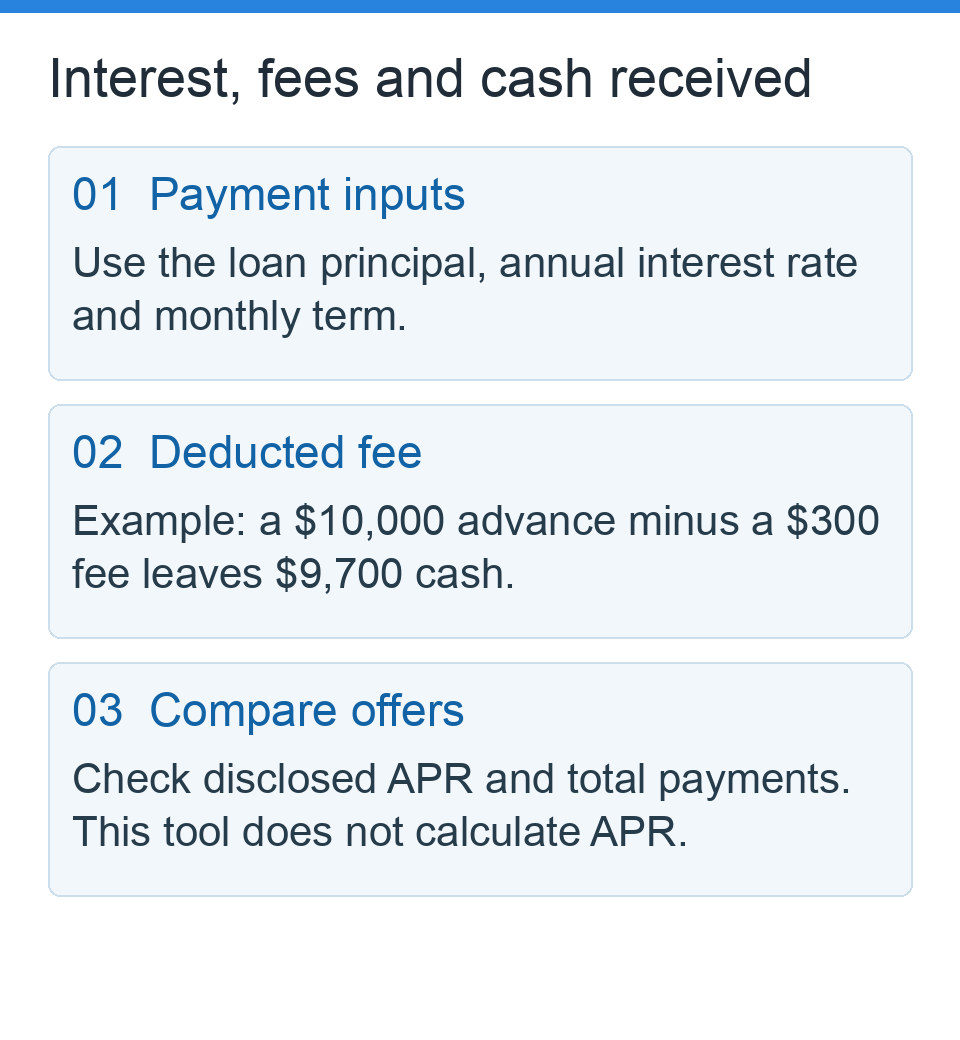
The interest rate determines this model’s monthly interest calculation. APR is a broader annualized cost measure that reflects interest and applicable fees. The CFPB explains this distinction between interest rate and APR. They are not interchangeable inputs when fees are charged.
In the example, 10% is the annual interest rate and the $300 fee is deducted from the $10,000 advance. It is not a claim that a fee-inclusive APR of 10% produces this repayment schedule. This calculator estimates payment and dollar costs; it does not calculate a regulatory APR.
To compare real offers, keep the amount and term consistent, check each lender’s disclosed APR and total payments, and confirm whether a fee is deducted, paid separately or financed. A financed fee requires different inputs. Use the prequalification guide to distinguish an estimate from approval, and compare the proposed payment with your debt-to-income calculation and take-home budget.
Assumptions and Limits
- The calculation models a fixed-rate, fully amortizing personal loan with monthly payments and no other fees.
- The rate you enter is used as the annual rate for amortization. APR reflects interest and applicable borrowing fees and may be higher than the interest rate used for payments. Do not enter a fee-inclusive APR and then add that same fee separately. Use the lender’s disclosed interest rate for this model and its repayment schedule as the authoritative figure.
- Late fees, optional insurance or add-on products, and prepayment penalties are not modeled. Ask whether a loan has a prepayment penalty before planning extra payments.
- An origination fee is modeled as deducted from the amount you receive. Some lenders instead add the fee to the balance; check your offer to see which applies.
- Results are rounded to cents for display and are educational estimates, not a loan offer, quote, or approval.
Personal Loan Calculator FAQ
What is a good APR for a personal loan?
It depends heavily on your credit profile, the loan amount, and the term, and rates change over time. Rather than chasing a single "good" number, compare offers from several lenders on the same amount and term, and judge them by total cost — interest plus fees — using this personal loan calculator.
The Consumer Financial Protection Bureau advises consumers to shop and compare loan offers, since rates and terms vary widely between lenders.
Does a longer term save me money?
It lowers the monthly payment, which can protect your cash flow, but it increases total interest in almost every case — in the worked example, stretching $10,000 at 10% from 36 to 60 months added about $1,132 of interest. A longer term saves money only indirectly, for example if the lower payment keeps you from missing payments or using higher-cost credit.
How does an origination fee affect what I receive?
In this calculator the fee is deducted from the disbursement, so a $10,000 loan with a 3% fee puts $9,700 in your account while your payments are still based on $10,000. That gap is why two loans with the same interest rate can have different APRs and amounts received, and why the amount received is shown as its own result.
Should I borrow more than I need, just in case?
Borrowing extra "just in case" means paying interest on money you may never use, and a larger balance also means a larger required payment every month. A safer pattern is to borrow the amount tied to a specific purpose, and build a small emergency fund for the unexpected instead.
If you already have savings elsewhere, compare the interest you would pay on a bigger loan with the interest that savings earns before deciding.
Will using this calculator affect my credit score?
No. This calculator runs entirely in your browser and checks nothing. Applying for a loan is different: lenders may make a hard credit inquiry when you formally apply, which can affect your score. Getting pre-qualified or checking rates, where a lender offers it, usually involves a soft inquiry instead — confirm which type a lender uses before submitting your details.
Bottom Line
A personal loan should be judged on three numbers, not one: the monthly payment, the total interest, and the total cost after fees. On a $10,000 loan at 10% annual interest rate over 36 months, those numbers are $322.67 a month, $1,616.19 of interest, and $1,916.19 of total borrowing cost with a 3% fee.
Run every real offer through this personal loan calculator, test a shorter term and a smaller amount, and confirm the payment fits your budget before you apply.
Editorial note: Zarvis provides general educational information only, not personalized financial, legal, tax, or investment advice. Loan rates, fees, eligibility, and terms vary by lender and can change, so verify all figures in the lender’s official disclosure before signing.
Sources
- Consumer Financial Protection Bureau (consumerfinance.gov) — guidance on shopping for loans, comparing APR, fees and total cost, and understanding your loan disclosure rights.
- Federal Trade Commission (ftc.gov) — guidance on borrowing money, comparing loan offers, and avoiding credit scams and deceptive lending.