

A zero-based budget is a monthly plan in which you assign every dollar of your take-home income to a specific purpose — a bill, a spending category, savings, or a debt payment — until income minus planned allocations equals zero. Zero does not mean you spend everything. It means nothing is left unassigned. Money planned for savings counts as assigned, just as money planned for rent does.
This method suits people who feel that money “disappears” each month even though they cannot point to one large mistake. Because every dollar has a named job before the month starts, leaks become visible: when a category runs out, the budget forces a conscious decision to move money from somewhere else, rather than a quiet slide into a credit card balance.
Quick Answer
Write down your monthly take-home income. List every bill, spending category, savings goal, and debt payment, and give each one a planned amount. Keep adjusting the amounts until total planned allocations exactly equal total income, so income minus allocations is $0. Then track spending during the month and, when a category overspends, move money deliberately from another category instead of spending untracked.
Key Takeaways
- Zero-based means fully assigned, not fully spent. Savings and extra debt payments are assignments.
- The method works with any income level and pairs naturally with any worksheet, including our monthly budget template.
- You build the budget fresh each month, so irregular bills and seasonal costs get planned in the month they actually occur.
- Overspending in one category is allowed — but only by moving money from another category on purpose.
- The first two or three months are estimates. Accuracy improves quickly once you compare plans with actual spending.
How Zero-Based Budgeting Works
The core equation is one line: income − bills − spending − savings − debt payments = 0.
You start with income, because the plan cannot assign money you will not receive. Then you work through categories in priority order: housing and essential bills first, then minimum debt payments, then everyday spending, then savings and extra debt payments. If money runs out partway down the list, lower-priority categories get smaller amounts — or zero for that month — rather than the budget quietly going negative.
The monthly reset is what makes this method different from a static budget, which is often written once and ignored. A zero-based budget is rebuilt around each month’s reality: an insurance premium in March, school costs in August, or three paychecks instead of two. Each change alters the assignments, and the equation must still end at zero.
Tracking is the other half of the system. Record spending at least weekly — our budget tracker template is designed for exactly this — and when a category is exhausted, decide explicitly: move money from another category, or stop spending in this one. The one response the method rules out is not noticing.
Worked Example: A Zero-Based Budget on $4,000
Our example household has monthly take-home pay of $4,000 — the same example used in our 50/30/20 budget guide, so you can compare the two methods line by line. Income is $3,800 from a paycheck plus $200 of regular side income.
| Category | Planned ($) | Notes |
|---|---|---|
| Income | 4,000 | Paycheck $3,800 + side income $200 |
| Rent | 1,400 | Fixed |
| Utilities | 180 | Electric, water, gas |
| Insurance | 160 | Auto insurance |
| Phone | 60 | |
| Internet | 55 | |
| Minimum debt payments | 150 | Required payments only |
| Groceries | 350 | |
| Transportation and fuel | 150 | |
| Dining out | 200 | |
| Entertainment | 120 | |
| Shopping and personal care | 180 | |
| Household items | 75 | |
| Emergency fund | 400 | Savings assignment |
| Retirement savings | 270 | Savings assignment |
| Extra debt payment | 250 | Above the minimum |
| Total assigned | 4,000 | |
| Income minus assigned | 0 | The zero-based check |
Check the arithmetic in groups. Bills come to $2,005, everyday spending to $1,075, and savings and extra debt payments to $920. Together: $2,005 + $1,075 + $920 = $4,000, exactly matching income, leaving $0 unassigned. Kept in a high-yield savings account, the $400 monthly emergency assignment would also earn interest while it builds.
Now watch how the method handles a surprise. Suppose a $180 car repair appears mid-month. You add a car repair line of $180 and remove $180 elsewhere — dining out drops from $200 to $110, entertainment from $120 to $80, and the extra debt payment from $250 to $200, releasing $90 + $40 + $50 = $180. The total is still $4,000 and the trade-off was a decision instead of an accident. If repairs happen often, the longer-term fix is a monthly car maintenance line funded in advance.
How to Build Your First Zero-Based Budget
Step 1: State your income for this month. Use take-home pay you are confident you will receive. With variable income, start from your lowest recent month and assign anything extra only when it arrives.
Step 2: List fixed obligations. Rent or mortgage, utilities, insurance, phone, internet, and minimum debt payments. If a large bill is due this month — a semiannual insurance premium, for example — it belongs in this month’s plan at its full amount, funded partly by earlier set-asides.
Step 3: Estimate everyday spending from evidence. Use last month’s statements to set groceries, transportation, dining, entertainment, and personal categories. First-month estimates will be imperfect; that is expected.
Step 4: Assign savings and extra debt payments. Treat these as categories competing for dollars like everything else. If you are considering consolidating debts, price any new loan first with a personal loan calculator and make sure its payment fits inside this plan.
Step 5: Force the zero. If assignments total less than income, assign the remainder to savings or extra debt. If they exceed income, shrink categories until they do not. Never leave a negative remainder and hope the month works out.
Step 6: Track, adjust, and rebuild. Check spending weekly, move money deliberately when life changes, and rebuild next month using what you learned.
Zero-Based Budgeting: Benefits and Drawbacks
The main benefit is visibility. Because every dollar is assigned, there is no vague “miscellaneous” pool quietly absorbing hundreds of dollars, and the month-end question “where did it go?” always has an answer. Rebuilding monthly also means irregular expenses are planned, not feared, and savings must compete openly with spending — which usually means savings actually happens.
The main drawback is effort: 30 to 45 minutes to build the plan the first few times, plus tracking several times a week. People who want a lighter system may prefer the 50/30/20 rule’s three percentages. And do not set every category aggressively low — a plan with zero room for ordinary life will be abandoned, and an abandoned budget controls nothing.
Common Zero-Based Budgeting Mistakes
- Reading “zero” as “spend it all.” Savings assignments are the point, not an afterthought. In the example, $920 — 23% of income — never leaves savings and debt payoff.
- Forgetting irregular expenses. Annual and semiannual bills must enter the plan in the month they are due, ideally pre-funded by monthly set-asides.
- Never adjusting mid-month. Refusing to move money when circumstances change turns a flexible tool into a brittle one. Adjustments made openly are part of the method.
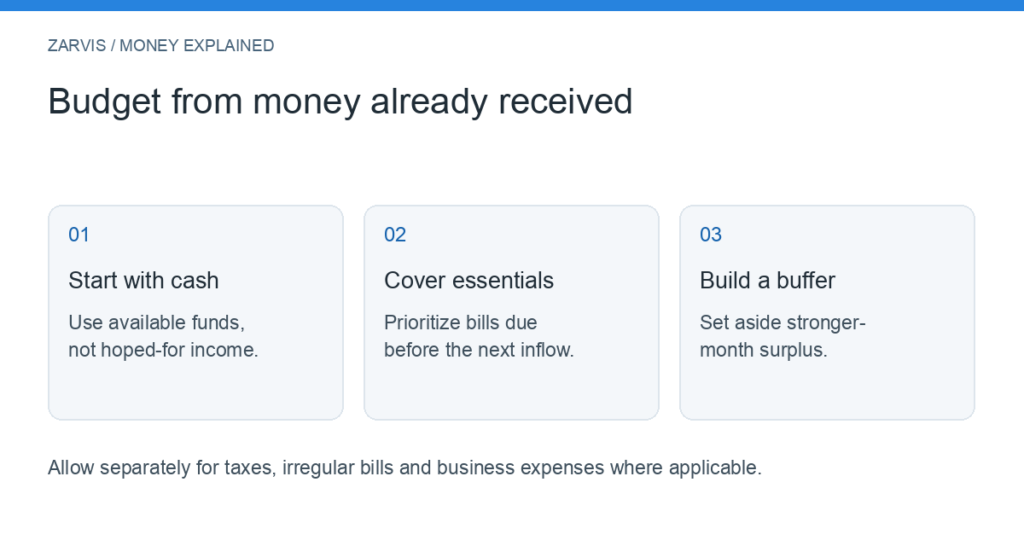
- Budgeting money you do not have yet. Assign only income you are confident about. Expected bonuses and hoped-for side income get assigned when they arrive, not before.
Zero-Based Budget FAQ
Does a zero-based budget mean I spend all my money each month?
No. It means all your money is assigned, including to savings accounts, retirement contributions, and extra debt payments. In the worked example, $920 of the $4,000 goes to savings and extra debt payoff and is not spent at all. Money sitting in a savings account with a job — emergency fund, for instance — is fully consistent with a zero-based budget.
How is a zero-based budget different from a regular budget?
A regular budget often sets spending limits but leaves part of income unplanned, and it may be written once and reused unchanged. A zero-based budget must account for 100% of income every single month, and it is rebuilt monthly so it reflects that month’s actual bills, income, and priorities.
What do I do when a category runs out of money mid-month?
You have two legitimate options: stop spending in that category until next month, or move money from another category and record the change. What the method excludes is continuing to spend without adjusting the plan, because that silently breaks the zero and usually ends in debt.
Can zero-based budgeting work with irregular income?
Yes, and it is often recommended for variable income because the plan is rebuilt around actual money each month. Build the plan from the lowest income you reasonably expect, cover essentials and minimum payments first, and keep a list of priorities for any extra income — savings, extra debt payments, then optional categories — so additional money is assigned as soon as it arrives.
How long does a zero-based budget take to maintain?
Expect 30 to 45 minutes to build your first few monthly plans and about ten minutes a week to track and adjust. It gets faster once your categories match your real spending patterns, usually by the third month. The Consumer Financial Protection Bureau similarly encourages consumers to track income and spending regularly as the foundation of any workable budget.
Bottom Line
Zero-based budgeting is one equation — income minus every assignment equals zero — repeated every month. On the $4,000 example, $2,005 of bills, $1,075 of everyday spending, and $920 of savings and extra debt payments account for every dollar, and surprises are handled by moving money openly rather than spending blindly. Give it three full months before deciding whether the extra effort is worth the extra control.
Editorial note: Zarvis provides general educational information only, not personalized financial, legal, tax, or investment advice. The best budgeting method depends on your income pattern, debts, and habits, so consider speaking with a qualified professional before making a major financial decision.
Sources
- Consumer Financial Protection Bureau (consumerfinance.gov) — guidance on budgeting, tracking spending, and building an emergency fund.
- Federal Trade Commission (ftc.gov) — consumer guidance on managing money, credit, and debt.

Pingback: Budget Tracker Template: Best Way to Track Spending in 15 Minutes a Week - Zarvis | US Personal Finance & Credit Guides
Pingback: High Yield Savings Account: How It Works and Compares
Pingback: Personal Loan Calculator: Best Way to Estimate Payments — $10,000 at 10% Costs $1,616 in Interest - Zarvis | US Personal Finance & Credit Guides