
A monthly budget template is a reusable worksheet that lists your income, bills, everyday spending, savings, and debt payments in one place, with a planned amount and an actual amount for each line. Its purpose is simple: before the month begins, you decide where your money should go, and after the month ends, you can see where it actually went. The gap between those two columns is where almost every useful budgeting lesson lives.
You do not need an app or a paid spreadsheet to use a monthly budget template. Copy the tables below into a notebook, a spreadsheet, or a notes app. What matters is that you review it regularly and adjust it honestly.
Quick Answer
Copy the monthly budget template below, enter your monthly take-home income at the top, and fill in a planned amount for every bill, spending category, savings goal, and debt payment. Make sure your total planned spending and saving does not exceed your income. During the month, record what you actually spend. At the end of the month, compare planned versus actual for each line, move any leftover money to savings or debt, and adjust next month’s planned amounts based on what you learned.
Key Takeaways
- A monthly budget template works in two passes: a plan before the month, and a review after it.
- Always budget from take-home pay — the money that actually reaches your bank account — not your salary before taxes and deductions.
- Planned spending plus planned saving should never exceed planned income.
- Include irregular costs, such as annual insurance premiums and car repairs, as small monthly amounts so they do not surprise you.
- Small weekly check-ins are more useful than one long, stressful review at the end of the month. Pair this template with our budget tracker template if you want a simple way to record spending as you go.
How to Use This Monthly Budget Template
Step 1: Start with take-home income
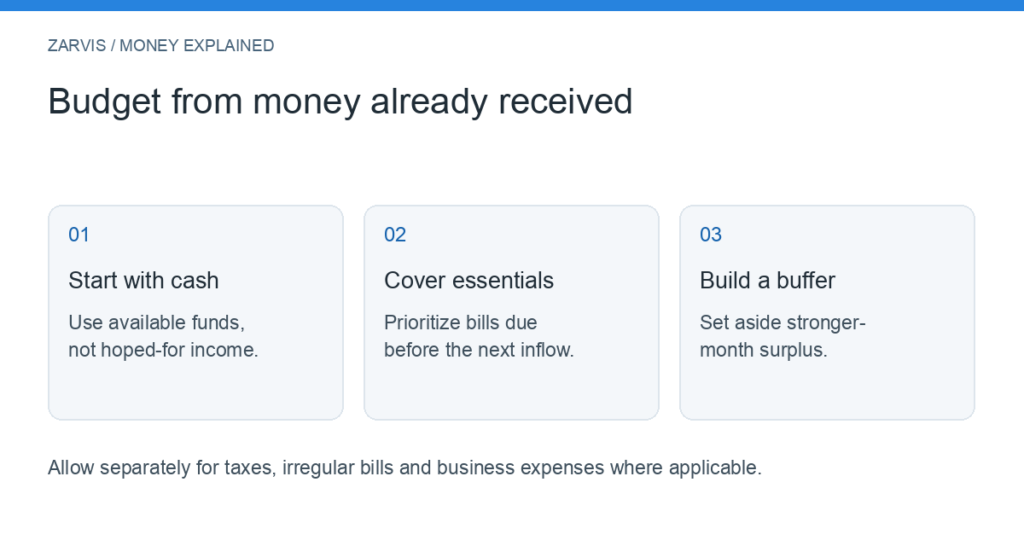
List every source of money you expect this month: paychecks, side income, benefits, or any other regular payment. Use the amount that lands in your account after taxes and payroll deductions. If your income changes from month to month, plan from your lowest recent month and treat anything above that as extra, not as guaranteed.
Step 2: List fixed bills first
In a monthly budget template, fixed bills are the payments that are roughly the same each month and hard to change quickly: rent or mortgage, utilities, insurance, phone, internet, subscriptions you keep, and minimum debt payments. These come first because missing them can trigger late fees, service interruptions, or credit damage.
Step 3: Estimate variable spending honestly
Variable spending changes month to month: groceries, fuel or transit, dining out, entertainment, clothing, and household items. Look at your last two or three bank statements and use your real average, not the number you wish were true. A realistic plan you mostly follow beats an strict plan you abandon by the second week.
Step 4: Give savings and extra debt payments a line
Savings should be a category in the budget, not whatever is left over. Add lines for an emergency fund, retirement contributions, and extra payments toward high-interest debt. Our guide to a high-yield savings account explains where to keep emergency savings, and a personal loan calculator can estimate a loan payment before you commit to it.
Step 5: Check the math, then track and review
Add up all planned categories. If the total is more than your income, something has to shrink — reduce variable spending first, then review optional fixed costs. During the month, record actual amounts. At the end of the month, calculate the difference on every line and carry what you learn into next month’s plan. If you prefer a method where every dollar is assigned until nothing is left unplanned, read our guide to a zero-based budget. If you prefer simple percentage targets instead, see the 50/30/20 budget.
The Complete Monthly Budget Template
Copy this table and fill in your own numbers. In the spending sections, the difference is planned minus actual, so a positive number means you spent less than planned.
Income
| Income source | Planned ($) | Actual ($) | Difference ($) |
|---|---|---|---|
| Paycheck (take-home) | |||
| Side income | |||
| Other income | |||
| Total income |
Fixed bills
| Bill | Planned ($) | Actual ($) | Difference ($) |
|---|---|---|---|
| Rent or mortgage | |||
| Utilities (electric, water, gas) | |||
| Insurance (auto, renters, home) | |||
| Phone | |||
| Internet | |||
| Minimum debt payments | |||
| Other fixed bills | |||
| Fixed bills subtotal |
Variable spending
| Category | Planned ($) | Actual ($) | Difference ($) |
|---|---|---|---|
| Groceries | |||
| Transportation and fuel | |||
| Dining out and takeout | |||
| Entertainment | |||
| Shopping and personal care | |||
| Household items | |||
| Other variable spending | |||
| Variable spending subtotal |
Savings and extra debt payments
| Category | Planned ($) | Actual ($) | Difference ($) |
|---|---|---|---|
| Emergency fund | |||
| Retirement savings | |||
| Extra debt payment | |||
| Other savings goals | |||
| Savings subtotal |
Month-end summary
| Summary line | Planned ($) | Actual ($) |
|---|---|---|
| Total income | ||
| Total bills, spending, savings and debt | ||
| Left over (income minus total out) |
Worked Example: A $4,000 Monthly Budget
To show how the monthly budget template works in practice, here is a completed example using a monthly take-home income of $4,000 — $3,800 from a paycheck and $200 from side income. Throughout our budgeting guides we use this same $4,000 example so you can compare methods easily.
| Section | Planned ($) | Actual ($) | What happened |
|---|---|---|---|
| Total income | 4,000 | 3,950 | Side income was $50 lower than expected |
| Fixed bills | 2,005 | 2,017 | Utilities ran $12 over plan |
| Variable spending | 1,075 | 1,086 | Dining out ran over; fuel and entertainment came in under |
| Savings and extra debt | 920 | 797 | Savings were reduced to cover the overages |
| Total out | 4,000 | 3,900 | $50 of actual income was left unspent |
The fixed bills plan of $2,005 is made up of rent ($1,400), utilities ($180), insurance ($160), phone ($60), internet ($55), and minimum debt payments ($150). The variable plan of $1,075 covers groceries ($350), transportation ($150), dining out ($200), entertainment ($120), shopping and personal care ($180), and household items ($75). The savings plan of $920 sends $400 to an emergency fund, $270 to retirement, and $250 as an extra debt payment. Together, $2,005 + $1,075 + $920 = $4,000, exactly matching planned income.
Notice what the review reveals: nothing went dramatically wrong, yet savings quietly absorbed every small overage and the lower side income, ending $123 below plan. That is exactly why the actual column matters. Next month, this household should raise the utilities plan slightly, set a realistic dining amount, and protect the emergency fund line first.
Planning for Irregular and Annual Expenses
Many budgets fail because of predictable costs that do not arrive monthly: annual insurance premiums, vehicle registration, holiday spending, and routine repairs. Estimate each cost’s yearly total, divide by 12, and add that monthly amount as its own savings line in your monthly budget template, often called a sinking fund. When the bill arrives, the money is already set aside.
If Your Income Changes Each Month
If you work on commission or earn freelance income, build the plan around your lowest typical month. In stronger months, decide in advance where the extra goes — for example, half to savings, half to extra debt payments. If you can, gradually build a buffer of one month of essential bills to smooth out timing gaps.
Common Budget Template Mistakes
- Budgeting from gross pay. Your salary is not your spendable income. Always start from take-home pay.
- Forgetting cash and small purchases. Small untracked spending is often the whole gap between plan and reality.
- Setting unrealistic targets. A grocery or dining amount far below your real habits will be ignored, and then the whole monthly budget template feels broken.
- Skipping the review. The planned column alone changes nothing; the end-of-month comparison is what improves the next budget.
- Treating one bad month as failure. A month with a car repair is information, not a verdict. Adjust and continue.
Monthly Budget Template FAQ
How often should I update my budget template?
Fill in the planned column of your monthly budget template before each month starts, record actual spending at least once a week, and do a full review in the last few days of the month. The weekly update takes about ten minutes once it becomes a habit, and it prevents end-of-month surprises.
Should my budget include savings, or do I save what is left?
Include savings as a planned line, the same way you include rent. In the worked example above, savings and extra debt payments of $920 were planned from the start. When saving depends on leftovers, there usually are none, because spending expands to fill the available money.
What if my planned spending is higher than my income?
Start by reducing variable categories such as dining out, entertainment, and shopping. Next, review optional fixed costs like subscriptions. Then look at larger structural choices — housing, vehicles, and debt payments — which take longer to change but matter most. Never plan to cover a regular monthly gap with a credit card, because the interest cost makes the gap bigger each month.
How much should I keep in an emergency fund?
A common starting goal is $1,000, then one month of essential expenses, building gradually toward three to six months of essentials over time. The right size depends on how stable your income is and how many people depend on it. The Consumer Financial Protection Bureau encourages building an emergency fund as a basic protection against unexpected expenses and income disruptions.
Can I use this template if I am paid every two weeks?
Yes. Add up the take-home pay you will receive within the calendar month. Most months will contain two paychecks and two months a year will contain three. Budget the regular months from two paychecks, and assign the third paycheck in advance — commonly to savings, extra debt payments, or annual expenses.
Bottom Line
A monthly budget template is not a test you pass or fail. It is a repeatable routine: write down take-home income, plan every major category before the month begins, record what actually happens, and adjust. Use it for three months before judging it — the first month is usually rough, and by the third the planned amounts start to look like your real life.
Editorial note: Zarvis provides general educational information only, not personalized financial, legal, tax, or investment advice. Your income, expenses, debts, and goals are specific to you, so consider speaking with a qualified professional before making a major financial decision.
Sources
- Consumer Financial Protection Bureau (consumerfinance.gov) — guidance on budgeting, tracking spending, and building an emergency fund.
- Federal Trade Commission (ftc.gov) — consumer guidance on managing money, avoiding scams, and understanding credit offers.

Pingback: 50/30/20 Budget: Best Guide — a $4,000 Example Split $2,000 / $1,200 / $800 - Zarvis | US Personal Finance & Credit Guides
Pingback: Zero-Based Budget: Best Monthly Guide — Give All $4,000 a Job, Leave $0 Unassigned - Zarvis | US Personal Finance & Credit Guides
Pingback: Budget Tracker Template: Best Way to Track Spending in 15 Minutes a Week - Zarvis | US Personal Finance & Credit Guides
Pingback: High Yield Savings Account: How It Works and Compares
Pingback: Personal Loan Calculator: Best Way to Estimate Payments — $10,000 at 10% Costs $1,616 in Interest - Zarvis | US Personal Finance & Credit Guides
Pingback: Budget With Irregular Income: 6 Helpful Steps