
To budget with irregular income, plan essential payments around money you can rely on, then assign extra income after it arrives.
An irregular-income budget works best when it answers two questions separately: what must be paid, and when will cash actually arrive?
A freelancer can earn enough for the month and still come up short on rent if an invoice is paid late. A worker with variable hours can make a realistic annual plan that fails during a quiet week. The problem is not always overspending. Sometimes the timing is wrong.
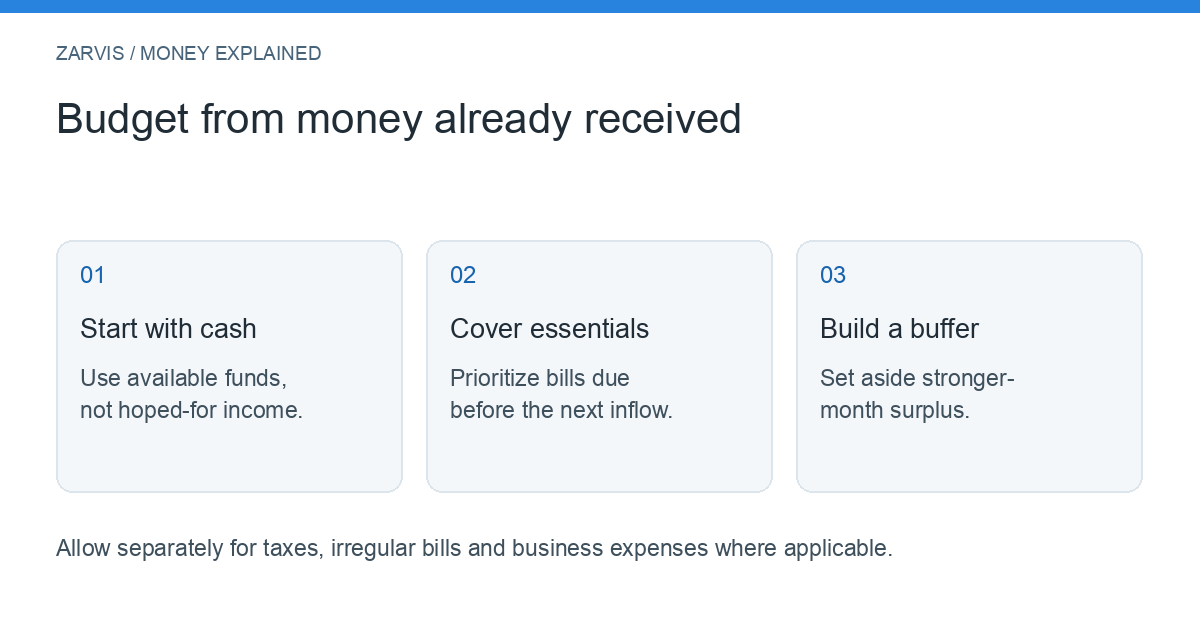
Start with a conservative spending plan for essentials, then give extra income specific jobs after it reaches your account. Do not build a routine around your best month.
Start your budget with irregular income at the essential floor
List housing, basic utilities, groceries, necessary transport, insurance, and required debt payments. Include costs that make it possible to keep earning, such as essential work tools or childcare.
Separate those costs from flexible spending. This is a planning exercise, not a judgment about which purchases are “good.”
For example, your essential monthly plan might look like this:
| Category | Illustrative monthly amount |
|---|---|
| Housing and basic utilities | $1,350 |
| Groceries and household essentials | $400 |
| Necessary transport | $250 |
| Insurance | $200 |
| Minimum debt payments | $200 |
| Total essentials | $2,400 |
These figures are invented to explain the method. They are not suggested spending limits for your household.
Use our monthly budget template guide to build your own list. Include irregular bills too: an annual $600 insurance bill needs a funding plan, even in months when nothing is due.
Choose an income baseline you can defend
Review your actual income history and consider seasonality, cancellations, and slow-payment periods. A conservative baseline is more useful than an optimistic average if you have little cash available to cover a weak month.
Keep the definitions consistent. For a self-employed person, customer payments are not automatically household spending money. Business expenses and tax obligations may need to be set aside first. The appropriate tax reserve depends on your circumstances; a qualified tax professional can help you determine it.
If the amount available for household spending is sometimes below your essential floor, the budget needs a gap plan: reduce or renegotiate costs where possible, seek additional income or assistance, and contact creditors early. A spreadsheet cannot make a recurring shortfall disappear.
Use a cash calendar to budget with irregular income
Record when bills are due and when income is likely to clear. Mark expected income as expected, not received.
The CFPB’s cash-flow guidance discusses adjusting the timing of expenses and exploring whether bill due dates can better match income. A provider may agree to a change, but confirm the effective date and any conditions before relying on it.
For the next two weeks, total the essential payments due before the next reliable deposit. That short window can reveal a problem hidden by a monthly total.
Give each incoming payment a sequence
When money arrives, use an order you have chosen in advance:
- Set aside required business or tax amounts, where relevant.
- Cover essentials due before the next reliable payment.
- Fund upcoming nonmonthly bills.
- Rebuild the cash buffer used during lean periods.
- Allocate remaining money to debt goals, longer-term savings, and flexible spending.
This is one practical framework, not a universal priority rule. Your housing, legal obligations, dependents, and immediate safety needs may change the order.
Suppose $3,100 is available for household use after necessary business and tax reserves. If $2,400 covers the essential plan and $150 is needed for upcoming annual bills, $550 remains. Decide how to divide that $550 before it disappears into everyday spending.
Use strong months to make weak months less disruptive
A cash-flow buffer helps pay ordinary bills when income arrives unevenly. An emergency fund addresses unexpected costs or a more serious interruption. The two can overlap, but naming the purpose helps prevent spending the same dollar twice.
Set an initial buffer target around the timing gap you actually face. Then review whether a larger reserve is realistic. Our emergency fund guide explains how to think through essential expenses and uncertainty without treating one target as right for everyone.
Do not commit every strong month to extra debt payments if that leaves no money for predictable lean periods.
Your budget with irregular income needs a rule for late payments, not just a forecast for on-time ones. Mark the bills that would be affected first so you know which providers to contact if expected income does not arrive.
Review briefly, but often
Once a week, update received income, bills due, and the available buffer. If a payment is late, change the plan immediately rather than leaving an old income estimate in place.
A budget tracker can capture what happened; your cash calendar shows what needs to happen next. A zero-based budget can also help assign money you already have without pretending you know next month’s exact earnings.
The goal is not a perfect forecast. It is a repeatable process that remains useful when your income changes.
This article is general financial education. It is not personalized financial, legal, or tax advice.
Making the irregular-income plan workable
What should I do in a stronger month?
Decide where the surplus belongs before treating it as available spending money. Catch up on essentials, reserve money for known irregular bills, and replenish the income buffer where possible. Self-employed workers may also need a separate tax reserve. The right allocation depends on actual obligations; a single fixed percentage is not a substitute for knowing what is due.
What if this month’s income will not cover essentials?
Write down the shortfall and payment dates rather than spreading money evenly across every category. Prioritize immediate necessities and contact providers about options before a missed payment where possible. A budget can show the gap, but it cannot make an unaffordable month affordable on paper. Avoid treating uncertain future work or new credit as income already available.
Should I rebuild the budget after every payment?
You do not need a complicated spreadsheet each time. Update the available cash, check what must be covered before the next expected inflow, and allocate the remainder deliberately. If work is seasonal, review a longer history as well. One unusually good week is not reliable evidence that your ongoing spending level can rise permanently.
How do I keep business income separate?
If you run a business, customer receipts may still need to cover business expenses and taxes before money is available for household use. Keep records that distinguish gross receipts from the amount you can actually draw. Where the tax position is unclear, seek qualified advice instead of using a generic household budget percentage as a tax calculation.


Pingback: Debt Payoff Plan: How to Build One You Can Maintain — Best 7-Step Guide - Zarvis | US Personal Finance & Credit Guides