

A debt payoff plan is a written, month-by-month arrangement that states how much you will pay toward debt in total, which debt receives any extra money, and what happens when life interrupts. The difference between a debt payoff plan and a burst of enthusiasm is that a plan is sized for your ordinary months, automated where possible, and designed to bend during a hard month instead of breaking.
Quick answer: List every debt, automate all minimums, choose one ordering method for your debt payoff plan, and fix a total monthly payment your budget can sustain even in a below-average month. Keep a small starter emergency cushion, review progress monthly with a tracker, and decide in advance how you will handle setbacks — reduce the extra payment temporarily rather than skipping payments.
In the example below, a $500 monthly plan clears $12,800 of hypothetical debt in 31 to 32 months.
Key Takeaways
- A maintainable debt payoff plan is built on your worst normal month, not your best one.
- Automation handles the minimums; your attention should only be needed for the one target debt.
- The payoff order matters less than the fixed total and the rollover of freed payments. Choose a method in our debt payoff strategies guide and commit.
- A small emergency cushion protects the plan from going back onto a credit card.
- Setbacks are part of the plan, not the end of it, if you decide the fallback in advance.
Step 1: Get the Full Picture on One Page
Start with a single list: every debt, its balance, APR, minimum payment, and due date — including store cards, medical bills, and buy-now-pay-later balances, because a forgotten minimum becomes a late fee. Add your take-home income and essential spending. The gap between them is the raw material of your plan, and this list is also the first page of your debt payoff tracker.
Step 2: Set a Monthly Total You Can Sustain
Your total monthly debt payment must survive an ordinary bad month — a car repair, a thinner paycheck, a higher utility bill. Two tests help:
- The repeat test: Could you pay this amount for the next 24 months without new borrowing? If the honest answer is no, the amount is too high, whatever a calculator says.
- The minimum-plus test: Your total must at least cover all minimums plus something extra — even $25 — aimed at one target. Paying only minimums on revolving debt can stretch repayment for many years because minimums often shrink as balances fall.
Consider the hypothetical household used across these guides: four debts totaling $12,800, with minimums of $300 a month. They chose a $500 total — $300 of minimums plus $200 extra. That choice, not an extreme one, clears the debts in about 31 months under the debt avalanche method or 32 months under the debt snowball method
, assuming fixed hypothetical APRs, no new charges, and no fees. A plan at $600 would finish sooner, but if it failed in month six, it would finish never. Sustainable beats aggressive.
If no extra amount seems possible, look first at timing rather than size: shifting due dates — many issuers allow this on request — can align payments with payday and remove overdraft risk, which is often the real reason “extra” money evaporates.
Step 3: Choose One Order and Write It Down
Indecision is a quiet plan-killer. Pick your ordering rule now:
- Smallest balance first (snowball) if motivation and early wins keep you engaged.
- Highest APR first (avalanche) if minimizing cost motivates you and your first target is realistically clearable.
- A stated hybrid — for example, “clear the $800 card, then go by APR” — if you want one quick win before the cost-based order.
Write the order, with each debt’s rank, into your plan document. Future-you, tired in month nine, should not have to re-decide strategy; the decision is already made. Note that paying down card balances also changes your credit utilization ratio over time, a side benefit worth understanding but not the plan’s purpose.
Step 4: Protect the Plan With a Starter Cushion
The most common reason payoff plans collapse is not laziness; it is an uninsured surprise going straight back onto a card. Before or alongside your first extra payments, build a small starter emergency fund — many households use $500 to $1,000 as an initial target, held in a separate savings account.
This is deliberately modest: the goal is to keep a tire replacement or a broken phone from becoming new 24%-APR debt, not to fully fund emergencies before starting. Once high-interest debt is gone, building a larger fund of several months of essential expenses typically becomes the next priority. Keep the cushion boring and reachable; raiding it for sales or trips resets the protection to zero.
Step 5: Automate the Floor, Manualize Nothing Important
Set automatic payments for every minimum, scheduled shortly after payday and a few days before due dates. Then automate the target debt's extra payment as a separate scheduled transfer if your issuer allows it, or as a standing calendar task on payday — automation is better, because willpower fluctuates and automation does not.
Review statements monthly anyway; automation handles payment, not verification, and errors or unexpected fees still occur.
Step 6: Decide Your Setback Rules in Advance
Write down what happens when a month goes wrong, before it does:
- Income drops for one month: Extra payment pauses; all minimums continue. The plan resumes next month with the same order.
- An emergency exceeds the cushion: Cover essentials, keep minimums current, and call affected creditors early to ask about hardship options rather than silently missing payments.
- You receive a windfall — a tax refund, bonus, or sold item: Decide the split now, for example half to the target debt, a portion to the cushion, and a small portion you may spend without guilt. Rules made in calm moments prevent both waste and resentment.
- You miss a payment anyway: Pay it as soon as possible, ask about fee relief, and continue the plan. One missed payment is an event, not a verdict on the plan.
If minimums themselves become impossible, that is a different situation from a setback, and it calls for outside help sooner rather than later. The Consumer Financial Protection Bureau (CFPB) describes how nonprofit credit counselors work, and the Federal Trade Commission (FTC) outlines the risks of for-profit debt relief pitches. Getting that advice is a step in a plan, not an abandonment of it.
Step 7: Review Monthly, Adjust Quarterly
Once a month, spend ten minutes updating balances, confirming every payment posted, and noting the total paid toward principal versus interest. Once a quarter, ask three questions: Is the monthly total still realistic? Has any APR changed, requiring a re-rank under an avalanche or hybrid order? Has income changed enough to raise the extra payment — the fastest legitimate way to shorten any plan?
Changes made deliberately at a quarterly review strengthen a debt payoff plan; changes made impulsively mid-month usually weaken it.
A One-Page Debt Payoff Plan Template
Your written plan can fit on one page:
| Item | Your entry |
|---|---|
| Total monthly debt payment | $ ______ |
| Payday(s) and payment dates | ____________ |
| Payoff order (method and ranks) | ____________ |
| Current target debt | ____________ |
| Starter cushion goal / current amount | $ ______ / $ ______ |
| Windfall rule | ____________ |
| Setback rule | ____________ |
| Monthly review date | ____________ |
| Projected debt-free month (estimate) | ____________ |
If the plan no longer fits your income
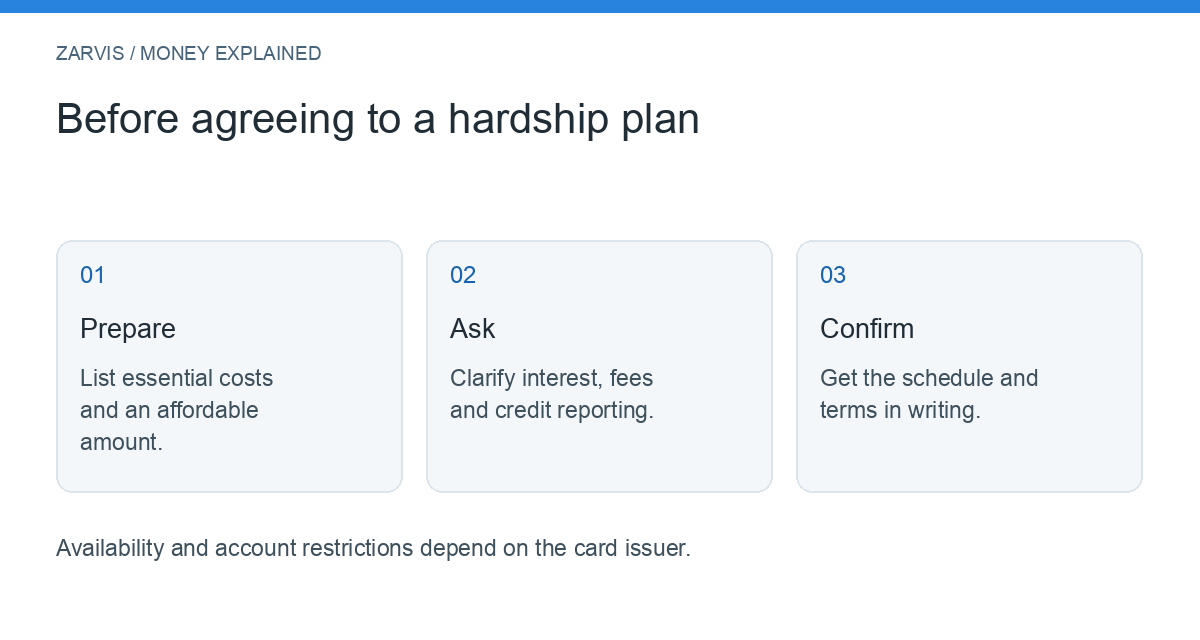
When essential bills leave too little for the contractual minimums, changing from snowball to avalanche does not fix the cash shortfall. Read our hardship-plan questions before asking a card issuer about assistance. Do not assume a phone discussion changes your existing payment obligation; confirm any agreement and its start date in writing.
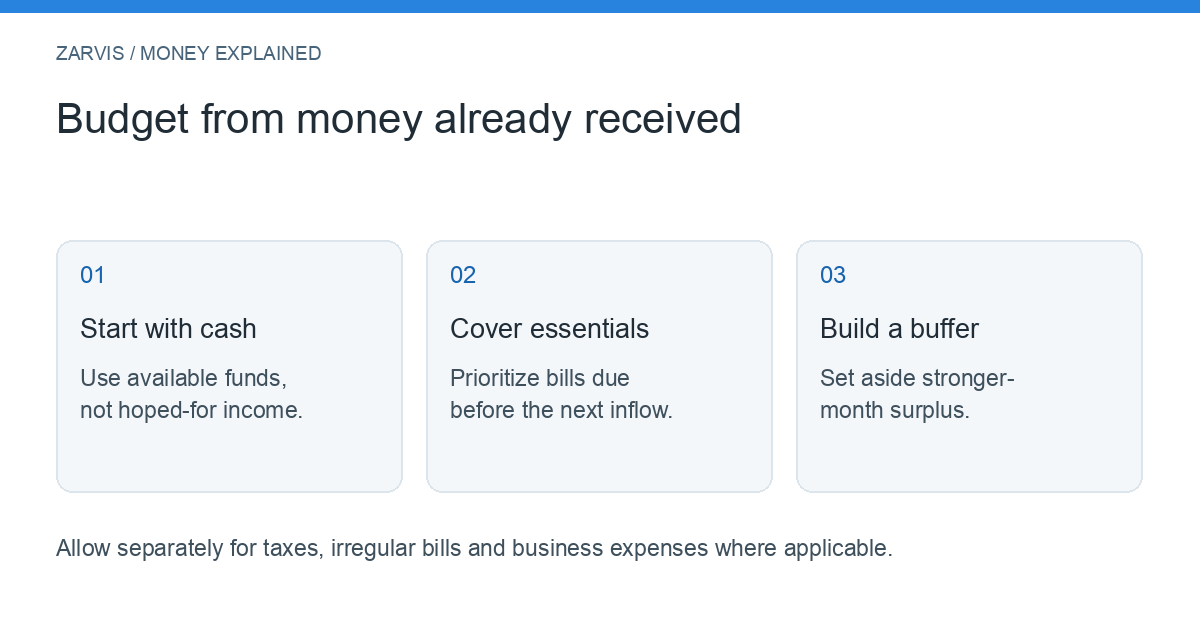
For variable earnings, budget from income already received and keep a calendar of bills due before the next expected inflow. Revisit the payoff amount when that cash-flow picture changes.
Debt Payoff Plan FAQ
How much of my income should go to my debt payoff plan?
There is no universal percentage. Your minimums are fixed obligations; the extra amount should be what remains after essentials, a small cushion contribution, and irregular expenses you know are coming, such as annual insurance premiums. A total you can repeat for two years is worth more than a heroic figure you sustain for two months.
Should I pause retirement contributions during the plan?
That is a personal decision with long-term consequences, and general articles cannot settle it. Some households temporarily reduce contributions to free cash for very high-interest debt, while keeping any employer match where possible, because the match is an immediate return. Consider discussing your situation with a qualified professional, especially if you are near retirement.
What if my income varies month to month?
Base the fixed total on your lowest typical month, and treat higher months as windfalls governed by your windfall rule — most of the surplus to the target debt. Variable-income plans fail when the fixed amount is set from average or best months.
How often should I change my payoff order?
Rarely. Re-rank only at a quarterly review, or when a fact changes materially — an APR increase, a promotional rate expiring, or a debt being paid off. Monthly reshuffling usually reflects mood rather than math.
Is it a problem if my debt payoff plan takes three years?
A three-year plan you finish is a success. Long timelines are normal for five-figure balances on ordinary incomes, and the plan improves your position every month along the way: total interest falls as balances fall, and each cleared account simplifies your financial life.
Bottom Line
A maintainable debt payoff plan is a fixed, affordable monthly total; every minimum automated; one written order for extra payments; a small cushion against surprises; setback rules decided in advance; and a brief monthly review.
Build those six pieces and your debt payoff plan no longer depends on motivation, which is fortunate — because finishing debt payoff is mostly a matter of repeating an ordinary month many times in a row.
Editorial note: Zarvis provides general educational information, not personalized financial, legal, or tax advice. Examples are hypothetical, use illustrative rates, and do not guarantee any outcome. Interest rates, fees, and provider terms change and vary by applicant; verify current details directly with your creditors or providers, and consider a qualified professional for advice about your specific circumstances.
Sources
- Consumer Financial Protection Bureau: Credit cards and consumer money tools — https://www.consumerfinance.gov/consumer-tools/credit-cards/
- Consumer Financial Protection Bureau: Consumer tools for debt and budgeting — https://www.consumerfinance.gov/consumer-tools/
- Federal Trade Commission: How to Get Out of Debt — https://consumer.ftc.gov/articles/how-get-out-debt
- Federal Trade Commission: Credit Repair: How to Help Yourself — https://consumer.ftc.gov/articles/credit-repair-how-help-yourself
- Board of Governors of the Federal Reserve System: Consumer Credit (G.19) statistical release — https://www.federalreserve.gov/releases/g19/current/default.htm
Author: Harsh Kardam

Pingback: Debt Payoff Tracker: Best Way to Record Debts and Measure Progress in 10 Minutes a Month - Zarvis | US Personal Finance & Credit Guides