

The debt avalanche method is a payoff strategy in which you list your debts from the highest annual percentage rate (APR) to the lowest, pay the minimum on everything, and send all extra money to the highest-rate debt until it is gone. You then roll that payment into the next-highest rate, and repeat. Because interest grows fastest on the most expensive debt, this order generally produces the lowest total cost of any fixed-payment payoff plan.
Quick answer: Rank debts by APR, highest first, regardless of balance. In the worked example below — the same $12,800 of debts used in our snowball guide — the debt avalanche finishes in 31 months with about $2,669 of interest, saving about $509 and one month compared with paying smallest balance first. The savings grow when rate gaps are wide, balances are large, and payoff takes a long time.
Key Takeaways
- The debt avalanche orders debts by interest rate only; balance size does not affect the order.
- Minimum payments on every account continue throughout — “highest rate first” describes where extra money goes.
- The method’s advantage is real but not magic: it comes from reducing the time your most expensive balance has to accrue interest.
- The first debt cleared may take longer than under the snowball, which is the method’s main behavioral risk.
- If two debts share a similar APR, paying the smaller balance first within that pair is a reasonable tiebreaker.
How the Debt Avalanche Method Works
Interest is the rent you pay for owing money, and each debt charges its own rate of rent. At the start of the example used throughout this guide, the four debts generate roughly these amounts of interest in the first month:
| Debt | Balance | APR (hypothetical) | Interest in month 1 (approx.) |
|---|---|---|---|
| Credit Union Card A | $1,800 | 9% | $13.50 |
| Store Card B | $2,500 | 28% | $58.33 |
| Credit Card C | $3,500 | 22% | $64.17 |
| Personal Loan D | $5,000 | 11% | $45.83 |
One detail surprises many people: Credit Card C generates more interest dollars in month 1 than Store Card B, despite its lower APR, because its balance is larger. The avalanche still targets B first: every dollar of B you remove stops accruing interest at 28%, the fastest rate at which any of your dollars works against you. Once B is gone, the same logic points to C.
Step-by-Step: Setting Up Your Debt Avalanche
Step 1: List every debt with its APR
Record each creditor, balance, APR, minimum payment, and due date. Check whether any APR is promotional or variable — a card whose rate jumps in six months may deserve a higher position than its current rate suggests. Our guide to the credit utilization ratio explains how the balances themselves affect your credit profile.
Step 2: Sort by APR, highest to lowest
This is your payoff order. Keep it visible; the debt payoff tracker template in this series includes a rank column so the order survives from month to month.
Step 3: Automate every minimum payment
A late fee or penalty APR on a low-priority debt can erase months of avalanche savings, so the boring accounts still need protection.
Step 4: Set your fixed monthly total
Decide what you can pay every month in a normal month — minimums plus a sustainable extra. Sizing that amount is covered in our guide to building a debt payoff plan you can maintain.
Step 5: Attack the highest APR, then roll down
Send all extra money to the top-rate debt. When it reaches zero, roll its full payment to the next-highest rate. When only the lowest-rate debt remains, aim the whole monthly total at it.
Worked Example: The Avalanche on the Same Debts
This example is hypothetical and for education only, with illustrative APRs rather than current offers. It uses exactly the same debts, budget, and assumptions as our debt snowball method guide — fixed APRs, no new charges, no fees, minimums held at their starting amounts, interest calculated monthly, and freed payments rolled forward — so the two results can be compared directly.
| Debt | Balance | APR (hypothetical) | Minimum payment | Avalanche order |
|---|---|---|---|---|
| Store Card B | $2,500 | 28% | $65 | 1st |
| Credit Card C | $3,500 | 22% | $85 | 2nd |
| Personal Loan D | $5,000 | 11% | $110 | 3rd |
| Credit Union Card A | $1,800 | 9% | $40 | 4th |
| Total | $12,800 | — | $300 | — |
The household pays $500 a month: $300 of minimums plus $200 extra.
Months 1–11: Store Card B. B receives $265 a month ($65 minimum + $200 extra). Its balance falls to about $2,293 after month 1 and about $948 after month 7, and it is cleared in month 11. Meanwhile the cheapest debt, Card A, receives only its $40 minimum, and its balance drifts down slowly from $1,800 to about $1,497 by month 11. That patience is the avalanche’s price of admission.
Months 12–22: Credit Card C. C now receives about $350 a month and is cleared in month 22.
Months 23–30: Personal Loan D. The loan receives about $460 a month and is cleared in month 30.
Month 31: Credit Union Card A. The full $500 lands on the last, cheapest debt, clearing it in month 31.
| Result | Avalanche | Snowball (same debts) |
|---|---|---|
| First debt cleared | Month 11 | Month 8 |
| Debt-free | Month 31 | Month 32 |
| Total interest (approx.) | $2,669 | $3,178 |
| Difference | About $509 less, 1 month sooner | About $509 more, first win 3 months sooner |
For the full side-by-side discussion of how to choose, see our pillar guide to debt payoff strategies.
When the Debt Avalanche Saves the Most
The debt avalanche’s $509 saving above is meaningful but modest. The advantage grows when:
- Rate spreads are wide. At 29% versus 6%, order matters far more than when everything sits between 18% and 22%. With similar rates, the methods nearly converge.
- High-rate balances are large. A 28% APR on a $400 balance costs about $9 a month in interest; on a $6,000 balance it costs about $140.
- Timelines are long. Over six months, ordering differences are small. Over three or four years, they compound.
- The smallest debt is also large. If your “small” debt would take a year to clear under the snowball, expensive debts wait a year too, at full interest.
Conversely, the avalanche saves little when debts are small, rates are close, or your extra payment is large relative to your balances, because everything gets paid quickly under any order.
The Debt Avalanche’s Real Weakness: The Wait for the First Win
On paper the avalanche is cheapest. In a household, its vulnerability is that the first zero balance can take a while — month 11 in our example, versus month 8. If your highest-rate debt is also your largest, that wait can stretch much longer, and many plans die there from discouragement rather than bad math. Two safeguards help: track total balance and total interest paid, not just accounts closed, since your overall balance falls every month; and consider a planned hybrid — clear one genuinely small debt first, then switch to strict APR order.
Debt Avalanche FAQ
Is the avalanche always cheaper than the snowball?
On total interest, yes, assuming the same debts, the same monthly total, and that both plans are followed to completion — paying the highest rate first cannot cost more interest than paying a lower rate first. Real life adds a condition: the plan has to survive. An abandoned avalanche is more expensive than a completed snowball.
What if my highest-rate debt is also my biggest?
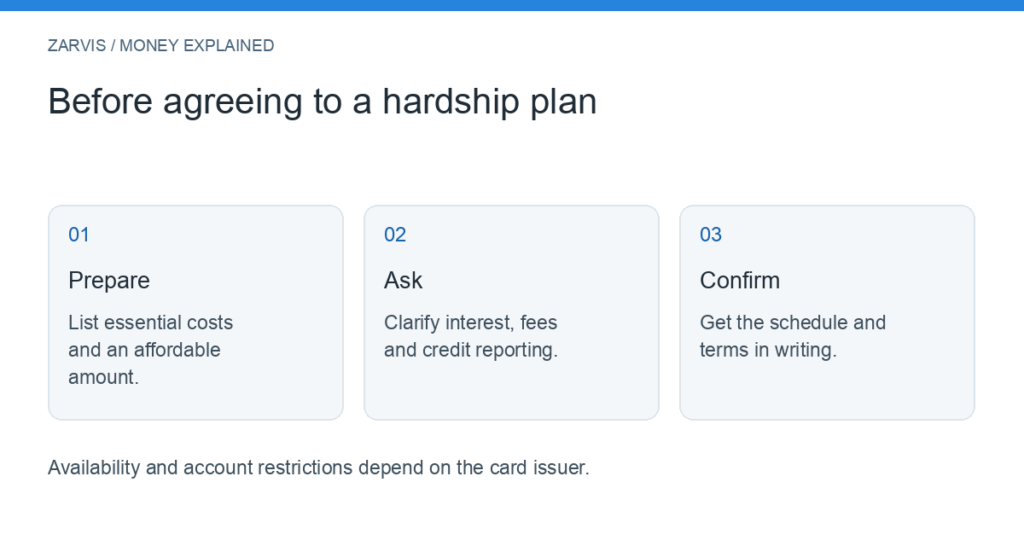
That is the hardest avalanche case. The math still favors attacking it, but consider a hybrid: clear a small debt first, then commit to the high-rate balance. Also ask the issuer about a lower APR or hardship program before assuming the rate is fixed — and get any change in terms in writing.
How do I handle a 0% promotional APR?
A balance at a genuine 0% promotional rate is, for now, your cheapest debt and belongs at the end of the order. Note when the promotion ends and what rate applies afterward, including whether deferred interest can be charged retroactively. Many households move that debt up a month or two before expiry.
Do I order debts by APR or by interest charged per month?
By APR for the standard avalanche. A larger balance at a lower rate can generate more interest dollars in a given month, but each dollar you pay removes interest at that debt’s rate — so paying the highest rate still reduces your future interest fastest per dollar paid.
Should I include my mortgage or auto loan in the avalanche?
Most households run the avalanche on unsecured, higher-rate debts and keep paying housing and auto loans on their normal schedules, because those rates are usually much lower and the assets are at risk if payments lapse. Never let an ordering strategy delay a secured payment or a minimum on any account.
Bottom Line
The debt avalanche is the cost-minimizing order: highest APR first, minimums everywhere, payments rolled downhill as each expensive debt disappears. On our example debts it saves about $509 and a month versus the snowball — and the gap widens when rates are far apart and balances are large. Choose it if you trust your staying power, track overall progress to stay motivated, and consider a planned hybrid if the first win would otherwise take too long to arrive.
Editorial note: Zarvis provides general educational information, not personalized financial, legal, or tax advice. Examples are hypothetical, use illustrative rates, and do not guarantee any outcome. Interest rates, fees, and provider terms change and vary by applicant; verify current details directly with your creditors or providers, and consider a qualified professional for advice about your specific circumstances.
Sources
- Consumer Financial Protection Bureau: Credit cards and consumer money tools — https://www.consumerfinance.gov/consumer-tools/credit-cards/
- Consumer Financial Protection Bureau: Consumer tools for debt and budgeting — https://www.consumerfinance.gov/consumer-tools/
- Federal Trade Commission: How to Get Out of Debt — https://consumer.ftc.gov/articles/how-get-out-debt
- Federal Trade Commission: Credit Repair: How to Help Yourself — https://consumer.ftc.gov/articles/credit-repair-how-help-yourself
- Board of Governors of the Federal Reserve System: Consumer Credit (G.19) statistical release — https://www.federalreserve.gov/releases/g19/current/default.htm
Author: Harsh Kardam

Pingback: Debt Payoff Plan: How to Build One You Can Maintain — Best 7-Step Guide - Zarvis | US Personal Finance & Credit Guides
Pingback: Debt Payoff Tracker: Best Way to Record Debts and Measure Progress in 10 Minutes a Month - Zarvis | US Personal Finance & Credit Guides