A credit card hardship plan may offer a way to discuss more manageable terms with your issuer when the regular payment is unaffordable.
If you cannot afford your credit card payment, contact the issuer as soon as possible and ask whether a hardship arrangement is available. You do not need to wait for a missed payment to ask about help.
A hardship plan may change payment terms temporarily or provide another form of assistance, depending on the issuer and your situation. It is not automatic debt forgiveness, and no particular rate, payment reduction, or approval is guaranteed.
The CFPB advises people struggling with credit card bills to explain why they cannot pay, how much they can afford, and when normal payments might resume.
Prepare a realistic credit card hardship plan request
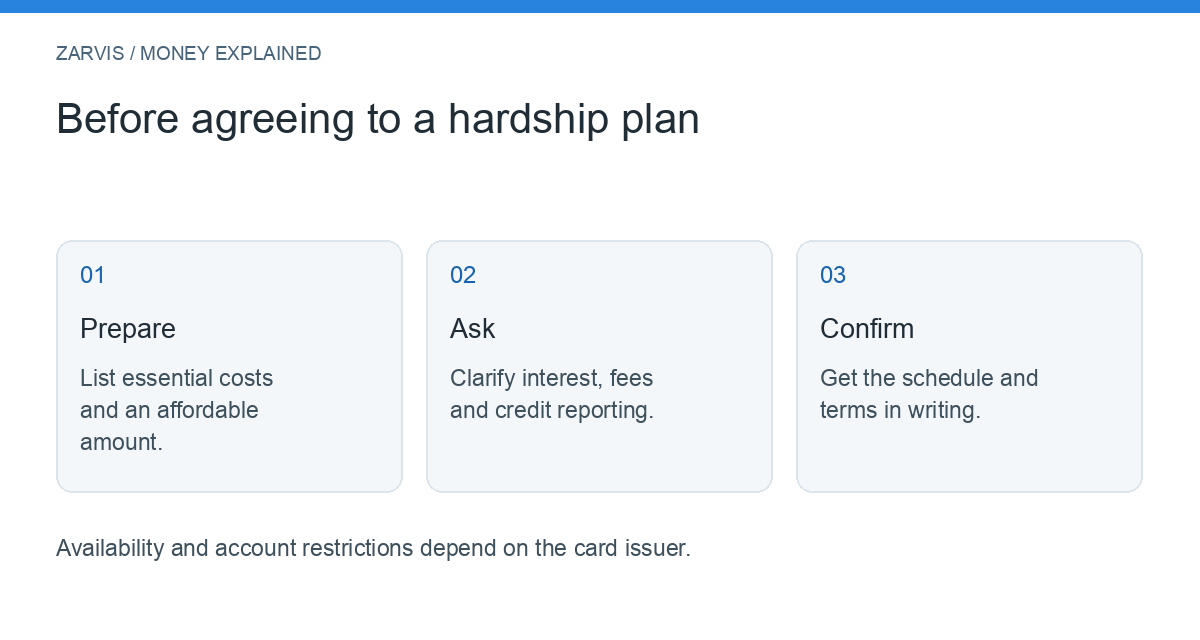
Before calling, list the money available for essential expenses and required obligations. Include housing, food, utilities, necessary transport, and other immediate needs.
Then estimate what remains for this card. Do not promise a payment that depends on overtime you have not been offered or a sale you have not completed.
For example, if the current minimum is $180 but only $90 is available after essential commitments, explain that gap. Paying $90 without an agreement does not necessarily satisfy a $180 minimum. Ask the issuer what arrangement, if any, it can approve.
Our debt payoff plan guide can help you organize the wider picture. During a shortage, making aggressive extra payments may need to take a back seat to keeping essentials covered.
Call through a verified channel
Use the number on your card, statement, or authenticated account portal. Ask for the department that handles financial hardship or payment assistance.
Have your statement and a short budget ready. Follow the issuer’s verification process, but do not share account credentials with an unsolicited caller claiming to arrange relief.
You can use a plain script:
“My income has dropped, and I am concerned I cannot make the current payment. I can afford approximately $90 a month for now. What assistance options are available, what would they cost, and how would they affect my account?”
That is an example, not a promise that the issuer will accept $90 or any other amount.
Credit card hardship plan: nine questions to ask
A smaller payment is only one part of the decision. Ask these questions before agreeing:
- What is the required payment, and when does it begin?
- Does the interest rate change, and for how long?
- Will interest continue to accrue?
- Are any existing or future fees waived?
- Is the card restricted, suspended, or closed?
- How will the account and payments be reported to credit bureaus?
- What happens when the arrangement ends?
- What happens if you miss a plan payment?
- Will autopay change, or do you need to update it?
Get the terms in writing or through a secure account message. Keep a record of the date, representative, and next steps.
Do not assume the balance has stopped growing
If the agreed payment is lower but interest continues, the debt may fall slowly or could grow, depending on the terms and charges. Ask for an explanation of how the balance is expected to change.
Also ask whether there is a catch-up amount or a return to a higher payment after the assistance period. A plan that works for three months may require another decision in month four.
Our credit card interest guide and minimum-payment guide explain the mechanics. Do not plug a temporary arrangement into a standard payoff calculator without checking whether its assumptions still apply.
Hardship assistance is not the same as debt settlement
An issuer’s payment arrangement changes how you repay under agreed terms. Debt settlement seeks an agreement to resolve debt for less than the amount owed and can carry different risks and consequences.
Be wary of anyone guaranteeing that debt will disappear or telling you to stop communicating with the card company. The CFPB’s guidance flags these as warning signs of problematic debt-relief offers.
Do not stop required payments merely because a third party says negotiations have started. Ask a qualified counselor or adviser about the implications for your situation.
If the issuer cannot offer enough help
Ask whether another department or program can review your circumstances. You can also explore credit counseling. The CFPB’s credit counseling explanation describes the type of help these organizations may provide.
Before signing up, ask about fees, services, counselor qualifications, and any proposed debt-management plan. Nonprofit status alone does not establish that a service is free or suitable.
If an account issue remains unresolved, keep your records and consider the appropriate complaint or assistance channels. A complaint does not cancel payment obligations or guarantee relief.
Compare the credit card hardship plan with your actual cash calendar, including the first payment date. An arrangement is not workable if its first withdrawal arrives before the income you need to fund it.
Keep the next step small and specific
After the call, write down the next payment date, required amount, and review date. Use a debt payoff tracker to record the arrangement without storing passwords or full account numbers.
The immediate goal is a workable next step, not an impressive payoff promise. Ask early, be accurate about affordability, and keep the agreed terms.
This is general US financial education, not personalized financial, credit-repair, or legal advice.
Hardship-plan details to clarify on the call
What if the proposed payment is still unaffordable?
Say so before agreeing. Explain what remains after essential household costs and ask whether a different arrangement exists. A payment plan that only works by missing rent or another essential bill may not be workable. Availability varies, and the issuer may not offer an acceptable option; do not promise an amount solely to end the conversation.
Should I stop paying while waiting for a decision?
Do not assume a pending request changes the current agreement. Ask what payment is required while the request is reviewed, whether fees or interest continue, and when any approved changes take effect. Keep paying according to the applicable terms where possible. If a representative gives different instructions, request written confirmation and retain the date and reference number.
What should I ask about credit reporting?
Ask how the account, payment status, and any closure or limit change will be reported. Do not accept a general promise that your credit score will be unaffected: scoring depends on several factors, and no single outcome is guaranteed. Check subsequent statements and credit reports for accuracy and follow up if they differ from the agreed terms.
What happens when the plan ends?
Find out the end date, remaining balance, later APR, and payment calculation before enrolling. Ask whether the account can be used again or will remain restricted or closed. Put a reminder ahead of the end date to review the next payment. A temporary reduction is useful only if you understand the obligations that follow it.