

A credit card minimum payment is the smallest amount you must pay by the due date to keep the account in good standing. It is usually calculated as a small percentage of your balance, or as interest plus a small percentage of the balance, with a flat dollar floor — whichever method your card agreement describes.
Paying the minimum avoids a late fee and a missed payment on that cycle, but it is designed to keep the account current, not to pay the debt off quickly.
Quick answer: There is no single minimum payment formula for all cards. Common methods include 1% to 3% of the balance, or the month's interest and fees plus 1% of the balance, often with a minimum floor such as $25. If your balance is smaller than the floor, you generally owe the full balance.
Your cardmember agreement and your statement are the authoritative source for your card's exact method.
Key Takeaways
- The minimum payment is a floor for staying current, not a recommended payoff amount.
- Issuers commonly use a percentage of the balance, or interest and fees plus a percentage of the balance.
- Most agreements include a flat dollar minimum, so a small balance may be due in full.
- As your balance falls, a percentage-based minimum usually falls too, which stretches out the payoff timeline.
- Paying a fixed amount above the first month’s minimum can cut years and a large amount of interest from the payoff.
- A minimum payment does not stop interest from accruing on the remaining balance.
Where to Find Your Card’s Formula
Your statement shows the minimum amount due and the due date, but it may not spell out the formula in detail. The formula lives in your cardmember agreement, in a section often labelled "How to calculate your minimum payment" or similar.
The Consumer Financial Protection Bureau (CFPB) explains that issuers must disclose their terms, and your statement also includes a minimum payment warning that estimates how long payoff would take if you pay only the minimum, and what paying a higher fixed amount could save.
That warning box uses your actual balance and rate, so it is more specific than any general example, including the hypothetical ones in this guide.
The Common Calculation Methods
| Method | How it works | Typical features |
|---|---|---|
| Percentage of balance | Minimum = a set percentage of the statement balance | Often around 1% to 3%; payment shrinks as the balance shrinks |
| Interest + fees + percentage | Minimum = interest charged + fees + a small percentage of the balance | Often 1% of the balance on top of interest and fees |
| Flat floor | If the calculated amount is below a set dollar figure, you pay that figure instead | For example, a hypothetical $25 floor; small balances are due in full |
Many cards combine these ideas: a percentage or interest-plus-percentage calculation, subject to a flat dollar floor. Past-due amounts and amounts over your credit limit may also be added to the minimum due. Because methods differ, two cards with the same balance and interest rate can show different minimum payments in the same month.
Interest itself is usually calculated using the average daily balance method in your agreement, which is why a month’s interest charge is close to, but rarely exactly, the balance multiplied by the APR and divided by 12.
Worked Example 1: Two Formulas, One Balance
The following is a hypothetical example for illustration only. It is not a quote or a description of any specific card.
Assume:
- Statement balance: $5,000
- APR: 18% (hypothetical)
- No new purchases, fees, or penalty pricing
- Approximate monthly interest: $5,000 × 18% ÷ 12 = $75
Formula A — interest plus 1% of the balance:
$75 interest + ($5,000 × 1% = $50) = $125 minimum payment
Formula B — 2% of the balance:
$5,000 × 2% = $100 minimum payment
Same balance, same interest rate, two different minimums — $125 versus $100. Under Formula A, only $50 of the first payment reduces the balance, because $75 goes to interest. Under Formula B, only $25 reduces the balance. In both cases, most of the first payment is consumed by interest, which is why balances move slowly at the start when you pay only the minimum.
Worked Example 2: Why the Payoff Takes So Long
Continue the same hypothetical example, using Formula A (interest plus 1% of the balance, with a hypothetical $25 floor) and no new purchases.
Because the payment is tied to the balance, both fall together. After 12 months of minimum-only payments, the balance would still be about $4,432 — you would have paid for a year and reduced a $5,000 balance by only about $568. If you kept paying only the recalculated minimum until the balance was gone, payoff would take roughly 222 months, or about 18.5 years
, and total interest would be roughly $6,539 — more than the amount originally owed. These figures are estimates based on the stated assumptions; your issuer's minimum payment warning will show the equivalent estimate for your real account.
Now compare a simple change: keep the payment fixed at the first month’s $125 instead of letting it shrink. On the same assumptions, the debt would be cleared in roughly 62 months with about $2,693 in interest. Paying a fixed $200 a month instead would clear it in roughly 32 months with about $1,314 in interest.
| Strategy (hypothetical $5,000 balance, 18% APR) | Approx. payoff time | Approx. total interest |
|---|---|---|
| Minimum only (interest + 1%, $25 floor) | ~222 months | ~$6,539 |
| Fixed $125 per month | ~62 months | ~$2,693 |
| Fixed $200 per month | ~32 months | ~$1,314 |
The lesson is not that any one of these payments fits your budget. The lesson is that the minimum is a moving target that moves in the wrong direction: the less you owe, the less you are asked to pay, and the longer interest keeps running.
What Happens If You Pay Less Than the Minimum
Paying less than the minimum, or paying late, can trigger several consequences at once: a late fee, a possible penalty APR on some accounts, and — once a payment is 30 or more days late — a late payment reported to the credit bureaus, which can affect credit scores.
The CFPB notes that payment history is an important factor in credit scoring, so a missed minimum payment can cost more than the fee itself. If you cannot pay the full statement balance, paying at least the minimum by the due date protects the account from most of those outcomes, even though interest continues on the remaining balance.
If you cannot cover even the minimum, contact the issuer before the due date. Some issuers offer hardship arrangements; terms vary, nothing is guaranteed, and any arrangement should be confirmed in writing — but a call before the due date gives you more options.
How to Use the Minimum Payment Sensibly
- Treat the statement balance as the goal. Paying the full statement balance by the due date is what keeps you within the interest grace period on purchases for most cards.
- If you cannot pay in full, fix the payment. Choose the highest fixed amount your budget can sustain each month instead of paying the shrinking minimum. Our credit utilization ratio guide explains how paying a balance down also lowers reported utilization.
- Automate at least the minimum. Autopay set to the minimum amount due is a safety net against a forgotten due date; you can still make an additional manual payment toward the balance.
- Stop adding to the balance while you pay it down. New purchases rebuild the balance and, on many cards, begin accruing interest immediately once a grace period is lost.
- Revisit the warning box on your statement. It translates your real balance into a payoff time and a three-year comparison payment, which is a practical planning figure.
If most of your payment is being absorbed by interest across several cards, a structured payoff plan — or a balance transfer, after checking its fee and intro period — may be worth comparing against simply raising one payment.
What to check before choosing your payment
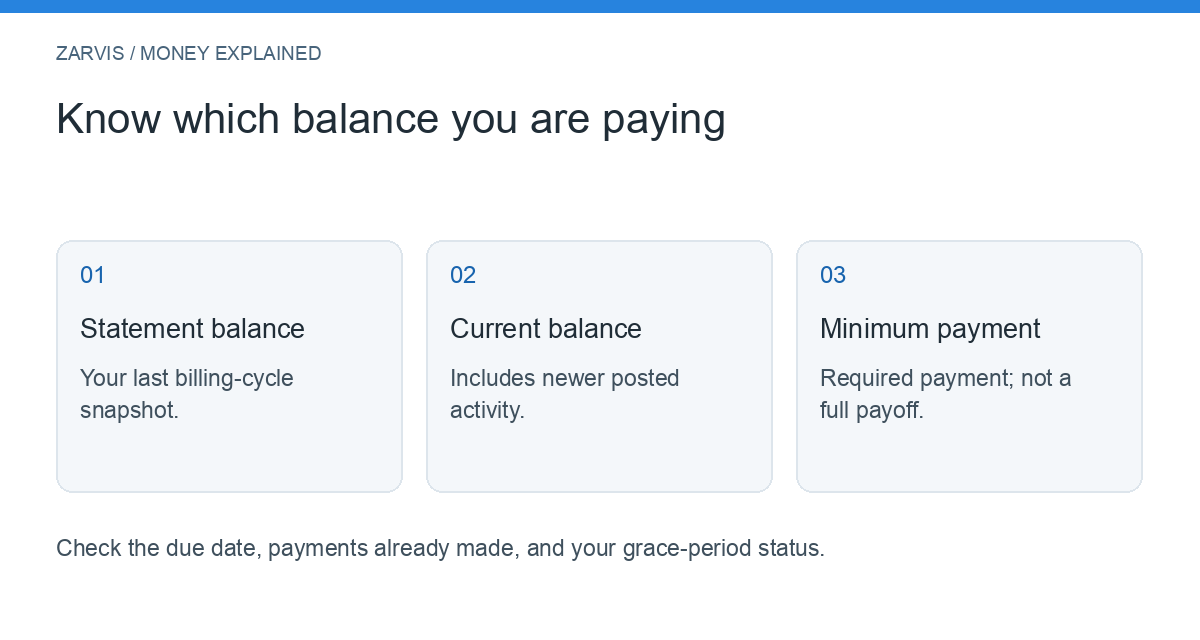
Read the minimum-payment warning on your own statement before using any generic example. Then distinguish the statement balance, current balance, and minimum payment. These figures are not interchangeable: satisfying the minimum does not mean you have paid off the statement or preserved a purchase grace period.
If even the minimum is unaffordable, review the questions in our credit card hardship plan guide before contacting your issuer. Ask how any offer affects interest, fees, account access, and credit reporting; availability and terms vary.
How the payoff comparison above was checked
The example starts with $5,000 at a constant 18% APR, uses a monthly rate of 18% ÷ 12, charges interest before the end-of-month payment, and assumes no new purchases, fees, or missed payments. Monthly interest is rounded to cents. The hypothetical minimum is interest plus 1% of the opening balance, subject to a $25 floor and capped at the amount owed.
The last payment is reduced to clear the balance. This produces 222, 62, and 32 payments for the three strategies shown. Actual cards may use daily interest, different rounding, and different minimum formulas.
Frequently Asked Questions
Is the minimum payment the same for every credit card?
No. Each issuer sets its own method in the cardmember agreement. Percentage of balance and interest-plus-a-percentage are common, and many agreements add a flat dollar floor. Check your own agreement and statement rather than assuming a standard formula applies.
Does paying the minimum hurt my credit score?
Paying at least the minimum on time keeps the account current, which supports your payment history. However, carrying a large balance can raise your credit utilization, which can weigh on scores. The CFPB explains both payment history and amounts owed matter, so “on time” and “low balance” solve different problems.
Why did my minimum payment change this month?
Because it is usually linked to your balance, interest, and fees. A higher balance, a purchase-heavy month, an interest charge, or an added fee can all raise it; a falling balance usually lowers it. A change in your APR can also change the interest portion of the calculation.
What if my balance is less than the flat minimum?
In general, you owe the full statement balance. Flat minimums such as a hypothetical $25 act as a floor for the calculation, not as permission to pay $25 toward a $15 balance.
Does paying the minimum stop interest?
No. Interest continues to accrue on the unpaid balance. On most cards, paying the full statement balance by the due date is what preserves the grace period on new purchases; paying only the minimum does not.
Bottom Line
A credit card minimum payment is calculated by a formula in your card agreement — commonly a percentage of the balance, or interest and fees plus a small percentage of the balance, with a flat dollar floor. It keeps your account current, and that matters for fees and payment history.
But it is one of the slowest and most expensive ways to repay a balance, because the payment shrinks as the balance shrinks. Whenever your budget allows, replace the shrinking minimum with a fixed payment you choose, and check your statement's minimum payment warning to see what that choice is worth in time and interest on your real numbers.
Editorial note: Zarvis provides general educational information, not personalized financial, legal, or tax advice. The rates, formulas, and dollar figures in the examples are clearly labelled hypothetical illustrations, not quotes, offers, or descriptions of any specific card. No payment strategy guarantees a credit score change or any particular outcome.
Verify your minimum payment formula, APR, fees, and due date directly in your own cardmember agreement and statement before you act.
Sources
- Consumer Financial Protection Bureau: Credit cards — key terms and minimum payment warnings. https://www.consumerfinance.gov/consumer-tools/credit-cards/
- Consumer Financial Protection Bureau: How do I get and keep a good credit score? https://www.consumerfinance.gov/ask-cfpb/how-do-i-get-and-keep-a-good-credit-score-en-318/
- Federal Trade Commission: Credit and debit cards — consumer advice. https://consumer.ftc.gov/articles/credit-debit-and-charge-cards
- myFICO: What is payment history? https://www.myfico.com/credit-education/credit-scores/payment-history

Pingback: Credit Card Annual Fees: When the Cost May or May Not Make Sense - Zarvis | US Personal Finance & Credit Guides
Pingback: Cash Advance Fees and Interest: Why They Can Get Expensive - Zarvis | US Personal Finance & Credit Guides
Pingback: Balance Transfer Credit Cards: Fees, Intro Periods and Payoff Math - Zarvis | US Personal Finance & Credit Guides
Pingback: Credit Utilization Calculator: Check Overall and Per-Card Usage — Proven Way to Stay Under 30% - Zarvis | US Personal Finance & Credit Guides