

Credit card interest is the price you pay for carrying a balance past its due date. Your issuer calculates it from your card’s APR using a daily rate and your average daily balance, which means interest accrues on what you owed, for each day you owed it — not in one monthly lump on the final balance.
Quick answer: Take the APR, divide it by 365 to get the daily periodic rate, and multiply that by your average daily balance and the number of days in the billing cycle. On an average daily balance of $1,250 with a 24% APR over a 30-day cycle, the credit card interest charge is $24.66. The worked example below shows every step.
Key Takeaways
- APR is a yearly rate, but credit card interest is charged daily using a daily periodic rate (APR ÷ 365).
- The average daily balance method rewards earlier and larger payments, because they lower the balance interest is charged on.
- A grace period lets you avoid interest on new purchases entirely if you pay the full statement balance by the due date.
- Cash advances usually have no grace period and often a higher APR, so their interest starts immediately.
- Carrying a balance does not help your credit scores, and you never need to pay interest to build credit.
Start With the APR
APR stands for annual percentage rate. For a credit card, the APR is the yearly interest rate applied to balances you carry. Card agreements express it as a yearly figure because disclosure rules require a standard measure, but no card waits a year to charge you. Interest accrues daily, from the day a balance becomes interest-bearing until the day it is paid off.
Many cards have several APRs at once: one for purchases, a usually higher one for cash advances, sometimes a penalty APR that can apply after a missed payment, and promotional APRs on balance transfers. Each balance segment can be charged at its own rate, and your payment may be applied between segments according to the rules in your cardholder agreement. When you use our credit card interest calculator, use the APR that matches the balance you are estimating.
APR also interacts with your credit utilization ratio: a high balance raises utilization and costs more interest at the same time, which is why paydown progress feels slow at first and faster later.
The Daily Periodic Rate
Issuers convert the APR into a daily periodic rate:
Daily periodic rate = APR ÷ 365
For a hypothetical 24% APR: 24% ÷ 365 = 0.06575% per day, or 0.0006575 as a decimal. That looks tiny, and per day it is. But it is applied to every dollar of average balance, every day of the cycle, and any interest you do not pay becomes part of the balance that later interest is charged on. Small daily rates on large, lingering balances are exactly how manageable debts become expensive ones.
The Average Daily Balance Method, Step by Step
Most issuers use the average daily balance method (sometimes called the average daily balance including new purchases). Here is a complete, hypothetical worked example.
Suppose a 30-day billing cycle, an APR of 24%, and this activity:
| Days | Daily balance | Days × balance |
|---|---|---|
| Days 1–15 (15 days) | $1,000 | $15,000 |
| Day 16: a $500 purchase posts | — | — |
| Days 16–30 (15 days) | $1,500 | $22,500 |
| Total | $37,500 |
Step 1 — Average daily balance: $37,500 ÷ 30 days = $1,250.
Step 2 — Daily periodic rate: 24% ÷ 365 = 0.0006575.
Step 3 — Interest for the cycle: $1,250 × 0.0006575 × 30 days = $24.66.
Two lessons hide in that arithmetic. First, the $500 purchase only cost interest for 15 days, not 30, because the method follows the balance day by day. Second, a payment works the same way in reverse: pay $500 on day 10 instead of day 28 and your average balance — and therefore your interest — drops for the remaining 20 days of the cycle. Timing is money, literally, with this method. You can model the longer-term effect of different payments with the credit card interest calculator.
Grace Periods: How Purchases Escape Interest
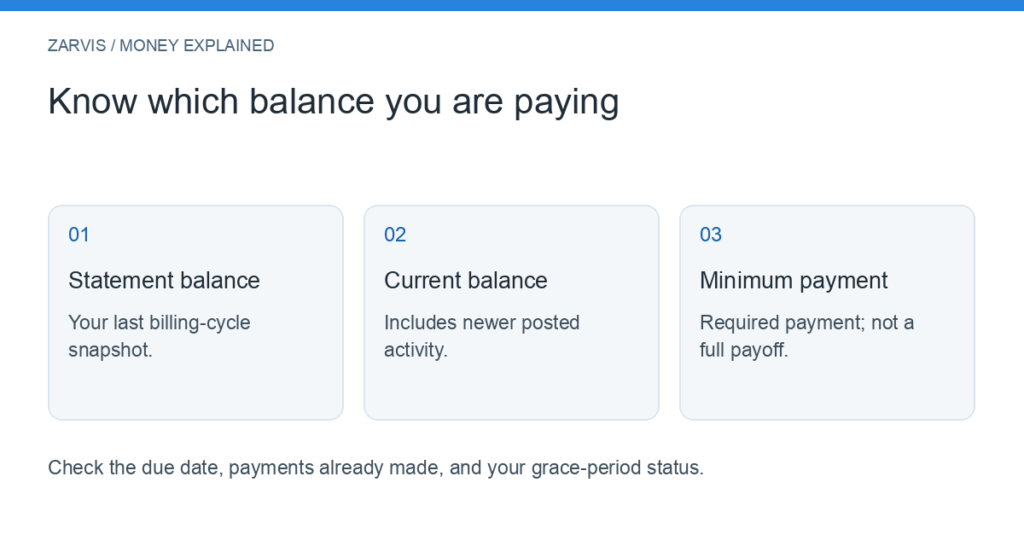
A grace period is the window that switches credit card interest off — commonly at least 21 days after the statement closes, under federal rules for issuers that offer one — during which you can pay the full statement balance and owe no interest on that cycle’s purchases. It is the reason a card paid in full every month can cost zero interest indefinitely: the APR is real, but it never gets applied.
The catch is that the grace period is normally conditional on paying in full. Carry even a small balance from one cycle to the next and new purchases may begin accruing interest from the day they post, until you restore a zero balance — sometimes for a cycle or two after paying in full, because of interest charged on the balance you carried during the final cycle (often called residual or trailing interest).
Not everything gets a grace period even when you pay in full. Cash advances typically start accruing interest immediately, at their own higher APR, and often carry a separate fee. Balance transfers follow the terms of the transfer offer. Check your cardholder agreement for which balances, if any, have a grace period.
Why Paying Only the Minimum Is So Expensive
Your minimum payment is designed to keep the account current, not to clear the debt quickly. A common formula is the month’s interest plus a small percentage of the balance, so as the balance falls, the minimum falls too — stretching the payoff over many years. Our minimum payment calculator shows the effect on a $3,000 balance at a 22% APR: paying only the minimum (interest plus 1% of the balance, with a $25 floor) takes about 180 months and about $4,433 in interest, while a fixed $150 payment clears the same balance in about 26 months with about $771 in interest. Same debt, same APR — the payment rule is the whole difference.
Common Misunderstandings
- “Credit card interest is charged on my statement balance once a month.” It is built up daily, from daily balances, as the worked example shows.
- “I should carry a small balance to build credit.” False. Paying in full still reports account activity, and interest paid buys no scoring benefit.
- “My APR is 24%, so $1,000 costs $240 a year, no matter what.” Only if the full $1,000 sat there for a full year. Pay it down and the cost falls with the balance — the same logic that raises the cost of loan fees in personal loan APR vs. interest rate.
- “A 0% promotion means the balance is free forever.” Promotions expire, and deferred-interest retail offers (different from 0% APR offers) can charge interest back to the purchase date if a balance remains. Read which type you have.
How to Pay Less Interest, Starting This Cycle
- Pay the full statement balance by the due date to keep — or regain — your grace period.
- If you are carrying a balance, switch from the minimum to a fixed payment you choose, and keep it fixed.
- Pay early in the cycle, or split the payment in two, to lower your average daily balance.
- Route new spending elsewhere while you repay, so purchases do not rebuild an interest-bearing balance.
- Ask your issuer whether a lower APR is available, and weigh any balance-transfer fee against the interest it would actually save.
How Credit Card Interest Works FAQ
When does interest start on a new purchase?
If you paid your previous statement balance in full, a grace period normally means no interest if you pay this statement in full by the due date. If you are carrying a balance, interest on new purchases usually starts on the day the purchase posts.
Why was I charged interest after paying my balance in full?
That is usually trailing (residual) credit card interest: interest that accrued between the statement date and the day your payment was received, on the balance you had been carrying. It typically appears on the next statement and stops once a full cycle passes at a zero balance.
Is credit card interest compounded?
Effectively, yes. Interest added to your balance becomes part of the balance used in later average daily balance calculations, so unpaid interest itself earns interest.
Do all issuers use the average daily balance method?
It is the most common method for purchases, but your cardholder agreement controls. It will name the method, the daily periodic rate, and which balances each APR applies to.
Does a lower APR or a higher payment help more?
For most balances, the payment you control helps immediately and compounds in your favour. Run both scenarios in the credit card interest calculator and compare the total interest figures.
Bottom Line
Credit card interest is daily rent on borrowed money: APR ÷ 365, charged on your average daily balance. Understand that one sentence and the rest follows — grace periods are valuable because they switch the rent off, minimum payments are costly because they keep the balance (and the rent) alive for years, and earlier, fixed, larger payments are the reliable way out.
Editorial note: Zarvis provides general educational information, not personalized financial, legal, or tax advice. Examples on this page are hypothetical and are not a quote, approval, or guaranteed rate or outcome. Your card’s APRs, grace period, and interest method are set by your cardholder agreement; verify them there and on your statement before acting.
Sources
- Consumer Financial Protection Bureau (consumerfinance.gov) — Ask CFPB explainers on credit card interest, grace periods, and how interest is calculated.
- Consumer Financial Protection Bureau (consumerfinance.gov) — consumer tools for comparing and understanding credit card terms.
- Federal Trade Commission (ftc.gov) — consumer guidance on credit cards, borrowing, and paying down debt.
- Federal Reserve (federalreserve.gov) — consumer information on credit card disclosures and terms.
Pingback: Minimum Payment Calculator: Best Way to See the Trap — $4,433 Interest Over 15 Years - Zarvis | US Personal Finance & Credit Guides
Pingback: Personal Loan APR: Best Guide — Why a 10% Loan Really Costs 13.56% - Zarvis | US Personal Finance & Credit Guides