A car loan preapproval can give you a financing reference before you visit a dealership: a potential loan amount, rate, and repayment term, subject to the lender’s conditions.
It is a comparison tool, not a reason to spend the maximum amount offered. The lender assesses whether it is willing to lend. You still need to decide whether the car and its full ownership costs fit your life.
The CFPB recommends considering preapproval and shopping around rather than judging a deal only by the monthly payment.
Start car loan preapproval with an ownership budget
Before applying, estimate the payment alongside insurance, fuel or charging, maintenance, registration, taxes, and parking. Keep a realistic amount available for repairs and other essential spending.
Then work backward to a purchase range and down payment. A lower monthly loan payment does not solve a budget problem if the insurance premium makes the car unaffordable.
Our auto loan calculator can help estimate principal-and-interest payments. Its output is not a complete cost-of-ownership quote or a lender approval.
Check the conditions on your car loan preapproval
Banks, credit unions, and other lenders may place conditions on the vehicle, transaction, and borrower. Ask for those conditions in writing.
| Check | Why it matters |
|---|---|
| Maximum loan amount | The amount approved may differ from your affordable budget |
| APR and term | These help compare financing on a similar basis |
| Offer expiration | The terms may not remain available indefinitely |
| Vehicle age and mileage | Some vehicles may not qualify |
| Dealer or private-party restrictions | The offer may apply only to certain purchases |
| Loan-to-value or down-payment requirements | You may need more cash than expected |
| Remaining verification | Income, identity, vehicle details, or other checks may still be required |
Ask whether the application involves a hard credit inquiry before authorizing it. Do not assume “preapproval” always means a soft check. See our credit inquiry guide if you are comparing application steps.
Compare the dealer’s offer against the same deal
A dealership may arrange financing that is worth considering. Compare it with your outside financing using the same vehicle price, down payment, amount financed, and repayment term.
Otherwise, a lower displayed payment may come from stretching the loan rather than improving its price.
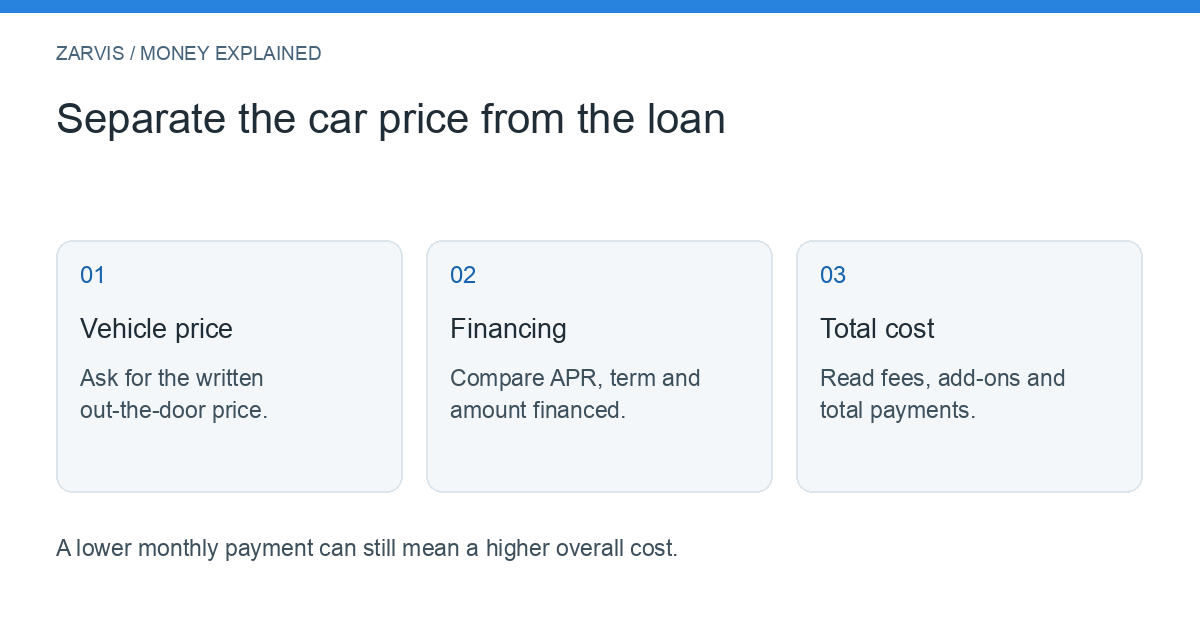
For a simple illustration, 60 payments of $400 total $24,000, while 72 payments of $350 total $25,200. The second payment is lower, but the scheduled payments total $1,200 more. This is arithmetic, not two real loan offers; fees, down payments, and financed amounts would also need to match for a fair comparison.
Our 72-month car loan guide explains the longer-term trade-off.
Keep the vehicle price separate from financing
Ask for a written out-the-door price showing taxes, fees, and any products added to the purchase. Then compare the financing.
If optional products such as a service contract or GAP coverage are offered, ask about their price, exclusions, cancellation terms, and whether they are being financed. Financing a product adds it to the amount on which you may pay interest.
Do not judge an add-on only by how few dollars it adds to the monthly payment. Ask for the total cost and whether you can buy suitable coverage elsewhere.
The CFPB’s auto-loan guide includes worksheets and questions for comparing the overall transaction.
Be careful with a trade-in that still has a loan
Get the current payoff amount and a realistic trade-in estimate. If the loan payoff exceeds the vehicle’s value, the difference is negative equity.
Rolling that difference into the next loan does not erase it. It increases the financing you need and can leave you owing more than the replacement vehicle is worth. The CFPB’s auto-loan key terms explain this risk.
If a salesperson says the old loan will be “paid off,” ask exactly where that amount appears in the new transaction.
Keep the car loan preapproval and the vehicle price quote together. If the vehicle or deal changes, confirm that the lender’s original conditions still apply before treating the offer as available.
Recheck the final contract
Before signing, compare the final amount financed, APR, term, payment schedule, down payment, and add-ons against the offer you intended to accept.
Confirm whether financing is final or still conditional, and ask what happens if a condition is not satisfied. Do not rely on a verbal statement that contradicts the paperwork.
For used vehicles, also review our used-car loan rates guide for the factors that can affect financing. No preapproval replaces a careful review of the vehicle itself.
The point of preapproval is to arrive with options and a comparison baseline. It should make it easier to walk away from a deal that does not work—not harder.
This article provides general US financial education. It does not recommend a particular lender, vehicle, or borrowing amount.
Before taking a preapproval to the dealership
Can every vehicle qualify for the same loan?
Not necessarily. A lender can restrict vehicle age, mileage, seller type, or the amount it will finance relative to the vehicle’s value. Read those restrictions before committing to a car. The specific vehicle and purchase documents may still need approval even when the lender has already reviewed your income and credit.
What should I do if the dealer offers another loan?
Compare the written terms against the outside offer. Use the same down payment, amount financed, and repayment term wherever possible. Check fees and optional add-ons separately so a change in the purchase package does not look like an improvement in financing. You can evaluate an alternative without assuming it is better merely because the payment is lower.
Does preapproval tell me what I can afford?
It tells you what the lender may be willing to finance, subject to conditions. Your own budget must also cover insurance, registration, fuel, maintenance, and other obligations. Leave room for costs that do not arrive every month. Borrowing up to an offered limit is not automatically a comfortable household decision.
What should I confirm before signing?
Check the vehicle details, sale price, down payment, APR, term, amount financed, and total of payments. Ask whether financing is final or still conditional. Read any cancellation or return terms rather than assuming there is a general right to change your mind after taking the car. Keep copies of the completed documents.