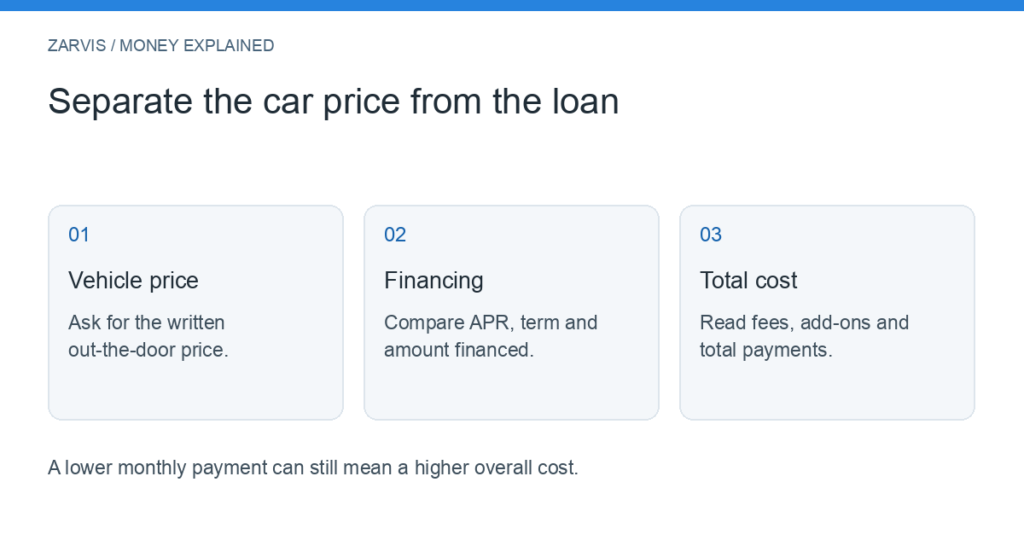
Car loan rates for used cars are usually higher than rates for new cars on the same borrower and term, because lenders view an older vehicle as less predictable collateral. The size of that difference is not fixed. It depends on your credit profile, the car’s age and mileage, how much you borrow relative to the car’s value, and how long you take to repay.
A higher rate does not automatically make a used car a worse deal. Used cars normally cost less, so the amount borrowed is smaller — and total interest is driven by both the rate and the loan size. This guide explains the factors that set the rate on a used-car loan and shows the total-cost math on clearly labelled hypothetical examples, not current market rates, which vary by credit profile, term, vehicle age, and lender.
Quick Answer
- Expect a used-car loan to be priced above a comparable new-car loan, all else equal, and expect older, higher-mileage cars to be priced higher still — or to fall outside a lender’s age and mileage limits entirely.
- The cheapest used-car loan is usually a moderate amount, borrowed for a moderate term, against a car new enough to stay within mainstream lender programs.
- Always compare APR plus total interest on the same amount and term. Use our auto loan calculator before you visit a dealer.
Key Takeaways
- Vehicle age and mileage affect both your rate and whether a lender will finance the car at all.
- A shorter term usually lowers both the rate offered and the total interest paid, at the cost of a higher monthly payment.
- Borrowing less — through a down payment or a cheaper car — can save more than a small rate improvement.
- Private-party purchases may be financed differently from dealer purchases, and some lenders charge more or require extra steps for them.
Why Used Cars Are Priced Differently
Our pillar guide to car loan rates explains the general pricing logic: the rate pays for the lender’s risk on you and on the collateral. With a used car, the collateral side carries extra uncertainty:
- Value is harder to pin down. Two cars of the same model and year can differ widely in condition, accident history, and maintenance.
- Remaining life is shorter. A loan that ends when the car is twelve years old is secured by a car that may need major repairs, and a borrower facing a large repair bill on a car they still owe money on is more likely to default.
- Resale is less certain. If the lender must repossess and sell the car, an older vehicle returns less and sells less predictably than a newer one.
Lenders manage that risk with some combination of higher rates, shorter maximum terms, age and mileage caps, and lower maximum loan-to-value ratios for older vehicles.
Factors That Set the Rate on Your Used-Car Loan
Your credit profile
As with any auto loan, your credit reports, scores, income, and existing debts are usually the biggest influence. A strong profile can offset some of the used-car premium; a weak profile compounds it.
Vehicle age and mileage
Many lenders tier their pricing: a two-year-old car with low mileage may price close to a new car, while a nine-year-old car with high mileage may price several points higher, be limited to a shorter term, or be ineligible. Ask about age and mileage limits before you fall in love with a specific car — the cheapest car on the lot may be the hardest to finance on good terms.
Loan term
Used-car terms are often shorter than new-car terms, partly because lenders do not want the loan to outlast the car. Stretching a used-car loan to 72 months is possible with some lenders, but it combines a higher used-car rate with a long repayment period — the most expensive combination, and one we examine in our guide to 72-month car loans.
Amount borrowed and loan-to-value
Taxes, fees, and add-ons can push the amount financed above the car’s price. If you owe more than the car is worth from day one, the lender’s risk rises and so may your rate. A down payment that at least covers taxes and fees keeps the loan closer to the car’s value.
Where you buy and where you borrow
Dealer purchases are the standard case for most lenders; private-party loans exist but may involve extra verification of title and value. Banks and credit unions often publish separate used-car tiers by model year. Certified pre-owned programs sometimes offer promotional rates that narrow the new-versus-used gap, but on cars priced higher than comparable non-certified cars — so compare total cost, not just APR.
Worked Example: Term Changes the Total Cost
Assume a hypothetical $20,000 used-car loan at a hypothetical 9% APR. Only the term changes. These figures are illustrations, not market quotes.
| Term | Monthly payment | Total of payments | Total interest |
|---|---|---|---|
| 36 months | $635.99 | $22,895.81 | $2,895.81 |
| 48 months | $497.70 | $23,889.64 | $3,889.64 |
| 60 months | $415.17 | $24,910.03 | $4,910.03 |
| 72 months | $360.51 | $25,956.77 | $5,956.77 |
Read the table carefully. Moving from 36 to 72 months cuts the payment by $275.48 a month — a real difference in a tight budget — but adds $3,060.96 in interest and keeps you paying until the car is six years older. The 48- and 60-month rows are the middle path many buyers choose, balancing a manageable payment against interest that does not balloon.
Now consider loan size on a used-car loan. At the same hypothetical 9% APR for 48 months, borrowing $15,000 instead of $20,000 costs $373.28 per month and $2,917.23 in interest — saving $972.41 in interest compared with the $20,000 loan, before any rate improvement a larger down payment might also produce. Choosing a slightly cheaper car or saving a little longer for the down payment is often worth more than negotiating a fraction of a point off the rate.
How to Get a Better Used-Car Rate
- Get preapproved before you shop. A bank or credit union preapproval tells you the rate tier you qualify for, the maximum age and mileage the lender allows, and a firm budget. It also gives you a benchmark to ask a dealer to beat.
- Choose the car to fit the loan, not the reverse. A slightly newer, lower-mileage car can qualify for a better tier and a longer allowed term, which may make its total cost competitive with an older car financed at a higher rate.
- Keep the term as short as your budget safely allows. Do not choose a payment you cannot sustain — a missed payment costs more than interest — but avoid defaulting to the longest term offered.
- Cover taxes and fees in cash where you can, so the amount financed stays close to the car’s value.
- Check your credit reports in advance and dispute errors. The Consumer Financial Protection Bureau provides guidance on reviewing your reports and on shopping for auto loans within a short window.
- Compare at least two offers on identical terms, and get the APR, term, amount financed, and total interest in writing.
Repair Risk Is Part of the True Cost
The payment on a used-car loan is not the whole cost of the car. An older vehicle may need tires, brakes, or major repairs during the loan term, while you are still making payments. When you compare a used car at a higher rate with a new car at a lower rate, include a realistic repair reserve for the used car and check whether any warranty remains. The loan should end well before the car’s reliable life does.
Used-Car Loan Rates FAQ
Why is my used-car rate higher than the rate I was quoted for a new car?
The lender is pricing the collateral as well as you. An older car has a less predictable value and a shorter remaining life, and it does not qualify for the manufacturer promotions that sometimes lower new-car rates. Our car loan rates guide explains both sides of the comparison.
Is there a maximum age or mileage for a used-car loan?
Many lenders set one, but the limits vary by lender and program. Some will not finance cars older than a set age or above a set mileage, or will only offer short terms on them. Ask your lender for its limits during preapproval, before you choose a specific car.
Should I finance a used car for 72 months to get a lower payment?
Usually it is the most expensive option: a used-car rate applied over six years produces high total interest, and the car ages six more years while you pay. It can still be the right choice for cash-flow reasons in some budgets, but compare it against 48- and 60-month totals first.
Can I refinance a used-car loan later?
Yes, if your credit improves, your balance falls relative to the car’s value, and a lender offers a lower APR on a term that does not stretch your repayment too far. See our guide to auto loan refinance for the break-even math and the fees to check.
Is a credit union or bank better for used-car loans?
Neither is automatically better. Credit unions often publish competitive used-car tiers and bank relationship offers vary. The only reliable method is to collect two or more real quotes for the same car, amount, and term, and compare APR and total interest.
Bottom Line
Used-car loan rates are higher because the collateral is riskier, but the used car itself usually costs less — so judge the deal on total interest and total cost, not on the rate alone. Pick a car that fits mainstream lender age and mileage tiers, borrow no more than you need, keep the term moderate, and verify every real rate and fee with the lender before you sign. Test your figures first in our auto loan calculator.
Editorial note: Zarvis provides general educational information only, not personalized financial, legal, or tax advice. All rates in this article are hypothetical examples used to explain loan math; they are not current market rates, quotes, or predictions, and no loan approval, rate, or term is guaranteed. Rates, fees, lender vehicle limits, and eligibility rules change, so always verify important details directly with the relevant lender or financial institution before making a decision.
Sources
- Consumer Financial Protection Bureau: Auto loans — consumer tools and guidance on shopping for a loan, comparing APR and term, and understanding total cost. https://www.consumerfinance.gov/consumer-tools/auto-loans/
- Federal Trade Commission: Consumer advice on buying a used car, dealer financing, and reviewing contract terms. https://www.ftc.gov/
- Federal Reserve: Consumer Credit (G.19) statistical release. https://www.federalreserve.gov/releases/g19/