

A 72 month car loan is an auto loan repaid over six years. It lowers the monthly payment by spreading the same debt over twelve more payments than a 60-month loan — but it does not make the car cheaper. At the same interest rate, a 72-month loan always costs more in total interest, keeps you in debt a year longer, and leaves you owing more than the car is worth for a longer stretch of the loan.
That does not mean a 72 month car loan is never the right choice. It means the choice should be made on total cost, not on the payment a dealer chooses to show you. This guide uses clearly labelled hypothetical examples — not current market rates, which vary by credit profile, term, vehicle age, and lender. Rates on longer terms are also often higher, which makes the real-world gap larger than the same-rate examples below.
Quick Answer
On a hypothetical $35,000 loan at a hypothetical 7% APR:
- 60 months: $693.04 per month, $6,582.52 in total interest.
- 72 months: $596.72 per month, $7,963.50 in total interest.
- The 72 month car loan lowers the payment by $96.32 a month but costs $1,380.98 more in interest — and that is before any rate increase for the longer term.
Key Takeaways
- A lower payment from a longer term is borrowed time, not a discount. You pay for it with extra interest and an extra year of debt.
- Long terms increase negative-equity risk: your balance falls slowly while the car’s value falls quickly.
- If the only way a car fits your budget is a 72 month car loan, the safer fix is usually a cheaper car or a larger down payment, not a longer loan.
- Compare any offer on APR, term, and total interest using our auto loan calculator.
How the Math Works
A car loan payment uses the standard amortization formula: each month, interest is charged on the remaining balance, and the rest of the payment reduces principal. Early on, most of each payment is interest, because the balance is at its highest. With a 72 month car loan, you stretch the same balance over more months and each payment is smaller, so the principal falls more slowly — and a balance that falls slowly generates more interest, month after month. That is the whole mechanism behind the higher cost. Our pillar guide to car loan rates explains how the rate itself is set.
Worked Example: 60 Months vs. 72 Months
Assume a hypothetical $35,000 loan at a hypothetical 7% APR in both cases, with no fees. Only the term changes.
| Term | Monthly payment | Total of payments | Total interest |
|---|---|---|---|
| 60 months | $693.04 | $41,582.52 | $6,582.52 |
| 72 months | $596.72 | $42,963.50 | $7,963.50 |
| Difference | $96.32 less per month | $1,380.98 more overall | $1,380.98 more |
Three observations from the table:
- The payment relief is modest compared with the extra cost. Saving $96.32 a month sounds meaningful, but you pay it for twelve extra months at the end — $596.72 a month for a full extra year, long after a 60-month borrower is payment-free.
- The real comparison is year six. In months 61 to 72, the 60-month borrower pays nothing and can save or invest the former payment, handle repairs, or build a down payment for the next car. The 72-month borrower is still paying.
- A higher rate widens the gap. In these examples the rate is held at 7% to isolate the effect of the term. If a lender charges even slightly more for the 72-month term, as many do, the extra interest grows beyond $1,380.98.
Try the same comparison with your own figures in the auto loan calculator. Enter the price, down payment, tax, APR, and term for a real car you are considering, then change only the term and watch the total interest.
The Negative Equity Problem
Cars lose value fastest in the first few years, while loan balances on long terms fall slowly. When the balance is higher than the car’s value, you have negative equity — being upside down. It matters most at the worst moments:
- If the car is stolen or written off, an insurance payout based on its value may not cover the balance, leaving you paying for a car you no longer have unless you bought gap coverage.
- If you need to sell or trade in, you must pay the difference in cash or roll it into the next loan, which starts that loan upside down as well — a cycle that is hard to exit.
On a 72 month car loan, the point where the balance finally falls below the car’s value typically arrives much later than on a 48- or 60-month loan — later still on a used car, as our guide to used-car loan rates explains. A larger down payment is the simplest protection: it starts the balance lower and shortens the underwater period.
When a 72 Month Car Loan Might Still Make Sense
A long term is a tool, and there are situations where using it deliberately can be reasonable:
- The rate is genuinely low and equal to the 60-month rate, and you actually save or invest the monthly difference with discipline. Spending the difference removes the argument.
- Cash-flow stability matters more than total cost. A borrower with reliable but tight income may prefer a required payment well below their maximum, then make extra principal payments in good months. This only works if there is no prepayment penalty — confirm it in writing — and if the extra payments actually happen.
- You keep cars well beyond the loan. If you drive a car for ten years, a six-year loan still leaves years of payment-free ownership. Trading in every three or four years on a six-year loan, by contrast, almost guarantees rolling negative equity into each new deal.
Notice what is not on this list: using a 72-month term to afford a more expensive car than your budget otherwise allows. That converts a payment problem into a total-cost and negative-equity problem, on a larger balance.
Alternatives to a 72-Month Term
Before accepting a 72 month car loan and six years of payments, price these options on the same car, and on a slightly cheaper one:
- A 60-month loan on a car priced a few thousand dollars less. Compare total interest, not just the badge or trim level.
- A larger down payment. Saving a few months longer reduces the amount borrowed and the underwater period on any term.
- A 48-month loan on a used car instead of a 72-month loan on a new one. The payment may be similar; the total cost and time in debt are very different.
If you already have a long loan, you are not stuck with its original cost. Extra principal payments shorten it directly, and auto loan refinance into a shorter term at a lower APR can cut total interest further, provided the fees do not eat the saving. The same term-versus-total-interest trade-off applies to home loans, as our mortgage payment calculator shows over decades instead of years.
Questions to Ask Before You Sign
- What APR would I get at 60 months from the same lender, and what is the total interest at each length?
- Is there a prepayment penalty if I pay extra or pay the loan off early?
- How much will I still owe after three years, and what is a car like this typically worth then?
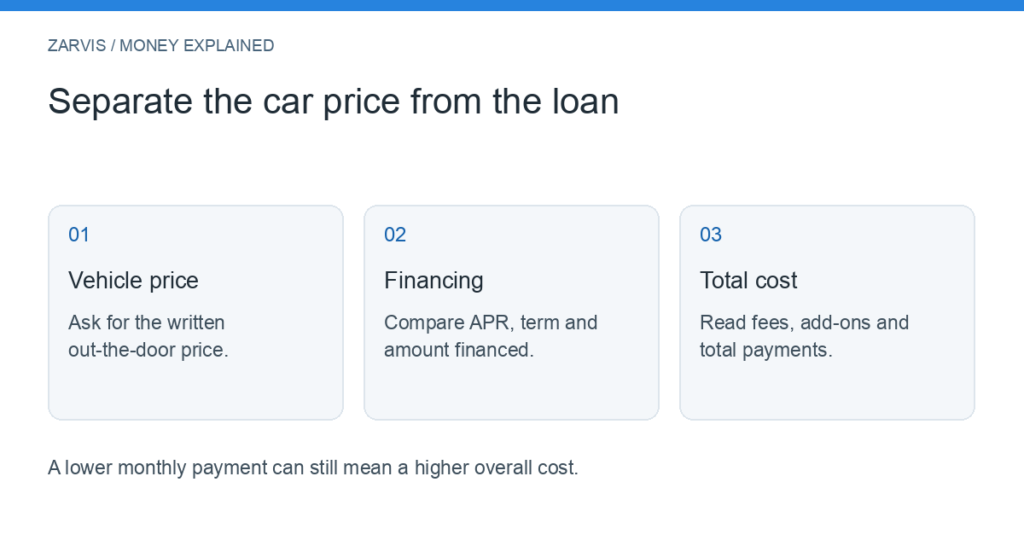
A seller who will only discuss the monthly payment is answering the question that helps them, not you. The Consumer Financial Protection Bureau advises buyers to negotiate the price, the APR, and the term as separate items and to compare total cost — advice that matters most exactly when a long term is on the table.
72-Month Car Loan FAQ
Is a 72 month car loan a bad idea?
Not automatically, but it is the more expensive way to borrow the same amount, and it carries more negative-equity risk. It is a poor fit for buyers who trade cars frequently or who need the long term to make an expensive car appear affordable. It is a more reasonable fit for a disciplined buyer with a low rate who keeps cars for many years.
How much more interest does a 72-month loan cost?
On our hypothetical $35,000 loan at 7% APR, $1,380.98 more than the 60-month loan. Your figure depends on the amount, rate, and any rate difference between terms; larger balances and higher rates make the gap bigger. Run your own numbers in the auto loan calculator.
Can I pay off a 72-month loan early?
Usually yes, and paying extra principal is one of the best ways to keep the low required payment of a long loan while cutting its total interest. First confirm your contract has no prepayment penalty, and tell the lender in writing that extra amounts go to principal, not to future payments.
Why do dealers promote 72-month and longer loans?
A longer term produces a lower payment for the same car, which makes a more expensive car or more add-ons fit a buyer’s monthly budget. The dealer’s job is to sell the car; yours is to price the loan. Compare total interest before agreeing.
Is a 72-month loan worse on a used car than a new car?
Generally yes. The rate is usually higher on a used car, the car will be six years older when the loan ends, and repair costs are more likely during the term. The combination of a higher rate and a long term produces the highest total cost and the longest period owing more than the car may be worth.
Bottom Line
A 72 month car loan trades a lower payment — $96.32 a month less in our example — for $1,380.98 more interest, an extra year of debt, and a longer stretch owing more than the car is worth. Sometimes that trade is worth making deliberately; it should never be made by default, or to stretch into a car your budget does not otherwise fit. Compare terms on total interest and verify every real rate, fee, and term with the lender before you sign.
Editorial note: Zarvis provides general educational information only, not personalized financial, legal, or tax advice. All rates in this article are hypothetical examples chosen to illustrate loan math; they are not current market rates, quotes, or predictions, and no loan approval, rate, or term is guaranteed. Rates, fees, and eligibility rules change, so always verify important details directly with the relevant lender or financial institution before making a decision.
Sources
- Consumer Financial Protection Bureau: Auto loans — consumer tools and guidance on negotiating price, APR, and term separately and comparing total cost. https://www.consumerfinance.gov/consumer-tools/auto-loans/
- Federal Reserve: Consumer Credit (G.19) statistical release. https://www.federalreserve.gov/releases/g19/
- Federal Trade Commission: Consumer advice on vehicle financing, dealer contracts, and add-on products. https://www.ftc.gov/

Pingback: Auto Loan Calculator: Best Way to Estimate Your Payment — a $24,800 Loan at $491.07 a Month - Zarvis | US Personal Finance & Credit Guides
Pingback: Car Loan Rates: Best Guide — Why a Used Car at 9% Costs $2,566 More Than a New Car at 6% - Zarvis | US Personal Finance & Credit Guides