

An emergency fund is money set aside in an accessible, insured account to cover essential expenses if your income stops or a large, unexpected bill arrives. It is not an investment and it is not a holiday fund. Its job is to buy you time — to pay rent, buy food, and keep minimum payments current while you fix the underlying problem, without high-interest borrowing.
Quick answer: A common starting target is three to six months of essential expenses — not three to six months of your salary, and not three to six months of your full spending. If your essential spending is $2,850 a month, a three-month fund is $8,550 and a six-month fund is $17,100. Use the Emergency Fund Calculator to set your own figure from your actual expenses.
Key Takeaways
- Size your fund from essential expenses — housing, utilities, food, transport, insurance, and minimum debt payments — not from your total income.
- Three months of essentials is a reasonable first milestone for many households; six months or more suits single incomes, variable earnings, and specialised jobs.
- Keep the money separate from everyday spending, in an insured account you can reach within a few days, such as a high-yield savings account.
- Build it in stages: a small starter buffer first, then one month, then your full target. A partial fund still helps.
- Rebuild after you use it, and review the target whenever your rent, income, or household changes.
What Counts as an Emergency?
An emergency is an expense that is urgent, necessary, and hard to predict. A job loss, a car repair you need to get to work, an urgent medical bill, or a broken water heater in winter can all qualify.
Predictable costs are not emergencies, even if they feel large. Annual insurance premiums, holiday spending, and routine car servicing are known costs — give those their own sinking funds. A fund that pays for everything is empty when a real crisis arrives.
How Much Emergency Fund Do You Need?
There is no single correct number. The right target depends mainly on how quickly you could replace lost income and how stable that income is.
Start With Essential Monthly Expenses
List what you would still have to pay in a month with no income:
| Essential expense | Example monthly cost |
|---|---|
| Rent or mortgage payment | $1,500 |
| Utilities and phone | $220 |
| Groceries | $450 |
| Transport (fuel, transit, car insurance) | $330 |
| Health and other insurance premiums | $200 |
| Minimum debt payments | $150 |
| Total essential expenses | $2,850 |
Leave out subscriptions, eating out, holidays, and other spending you could pause quickly. Those cuts are painful, but in a real emergency you would make them — so they do not need to be funded in advance.
Minimum debt payments stay in the list: missing them can damage your credit record and add late fees. See Zarvis’s guide to the credit utilization ratio for how balances and limits interact with your credit profile.
Choose Your Number of Months
| Your situation | Suggested coverage |
|---|---|
| Dual income, stable jobs, low fixed costs | About 3 months |
| Single income or a household with dependants | About 6 months |
| Self-employed, commission-based, or seasonal income | 6–9 months |
| Highly specialised role or a slow hiring market in your field | 6–12 months |
Treat these as guideposts, not rules. The Consumer Financial Protection Bureau (CFPB) encourages building an emergency fund as a basic protection against financial shocks, and even a small reserve can help cover a modest unexpected expense. The question is not whether your fund matches an ideal figure — it is whether it covers the gap between a shock and your next reliable income.
Worked Example
Suppose your essential expenses match the table above: $2,850 a month.
- Three-month target: $2,850 × 3 = $8,550
- Six-month target: $2,850 × 6 = $17,100
- You already have $2,100 saved. Your gap to a six-month fund is $17,100 − $2,100 = $15,000
- To close that gap in 18 months: $15,000 ÷ 18 = $833.33 a month
If $833 a month is not realistic, extend the timeline rather than abandoning the plan: $15,000 ÷ 24 months = $625 a month, and $15,000 ÷ 30 months = $500 a month. The target stays the same; only the pace changes. The Emergency Fund Calculator runs these numbers for 3, 6, 9, or 12 months of coverage against your own expenses.
Where to Keep an Emergency Fund
The fund needs three qualities, in this order: safety, access, and only then yield.
Safety
Keep the money in a deposit account at an FDIC-insured bank or a federally insured credit union. The FDIC generally insures eligible bank deposits up to $250,000 per depositor, per insured bank, for each ownership category; credit unions have similar cover through the NCUA. Do not invest the fund in stocks, funds, or crypto assets — their value can fall at exactly the moment you need the money.
Access
You should be able to reach the money within a few days without a penalty. A savings account separate from your everyday checking is a useful compromise: close enough to transfer in an emergency, separate enough that you do not spend it by accident. Keep a small buffer in checking for same-day problems, because external transfers can take several business days.
Yield
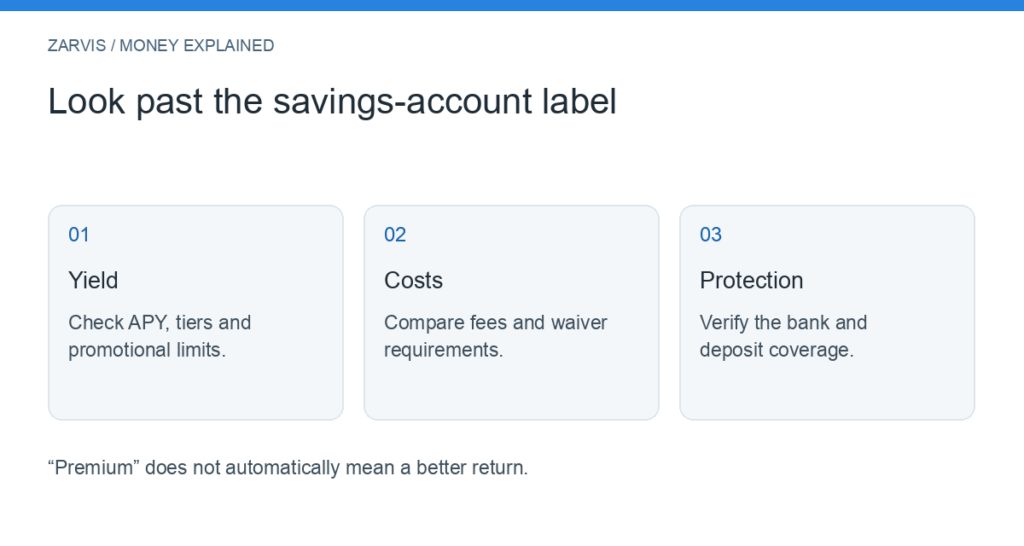
Once safety and access are covered, a competitive yield is a sensible bonus. Savings rates are usually variable, so compare accounts by method rather than by today’s headline number. Zarvis’s guide to how to compare high-yield savings accounts in 2026 walks through APY tiers, fees, and conditions, and the site’s general explainer on high-yield savings accounts covers how APY and federal insurance work.
Avoid locking an emergency fund into a certificate of deposit or any account with an early-withdrawal penalty. Money you might need next month should never carry a fee for being needed.
How to Build Your Fund, Step by Step
- Set a starter target. Aim first for a small buffer — for example $1,000 or two weeks of essentials.
- Open a separate account. Separation is the point. If the money sits in your checking account, it will be spent.
- Automate a transfer on payday. Move money the day income arrives, not at month end with whatever is left. Even $50 or $100 per payday builds the habit and the balance.
- Direct windfalls deliberately. Tax refunds, bonuses, and income from selling unused items can close the gap faster than monthly saving alone.
- Reach one month, then reassess. Then continue toward your chosen target.
- Sequence it with debt. If you carry high-interest debt, a common approach is: starter buffer first, then attack the expensive debt, then finish the fund.
- Review once or twice a year. Recalculate the target when your essentials change.
Common Mistakes to Avoid
Saving a Percentage of Salary Instead of Expenses
Rules like “save six months of salary” overshoot for high earners with modest costs and undershoot for households whose essentials are close to their income. Expenses are what the fund must pay, so expenses are the correct base.
Keeping the Fund Too Accessible — or Not Accessible Enough
Money in your everyday account gets spent; money in an account that takes a week and a penalty to reach is not emergency money. A separate savings account with a transfer time of a few days is the middle ground most households need.
Treating the Fund as Finished Forever
After you use the fund, rebuilding it becomes the first savings priority again. After your life changes, the target changes too. A fund sized for a single renter will not fit a homeowner with dependants.
Emergency Fund FAQ
Is three months of expenses really enough?
For a dual-income household with stable jobs and low fixed costs, three months is a reasonable target. It is a starting framework, not a guarantee. Households with one income, variable earnings, or higher risks usually need more, which is why six months is the more common recommendation for them.
Should I build an emergency fund before paying off credit card debt?
Usually a small starter fund comes first, because without any buffer the next surprise goes straight back onto the card. After that buffer, paying down high-interest debt often takes priority, and then you return to building the full fund. The exact order depends on your interest rates and job security.
Can I keep my emergency fund in a checking account?
You can, but separation helps. A checking account makes the money easy to spend accidentally, and many checking accounts pay little or no interest. A separate insured savings account keeps the fund visible, distinct, and slightly harder to touch for everyday spending.
Does emergency fund interest get taxed?
Generally, yes. Interest earned on savings is usually taxable income for federal purposes, and the Internal Revenue Service (IRS) states that reportable interest must generally be included on your tax return even if you do not receive a Form 1099-INT. State treatment varies.
What if I can only save a tiny amount each month?
Save it anyway. $25 a week is about $1,300 a year, and a small fund still prevents the most common outcome of a shock: high-interest borrowing. Increase the amount when income rises or an expense ends, rather than waiting for a perfect month that may never come.
Bottom Line
An emergency fund is measured in months of essential expenses, not months of salary. Add up what you must pay each month, choose three to six months of cover based on your income stability — more if your earnings vary — keep the money insured, separate, and reachable within a few days, and build it in stages. Start with the calculator and automate the first transfer on your next payday.
Editorial note: Zarvis provides general educational information, not personalized financial, legal, tax, or credit-repair advice. Account terms, rates, insurance rules, and tax treatment can change, so always verify important details directly with the relevant bank, credit union, or tax authority before you act.
Sources
- Federal Deposit Insurance Corporation (FDIC), deposit insurance guidance: https://www.fdic.gov/resources/consumers/deposit-insurance/
- National Credit Union Administration (NCUA), share insurance coverage: https://ncua.gov/consumers/share-insurance-coverage
- Consumer Financial Protection Bureau (CFPB), building an emergency fund: https://www.consumerfinance.gov/an-essential-guide-to-building-an-emergency-fund/
- Internal Revenue Service (IRS), interest income (Topic No. 403): https://www.irs.gov/taxtopics/tc403

Pingback: Emergency Fund Calculator: Best Way to Set Your Target — a $17,100 Goal at $625 a Month - Zarvis | US Personal Finance & Credit Guides
Pingback: Best High-Yield Savings Account: How to Compare — a 4.00% Headline That Pays 2.50% - Zarvis | US Personal Finance & Credit Guides
Pingback: Checking Account Bonus: Best Way to Keep $136 of a $200 Bonus After Tax and Fees - Zarvis | US Personal Finance & Credit Guides
Pingback: How High-Yield Savings Accounts Work: APY, Fees & Safety
Pingback: Budget With Irregular Income: 6 Helpful Steps
Pingback: Free Checking Account: Best Guide — the 'Free' Account That Costs $198 a Year - Zarvis | US Personal Finance & Credit Guides