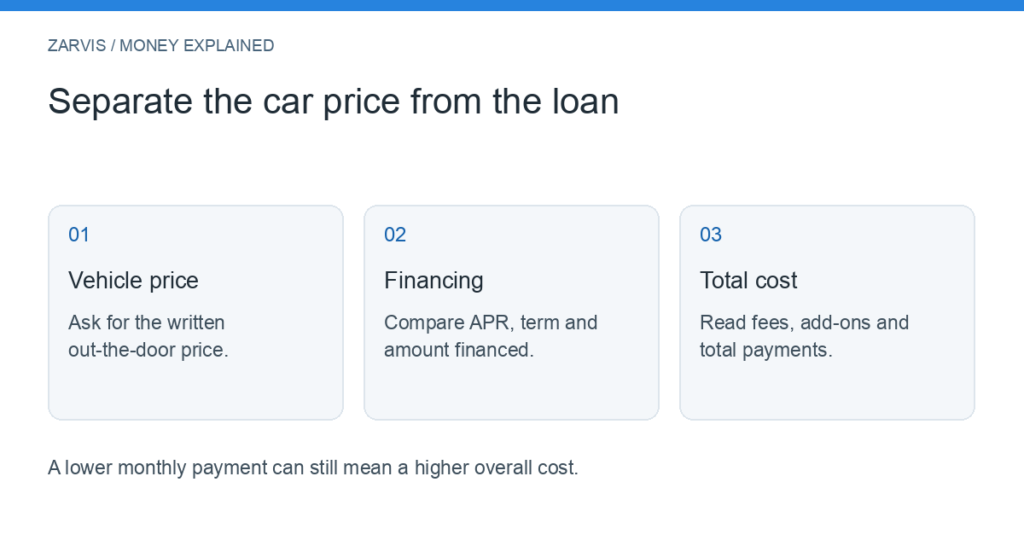
Auto loan refinance means replacing your current car loan with a new loan, usually from a different lender, that pays off the old balance. The new loan has its own rate, term, and fees. Refinancing can help when it lowers your interest rate enough to reduce total cost, or when you need a lower payment to keep the loan affordable — but those are two different goals, and a lower payment alone does not mean you saved money.
People choose an auto loan refinance for three common reasons: their credit has improved, lender pricing has changed, or the original loan was expensive — for example, dealer-arranged financing accepted under time pressure. The math below uses clearly labelled hypothetical examples only, not current market rates, which vary by credit profile, term, vehicle age, balance, and lender.
Quick Answer
- Refinance helps most when the new APR is meaningfully lower and the new term is no longer than the time left on your old loan.
- An auto loan refinance that stretches the term can lower the payment while increasing total interest — sometimes above what your old loan would have cost.
- Add up all fees first. If the fees are close to the interest you save, the refinance is not worth it.
- Run the break-even math before you apply, using our auto loan calculator.
Key Takeaways
- Compare total interest remaining on your current loan with total interest plus fees on the new loan.
- Never judge an auto loan refinance by the monthly payment alone.
- Check your current loan for a prepayment penalty, and the new loan for origination or title fees.
- If you owe more than the car is worth, refinancing may be difficult or require a cash payment to close the gap.
How Auto Loan Refinance Works
The process is similar to getting your first auto loan:
- Check your current position. Note your remaining balance, APR, payment, months left, and whether the loan has a prepayment penalty. Your payoff amount may differ slightly from the balance shown online because interest accrues daily.
- Check the car’s value. Lenders limit how much they will lend against a vehicle’s value. If you are “upside down” — owing more than the car is worth — a lender may decline, approve a smaller amount, or require you to pay the difference in cash.
- Apply and compare on the same term. Banks, credit unions, and online lenders offer auto loan refinance loans. Ask each for APR, term, fees, and total interest so you can compare like with like.
- Close and confirm the payoff. The new lender pays off the old loan and the lien is transferred. Confirm in writing that the old loan is closed, and do not stop paying it until that confirmation arrives — a missed payment during the switch can damage your credit.
If you are still deciding whether a refinance makes sense at all, first review how rates are set in our pillar guide to car loan rates. An auto loan refinance only changes your price; it does not change the factors lenders use to set it.
Worked Example: A Refinance That Saves Money
Assume you have $25,000 remaining on a loan at a hypothetical 10% APR, with 48 months left. A lender offers a refinance at a hypothetical 7% APR for 48 months — the same remaining term. These rates are illustrations, not market quotes.
| Loan | Hypothetical APR | Term | Monthly payment | Total interest |
|---|---|---|---|---|
| Current loan (remaining) | 10% | 48 months | $634.06 | $5,435.10 |
| Refinanced loan | 7% | 48 months | $598.66 | $3,735.49 |
- Monthly payment falls by $35.40.
- Total interest falls by $1,699.61.
Now subtract the costs. If the auto loan refinance charged, for example, $200 in combined application, title, and lien fees, the net saving would be about $1,499.61. If the fees were $1,800, the “saving” would be negative — you would pay more to end up in the same place. The break-even point in this example is $1,699.61: any fee total below that leaves you ahead, and any total above it leaves you behind, assuming you keep the loan for the full term.
Also consider how long you will keep the car. If you sell it in a year, you collect only twelve months of that $35.40 difference — about $424.80 — so even modest fees could wipe out the benefit.
Worked Example: The Term-Extension Trap
Take the same $25,000 balance at 10% with 48 months left, but this time the refinance offer is 7% for 60 months instead of 48.
| Loan | Hypothetical APR | Term | Monthly payment | Total interest |
|---|---|---|---|---|
| Current loan (remaining) | 10% | 48 months | $634.06 | $5,435.10 |
| Refinanced, extended term | 7% | 60 months | $495.03 | $4,701.80 |
The payment drops by $139.03, which looks like a big win. Total interest still falls in this particular case, because the rate drop is large — but it falls by only $733.30 instead of $1,699.61. Almost $1,000 of the potential saving was given back by adding twelve extra payments. If the rate drop were smaller, extending the term could easily leave you paying more total interest than your original loan, even at a lower APR. This is the same trap described in our guide to 72-month car loans: a lower payment is not the same thing as a lower cost.
There is one legitimate reason to accept that trade-off: cash flow. If the alternative is missing payments or default, a lower payment that costs more over time may be the better real-world choice — as long as you make it with the total cost in front of you.
What Refinancing Costs
Costs vary by lender and state, and some auto loan refinance loans have no application fee at all. Check for: a prepayment penalty on your current loan (many loans have none, but some do — check your contract); origination or application fees on the new loan; title transfer and lien recording fees set by your state; and a new hard credit inquiry, which can affect a score slightly. Ask for a written list of every fee and whether it is paid in cash or rolled into the new balance — fees rolled in also earn interest for the full term.
When an Auto Loan Refinance Usually Makes Sense
- Your credit profile has improved substantially since you took the loan — for example, a year or more of on-time payments and lower card balances.
- You accepted expensive financing at the dealership and have since found a materially lower APR for the same or a shorter term.
- Your current rate is high because the loan was made when you had little credit history, and you now have a track record.
- You need a lower payment to avoid default, and you understand the extra total cost of achieving it.
When Refinancing Usually Does Not Make Sense
- You have only a few payments left. Most of your remaining payments are principal, so there is little interest left to save.
- The rate difference is small — half a percentage point on a small balance may save less than the fees.
- You owe much more than the car is worth and cannot cover the gap.
- You plan to sell or trade the car soon.
- The only offer available extends the term dramatically. Compare it against our analysis of used-car loan rates and total cost before accepting.
Before You Apply
Compare an auto loan refinance with simply paying extra principal on your current loan. Extra payments reduce interest with no fees, no application, and no new inquiry, and for some borrowers they capture most of the benefit a refinance would. If you do apply, get quotes from at least two lenders within a short shopping window, read the new agreement for prepayment penalties before signing, and keep the written confirmation that the old loan was paid off.
Auto Loan Refinance FAQ
How soon can I refinance a car loan?
There is usually no legal waiting period, but practical limits apply: the title and lien must be recorded, and a new lender needs a payment history to evaluate. Refinancing very early is most common when the original loan was taken quickly at a dealership. Check for any prepayment penalty first.
Does refinancing hurt my credit score?
A new application usually involves a hard inquiry, which can lower a score slightly for a short time, and opening a new account changes the average age of your accounts. On-time payments on the new loan support your payment history. Multiple auto loan inquiries within a short shopping window are generally treated as a single event by common scoring models.
Can I refinance if I am upside down on my loan?
It is harder. Lenders limit loans relative to vehicle value, so you may need to pay the difference in cash, roll a limited amount into the new loan if the lender allows it, or wait until balance and value come closer together. Rolling a large gap into a new loan deepens the negative equity problem.
Can I skip a payment when I refinance?
Sometimes the timing of a payoff creates a gap month, but it is not free money — interest keeps accruing and the debt is unchanged. Do not count a “skipped” payment as savings.
Should I refinance to a longer term to invest the difference?
On the loan math alone, extending the term raises total interest and keeps you in debt longer, and investment returns are not guaranteed while loan interest is certain. Treat it as a personal risk decision, not a saving.
Bottom Line
Refinancing is a tool, not an automatic win. It helps when a genuinely lower APR, on a term no longer than the one you have left, saves more interest than the fees it costs. It disappoints when the saving is manufactured by stretching the loan. Get your payoff figure, price two offers on the same term, run the numbers in our auto loan calculator, and verify every rate and fee with the lender before you sign.
Editorial note: Zarvis provides general educational information only, not personalized financial, legal, or tax advice. All rates and fees in this article are hypothetical examples used to explain the math; they are not current market rates, quotes, or predictions, and no refinance approval, rate, or saving is guaranteed. Rates, fees, and eligibility rules change, so always verify important details directly with your current lender and any lender you apply to.
Sources
- Consumer Financial Protection Bureau: Auto loans — consumer tools, including guidance on refinancing, comparing APR and term, and total loan cost. https://www.consumerfinance.gov/consumer-tools/auto-loans/
- Federal Trade Commission: Consumer advice on vehicle financing contracts and reviewing terms before signing. https://www.ftc.gov/
- Federal Reserve: Consumer Credit (G.19) statistical release. https://www.federalreserve.gov/releases/g19/