
A free checking account is an account advertised with no monthly maintenance fee — but "free" describes one fee, not the account. An account with no monthly charge can still cost real money through overdraft fees, out-of-network ATM charges, paper statement fees, or the cost of keeping a large balance idle. The right question is not "is it free?" but "what would this account cost
me in a normal year, given how I actually bank?"
Quick answer: When you search for a free checking account near you, compare candidates on five numbers: (1) the monthly fee and whether it is truly zero or merely waivable, (2) the overdraft policy and what one overdraft costs, (3) ATM access — the size of the fee-free network and the fee outside it, (4) any minimum balance or direct deposit requirement, and (5) the everyday fees in the schedule.
Then estimate a year of costs using your own habits. The cheapest account is the one with the lowest total for your pattern, not the one with the word "free" in its name.
Key Takeaways
- “Free” usually means no monthly maintenance fee. It does not mean no fees at all.
- A waivable fee does not make a free checking account. It is a fee you must keep avoiding, every month, possibly by parking cash.
- Your habits decide the winner: two out-of-network ATM withdrawals a month can cost more than another account’s monthly fee.
- Confirm federal insurance — FDIC for banks, NCUA for credit unions — before you open.
- Local does not have to mean a branch. A large fee-free ATM network plus good support is often more useful than a nearby office you rarely visit.
What “Free” Actually Covers — and What It Does Not
Institutions use “free” loosely when marketing a free checking account. Typically it means there is no monthly maintenance or service fee. It says nothing about:
- Overdraft and non-sufficient funds (NSF) fees, and whether transactions can be declined instead
- Out-of-network ATM fees charged by the bank, plus surcharges charged by the ATM owner
- Fees for paper statements, replacement cards, cashier’s cheques, wires, or stop payments
- Minimum opening deposits or minimum balances on related account tiers
- Fees that begin after a promotional period ends
The Consumer Financial Protection Bureau (CFPB) requires clear fee disclosures for deposit accounts, and every institution publishes a fee schedule. That schedule — not the advertisement — is the document to compare. If a bank cannot show you a complete fee schedule before you open the account, treat that as information about the bank.
The Five Costs That Matter
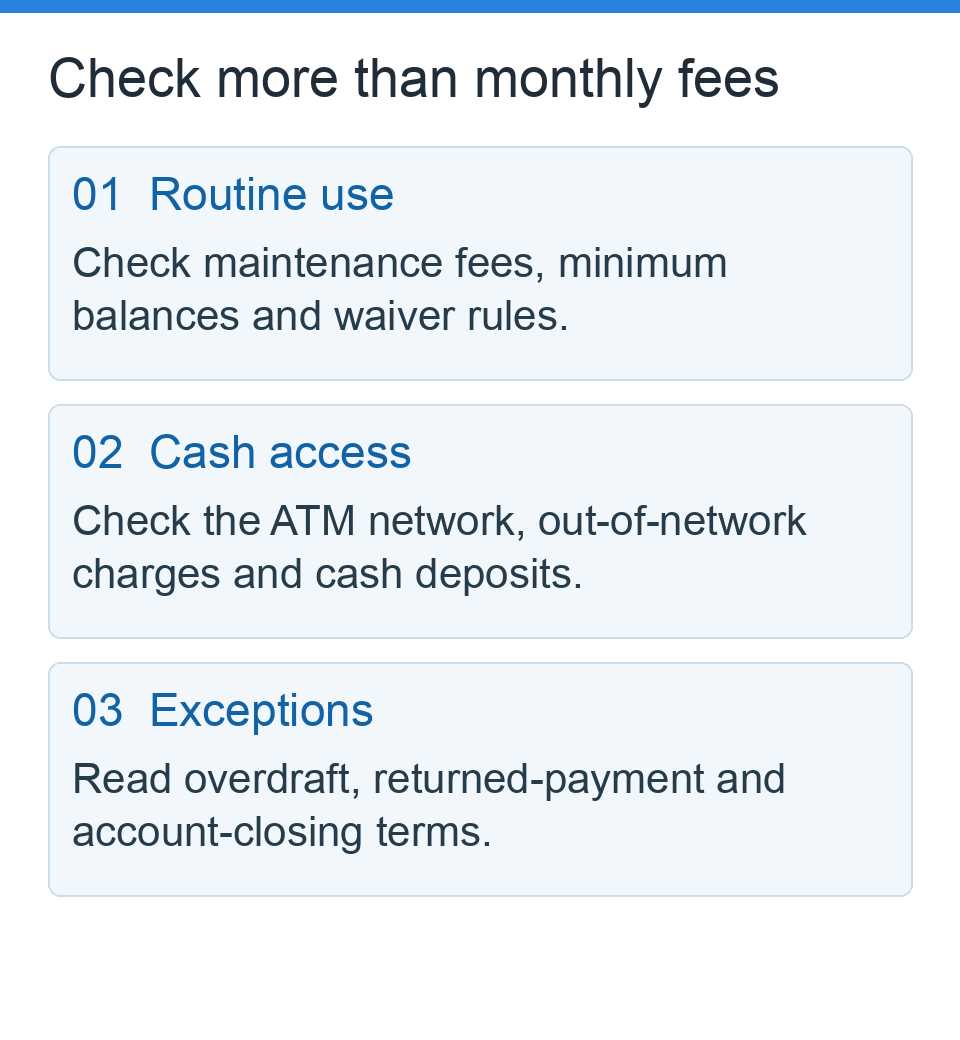
1. Monthly Fee: Zero, or Just Waivable?
There is a real difference between a genuinely free checking account and a waivable-fee account. A true no-fee account charges nothing each month regardless of your balance or activity. A waivable-fee account charges, for example, a monthly fee unless you maintain a stated balance, receive a stated direct deposit, or complete stated transactions.
Waivers carry a hidden price: the balance you must park to avoid the fee earns nothing in checking. Price the trade. At a purely illustrative 4.00% APY in savings, parking $1,500 gives up about $60 a year in interest ($1,500 × 0.04 = $60); waiving a hypothetical $10 monthly fee saves $120 a year ($10 × 12), so the waiver can still win — but only if you keep the balance every month.
2. Overdraft Policy
Ask four questions. Does the account charge overdraft fees, and how much per item? Is there a daily cap? Is there a grace amount or period — no fee if you are overdrawn by only a small amount, or you fix it by the next day?
And can you opt out of overdraft cover for debit purchases, so a transaction is declined rather than covered for a fee? The CFPB notes that overdraft fees apply under the account's terms and your elections, so your choices at opening genuinely change your costs.
3. ATM Access
For a free checking account, “near me” should mean near your life: home, work, and the places you travel. Check the fee-free network’s map, not its marketing count. Then check both sides of an out-of-network withdrawal — your bank’s fee and the ATM owner’s surcharge — and whether the bank reimburses surcharges, and up to what monthly cap.
4. Minimums and Direct Deposit Requirements
Some accounts require a minimum opening deposit, an ongoing minimum balance, or a qualifying monthly direct deposit — sometimes to earn the “free” status itself. Requirements you meet through your normal pay cycle are harmless; requirements that force you to split your pay are a recurring cost.
5. Everyday and Edge Fees
Scan the schedule for the fees matching your life: paper statements, a replacement card, an occasional wire, a stop payment, foreign transaction fees if you travel, and inactivity or closure fees.
Worked Example: Costing Two Accounts for One Person
Suppose you withdraw cash twice a month at whatever ATM is closest, occasionally run your balance low, and do not want to park a large balance. Both accounts below are hypothetical teaching examples, not current offers.
| Cost item | Account A: “free”, small ATM network | Account B: $10 fee, waivable, large ATM network |
|---|---|---|
| Monthly fee | $0 | $10, waived with a $500 direct deposit you already receive = $0 |
| Out-of-network ATM use | 2 per month × ($3 bank fee + $3 owner surcharge) = $12/month | $0 — your usual ATMs are in-network |
| Expected overdraft cost | 1 fee a year at $30 = $30 | $0 — account declines debit overdrafts at your election |
| Paper statement fee | $2/month if you choose paper = $24/year | Free statements |
| Estimated yearly cost | $144 + $24 + $30 = $198 | $0 |
The account named as a free checking account costs this person about $198 a year. The account with a monthly fee costs nothing, because the waiver matches a habit the person already has and the ATM network matches their life. Reverse the habits — no direct deposit, always in-network ATMs — and Account A wins easily.
That is the whole lesson: price the account against your pattern, not against the label. If an account also comes with an opening offer, value it separately using the net method in Zarvis's guide to checking account bonuses .
How to Search “Near Me” Sensibly
- List what local means for you. Branches you would realistically visit, ATMs near home and work, or shared branching at a credit union.
- Include credit unions. Federally insured credit unions often offer a genuinely free checking account, with deposits insured through the NCUA — the credit-union equivalent of FDIC cover at banks.
- Verify the institution. Confirm insurance status on the FDIC’s or NCUA’s website, and confirm the legal institution behind any app-based account.
- Download each fee schedule. Build the one-year cost table above for your top three, using your last three months of real banking as the template.
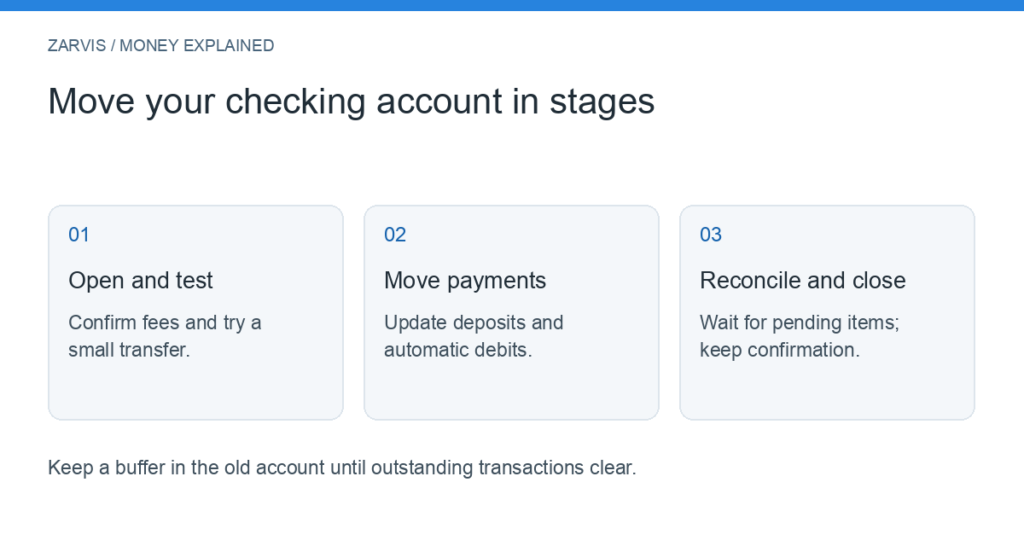
- Test before you commit fully. Run a small direct deposit and your normal transactions for a month, and only then move your remaining bills. Keep your old account open until every automatic payment has moved — a missed payment can cost more in late fees and credit damage than a year of checking fees.
- Keep a buffer in the account. A small cushion in checking is the cheapest overdraft protection there is — the same logic as a starter emergency fund.
A free checking account comparison you can repeat
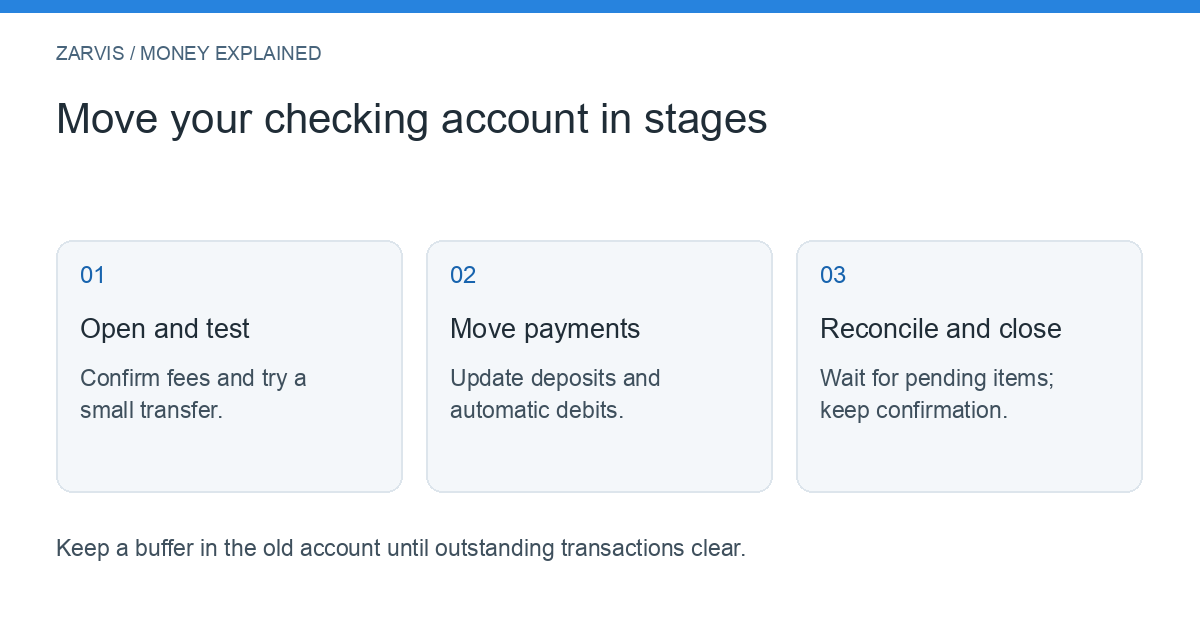
Open each candidate’s current fee schedule and fill in the same questions. A blank or unclear answer is a reason to ask the institution, not assume a zero charge. This is a comparison method, not a live ranking of bank offers.
| Record this | Where to verify it | Decision check |
|---|---|---|
| Monthly fee and waiver rules | Account fee schedule | Can you meet the rule in a low-income month? |
| ATM operator and bank charges | ATM locator and fee schedule | Are the ATMs you actually use in network? |
| Overdraft and returned-payment terms | Overdraft disclosure | Which transaction types are covered, and what fees can still apply? |
| Deposit insurance and account ownership | FDIC BankFind or NCUA institution search, plus account agreement | Which institution holds the money, and what limits apply? |
| Date checked and document link | Save the current disclosure | Recheck before applying; terms can change. |
After choosing an account, move checking accounts in stages, rather than closing the old account before deposits and automatic debits have been tested.
Common Mistakes to Avoid
Comparing Only the Monthly Fee
As the example shows, the monthly fee can be the smallest cost you pay on a free checking account. Total the year, across the fees your habits actually trigger.
Assuming Waivable Means Free
A waiver is a monthly test. A job change or a gap between employers can break it at exactly the moment money is tightest. If you choose a waivable account, know when you would start paying and what it would cost.
Moving Everything in One Day
A forgotten subscription can charge the old account, or a bill can hit the new account before your deposit does. Move in stages over one full pay cycle.
Free Checking Account FAQ
Is any checking account completely free?
Almost every account has a fee schedule covering something — a wire, a stop payment, an out-of-network ATM. “Completely free” is unrealistic for any account; a free checking account that is free for how you bank is the practical standard.
Are credit union checking accounts safe?
Yes, when the credit union is federally insured. NCUA share insurance generally covers up to $250,000 per depositor, per insured credit union, for each ownership category, comparable to FDIC insurance at banks. Verify the institution on the NCUA website.
How much does one overdraft usually cost me in total?
A single overdraft can trigger one fee, and further transactions the same day can trigger more, subject to any daily cap or grace period in your agreement. The exact figures are in your fee schedule — check the per-item fee, the daily maximum, and whether you can elect to have debit purchases declined instead.
Should I choose a branch bank or an online bank?
Choose based on how you use cash and help. If you deposit cash or value face-to-face help, a branch matters. If your banking is salary in and payments out, an online free checking account with a large fee-free ATM network may serve you better — often at lower cost.
Will opening a new checking account affect my credit score?
Opening a deposit account typically does not involve the kind of hard credit inquiry used for credit applications, though institutions may review deposit-account history. The larger credit risk in switching is a missed payment during the move, which is why staging matters.
Bottom Line
Price checking accounts the way you would price anything else: a full year, your habits, every fee. Treat "free" as a claim to verify in the fee schedule, respect the difference between zero fees and waivable fees, confirm federal insurance, and choose the account whose network and rules fit your life.
The best free checking account near you is the one that costs you nothing because of how you bank — not the one that merely says so.
Editorial note: Zarvis provides general educational information, not personalized financial, legal, tax, or credit-repair advice. Account fees and terms change frequently and vary by institution, so always verify current details directly with the relevant bank or credit union before opening an account.
Sources
- Consumer Financial Protection Bureau (CFPB), bank accounts and overdraft guidance: https://www.consumerfinance.gov/consumer-tools/bank-accounts/
- Federal Deposit Insurance Corporation (FDIC), deposit insurance guidance: https://www.fdic.gov/resources/consumers/deposit-insurance/
- National Credit Union Administration (NCUA), share insurance coverage: https://ncua.gov/consumers/share-insurance-coverage
- Federal Reserve, consumer banking resources: https://www.federalreserve.gov/
Pingback: Switch Checking Accounts: 7 Steps to Avoid Costly Mistakes