Checking account fees are charges a bank or credit union applies to a deposit account — most commonly a monthly maintenance (service) fee, overdraft and insufficient-funds fees, out-of-network ATM fees, and assorted charges for wires, paper statements, and other services. Most of them are avoidable, but only if you know which actions trigger them and what your account’s fee schedule actually says.
Quick answer: The fees that cost ordinary account holders the most are the monthly maintenance fee (charged when you miss a waiver condition such as a minimum balance or direct deposit), overdraft fees (charged when a payment exceeds your balance and the bank covers it), and returned-item/NSF fees (charged when a payment is declined for lack of funds). All three checking account fees are described in the fee schedule you received at account opening — and in the worked example below, a handful of hypothetical fees add up to $223 in a single year.
Key Takeaways
- Read your account’s fee schedule (sometimes called the schedule of fees or service charge list) to see every one of your checking account fees in one place. It is the authoritative list of what can be charged and when.
- Monthly maintenance fees usually have a published waiver — a direct deposit, a minimum daily balance, or linked accounts. Missing the waiver by a dollar or a day can trigger the full fee.
- Overdraft coverage for debit card purchases is optional: under federal rules you must opt in before a bank can charge an overdraft fee on one-time debit and ATM transactions.
- Out-of-network ATM use can cost two fees on one withdrawal — one from your bank and one from the ATM owner.
- Switching or restructuring an account is often cheaper than repeatedly paying avoidable fees.
The Most Common Checking Account Fees
All checking account fees below are shown as hypothetical examples for illustration only — they are not the current fees of any specific bank or account. Your account’s charges are whatever its fee schedule states.
| Fee | What triggers it | Hypothetical example | Typical way to avoid it |
|---|---|---|---|
| Monthly maintenance / service fee | Holding the account for another month without meeting a waiver condition | $12/month | Meet the waiver (direct deposit, minimum balance), or choose an account without one |
| Overdraft fee | A payment exceeds your balance and the bank pays it anyway (for debit/ATM, only if you opted in) | $35 per item | Opt out of debit overdraft coverage, keep a cushion, set low-balance alerts |
| NSF / returned item fee | A check or electronic payment is returned unpaid for insufficient funds | $35 per item | Track pending payments and your available balance before scheduling payments |
| Out-of-network ATM fee | Using an ATM outside your bank’s network | $3 from your bank, plus a surcharge from the ATM owner | Use in-network ATMs or fee-free cash-back at retailers |
| Stop payment fee | Asking the bank to block a specific check or payment | $30 per request | Resolve the payment with the payee first where possible |
| Wire transfer fee | Sending (or sometimes receiving) a wire | $25 outgoing, domestic example | Use standard ACH transfers when timing allows |
| Paper statement fee | Receiving mailed statements instead of e-statements | $2–$5/month | Switch to electronic statements |
| Foreign transaction / currency fee | Using the card abroad or in a foreign currency | 1%–3% of the transaction | Use an account or card without foreign transaction fees when travelling |
| Excess withdrawal / inactivity fees | Too many transactions on some accounts, or no activity for a long period | Varies | Match the account type to your habits; use dormant accounts occasionally or close them |
Worked Example: How Small Fees Become a Real Number
Consider a hypothetical year with one account holder who is not doing anything unusual:
| Event | Calculation | Cost |
|---|---|---|
| Monthly maintenance fee, waiver missed all year | 12 × $12 | $144 |
| Two overdrafts (hypothetical $35 each) | 2 × $35 | $70 |
| Three out-of-network ATM withdrawals (hypothetical $3 bank fee each, before any ATM-owner surcharge) | 3 × $3 | $9 |
| Total for the year | $223 |
$223 in checking account fees is real money — for many households it is a week of groceries — and none of it bought anything. Notice also how the total is built: no single fee looks dramatic, which is exactly why fee leakage survives. It is the same slow-drip pattern as paying only the minimum on a card, modelled in our minimum payment calculator: small recurring charges, repeated, beat large one-off charges. The fix is a one-time review, not monthly willpower.
Overdraft and NSF Fees Deserve Special Attention
These two are commonly confused, and the difference matters. An overdraft fee is charged when the bank pays a transaction that overdraws your account — you owe the bank the covered amount plus the fee. An NSF (non-sufficient funds) or returned-item fee is charged when the bank returns the payment unpaid — the payee does not get paid, may charge you their own late or returned-payment fee, and the underlying bill is still owed.
For one-time debit card and ATM transactions, federal rules give you a choice: a bank may not charge an overdraft fee for paying those transactions unless you have opted in to its overdraft service. If you have not opted in, a purchase that exceeds your balance is simply declined, with no overdraft fee. Checks and automatic bill payments (ACH) are treated differently — overdraft fees can apply to those without the same opt-in — so declining coverage is not a complete shield.
Managing the balance these fees are measured against is the same discipline as keeping a credit utilization ratio low: how close to a limit — or to zero — you run determines what you pay.
How to Avoid Checking Account Fees
- Find and read the fee schedule. Download it from your bank’s site or ask for it. List every fee that could apply to how you actually use the account.
- Meet the maintenance-fee waiver deliberately. If the waiver needs a direct deposit or a minimum daily balance, arrange the deposit or keep a buffer above the threshold — not exactly at it.
- Decide on overdraft coverage consciously. Declining debit-card overdraft coverage turns an expensive fee into a declined transaction. For bills, a small cash cushion plus low-balance alerts prevents most incidents.
- Stay in network for cash. Locate your bank’s fee-free ATMs before you need one, and remember the double-fee structure of out-of-network withdrawals.
- Go paperless if a paper statement fee applies, and keep your statements accessible for your records.
- Ask for a refund — politely, once in a while. Banks sometimes reverse occasional checking account fees as a courtesy, especially a first occurrence. It is not guaranteed, but asking costs nothing.
- Switch if the account no longer fits. If the waiver is unrealistic for your income pattern, an account with no monthly fee may be strictly better. Fees change true costs elsewhere too — see personal loan APR vs. interest rate and how credit card interest works.
Before You Switch Accounts
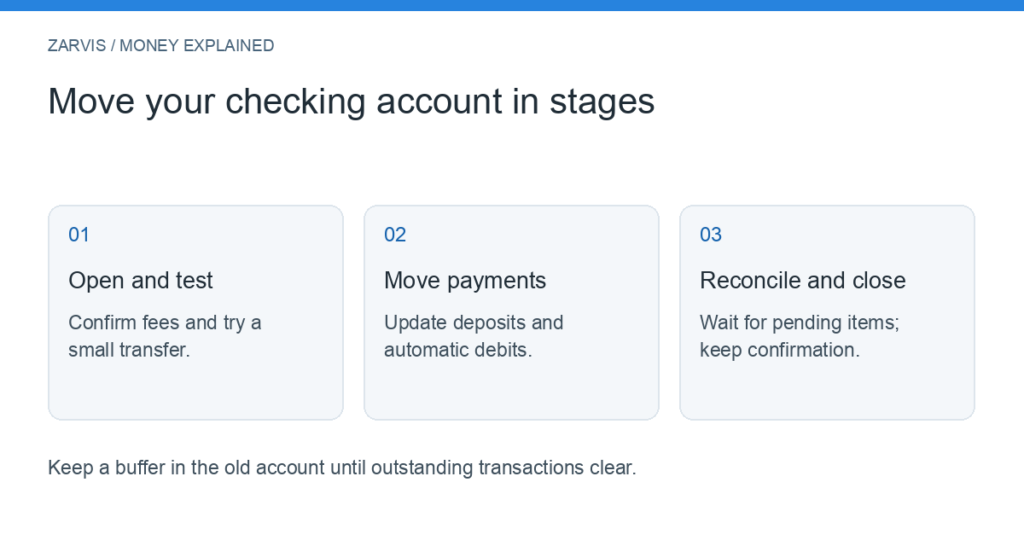
Open the new account first, move your direct deposit and automatic payments, and keep the old account funded until every pending payment clears — closing an account with payments still pointed at it reliably generates the very checking account fees this article is about. Confirm the new account’s fee schedule and ATM network before committing, and keep the closure confirmation.
Checking Account Fees FAQ
Where do I find my account’s actual fees?
In the fee schedule and account disclosures you received at opening, and usually in your bank’s app or website under account terms or pricing. Those documents, not general articles, state your fees.
Can a bank charge an overdraft fee on a debit card purchase without my permission?
For one-time debit card and ATM transactions, federal rules require your opt-in before overdraft fees can be charged for paying those transactions. Without opt-in, such a transaction is generally declined instead. Rules for checks and automatic payments differ.
What is the difference between an overdraft fee and an NSF fee?
An overdraft fee applies when the bank pays a transaction that overdraws the account. An NSF (returned item) fee applies when the bank returns the payment unpaid — the bill remains unpaid and the payee may add its own charges.
Are monthly maintenance fees always avoidable?
Monthly checking account fees can often be waived by meeting stated conditions such as direct deposit or a minimum balance, and some accounts have no monthly fee at all. Read the waiver terms precisely — “average balance” and “daily balance” conditions are not the same thing.
My bank charged a fee I do not recognise. What should I do?
Identify the fee on your statement, compare it with the schedule of checking account fees, and contact the bank to ask what triggered it. If it was charged in error, ask for reversal. If you cannot resolve it, you can file a complaint with the Consumer Financial Protection Bureau (consumerfinance.gov).
Bottom Line
Checking account fees are rarely about one large charge; they are about small, repeatable charges that survive because nobody re-reads the fee schedule. Read yours once, set up the waiver, alerts, and overdraft choices that match your habits, and the $223-a-year leak in the example becomes close to zero.
Editorial note: Zarvis provides general educational information, not personalized financial, legal, or tax advice. All fee amounts in this article are clearly hypothetical examples, not the rates or fees of any specific institution or product, and are not a quote or guaranteed term. Fees, waiver conditions, and overdraft policies vary by institution and change over time; verify your account’s current terms in its fee schedule and disclosures before acting.
Sources
- FDIC (fdic.gov) — consumer resources on bank accounts, account terms, and resolving issues with a bank.
- Consumer Financial Protection Bureau (consumerfinance.gov) — guidance and research on checking accounts, overdraft services, and account fees.
- Consumer Financial Protection Bureau (consumerfinance.gov) — Ask CFPB explainers on overdraft fees, NSF fees, and opting in to overdraft coverage.
- Federal Trade Commission (ftc.gov) — consumer guidance on managing bank accounts and avoiding unnecessary charges.