The safest way to switch checking accounts is to open the new account first, move deposits and payments in a controlled order, and close the old account only after outstanding transactions have cleared.
Opening the replacement account is usually the easy part. The awkward part is the electric bill still pulling from the old account while your paycheck has already moved to the new one.
The CFPB’s checking-account moving checklist recommends keeping enough money in the old account to cover uncleared checks and automatic payments. Build your switch around that overlap, not around a promise that everything will move overnight.
Before you switch checking accounts, compare the real costs
Write down why you are leaving: monthly fees, poor cash access, inconvenient branches, or an app that does not meet your needs. Then compare the replacement against that problem.
A “free” account can still charge for certain services. Read the fee schedule, including ATM use, overdrafts, wires, paper statements, and any minimum balance or direct-deposit conditions. Our free checking account guide separates a waived maintenance fee from the other costs.
If a welcome bonus attracts you, review the qualifying deposit rules and any early-closure conditions. Do not treat the advertised bonus as money already earned. See our checking account bonus guide for the questions to ask.
Make a transaction map before you switch checking accounts
Review recent statements and your bill calendar. A single month can miss quarterly insurance, annual subscriptions, or occasional payments.
| Item | What to record | How to confirm the change |
|---|---|---|
| Paycheck or benefits | Payment source and expected arrival date | First deposit reaches the new account |
| Utilities and loan payments | Amount, due date, and payment method | Provider shows the updated account |
| Credit card autopay | Linked account and scheduled withdrawal | Issuer confirms the new instruction |
| Outstanding checks | Check number, payee, and amount | Check clears or is properly canceled |
| Payment apps and transfers | Linked bank details and scheduled transfers | App shows the correct destination |
Keep account numbers out of shared spreadsheets or email. A private checklist can usually identify an account by its name and last few digits.
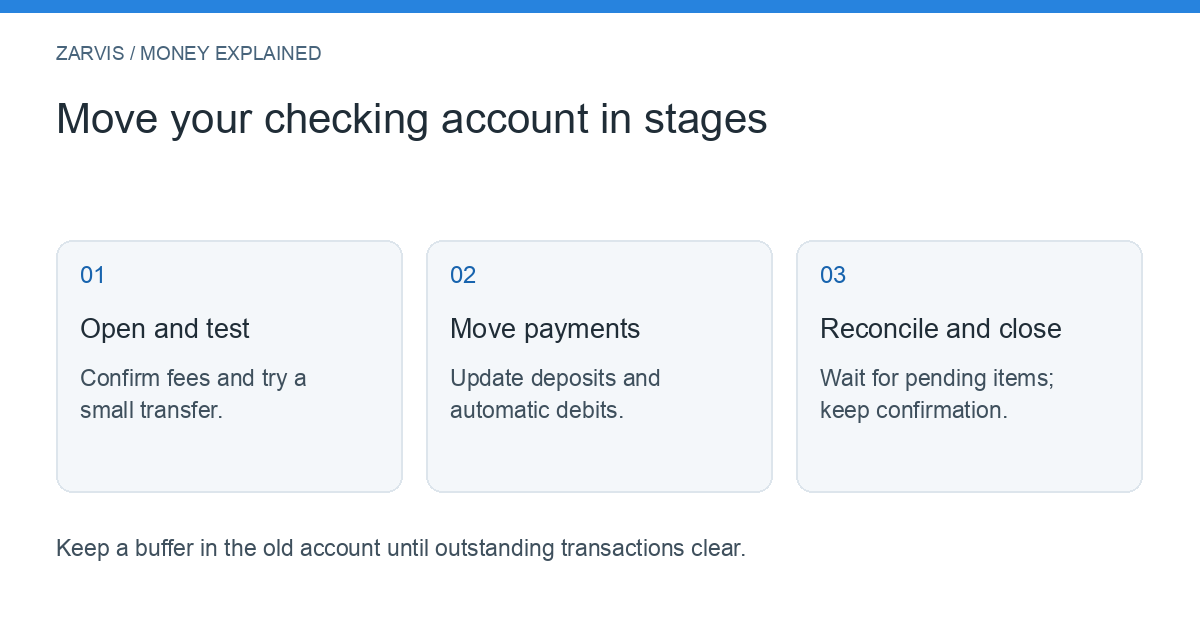
Open and test the new account
Ask the bank which identification it accepts, whether an opening deposit is required, and when deposited money will become available. Confirm your access to online banking and the payment methods you actually use.
If practical, test a small transfer before moving a large balance. A successful login does not prove that every outside payment service has the right account details.
Deposit protection also depends on the institution and account structure, not just the app’s branding. For bank deposits, the FDIC explains the standard coverage limit as $250,000 per depositor, per insured bank, for each account ownership category. Credit-union coverage uses a separate insurance system; verify the institution directly.
Move incoming deposits before relying on them
Update direct deposit through your employer, benefits provider, or other payment source. Use a trusted portal or verified contact method.
Ask when the change takes effect. Do not move every automatic debit based only on the day you submitted the form. Wait for confirmation and, where feasible, the first successful deposit into the new account.
Payroll cutoff dates vary. If the next paycheck could still land in the old account, leave room for that possibility in your plan.
Move outgoing payments one by one
Update each biller rather than assuming the bank will handle every instruction. Record the confirmation and effective date.
Watch for double payments. A recurring payment scheduled through the old bank’s bill-pay service is different from a merchant automatically withdrawing money. Starting a new instruction without canceling the old one can cause two withdrawals.
For example, if $420 in scheduled payments and a $90 check remain outstanding, emptying the old account after moving your paycheck creates an avoidable $510 gap. That is an illustration; your buffer should reflect your actual pending transactions and any account requirements.
Close the old account deliberately
Once deposits and payments are working correctly, reconcile the old account. Check for pending transactions, fees, and interest before transferring the remaining balance.
Ask how to close it and request written confirmation. Save statements and the closure record somewhere secure. Simply leaving a zero balance is not the same as closing the account.
Finally, remove obsolete bank details from payment apps and stored billing profiles. Keep an eye on the new account during the next billing cycle.
You do not have to switch checking accounts in a single day. A planned overlap is usually easier to manage than moving every deposit and payment at once, provided you understand any costs of keeping both accounts open.
Your last check
Before calling the switch complete, confirm that income arrives, essential bills are paid, outstanding checks are resolved, and the old bank has acknowledged closure. For fee questions during the overlap, use our checking account fees guide.
This checklist is general US financial education. Bank procedures, processing times, fees, and account terms vary.
Common questions when moving a checking account
Should I empty the old account immediately?
Usually that creates an unnecessary risk while payments are still moving. A debit-card purchase, outstanding check, bank fee, or automatic withdrawal may arrive later than expected. Work from your own transaction history to decide the buffer you need. There is no universal safe dollar amount or number of days that covers every household’s outstanding transactions.
What if my next paycheck goes to the old bank?
Keep access to the old account until the change is confirmed. Ask payroll when the new instructions take effect; a submitted form does not mean the next deposit will use them. Check the actual deposit before relying on the new account to pay bills. Be cautious about transferring nearly everything away while automatic debits still use the old routing information.
Will moving banks cancel subscriptions?
No. Updating or closing a payment account does not necessarily cancel the agreement with a merchant. Cancel an unwanted service with the provider and retain confirmation. For subscriptions you want to keep, update the payment details directly. Check both bank statements during the transition so a missed update does not become an overdue bill.
What records should I keep?
Save recent statements, the list of moved deposits and payments, and the final closure confirmation. Download any records you may need before online access ends. Reconcile the final statement against your own list, including checks that have not cleared. If a fee or unexpected debit appears, contact the old bank rather than assuming a zero balance meant the account had closed.