
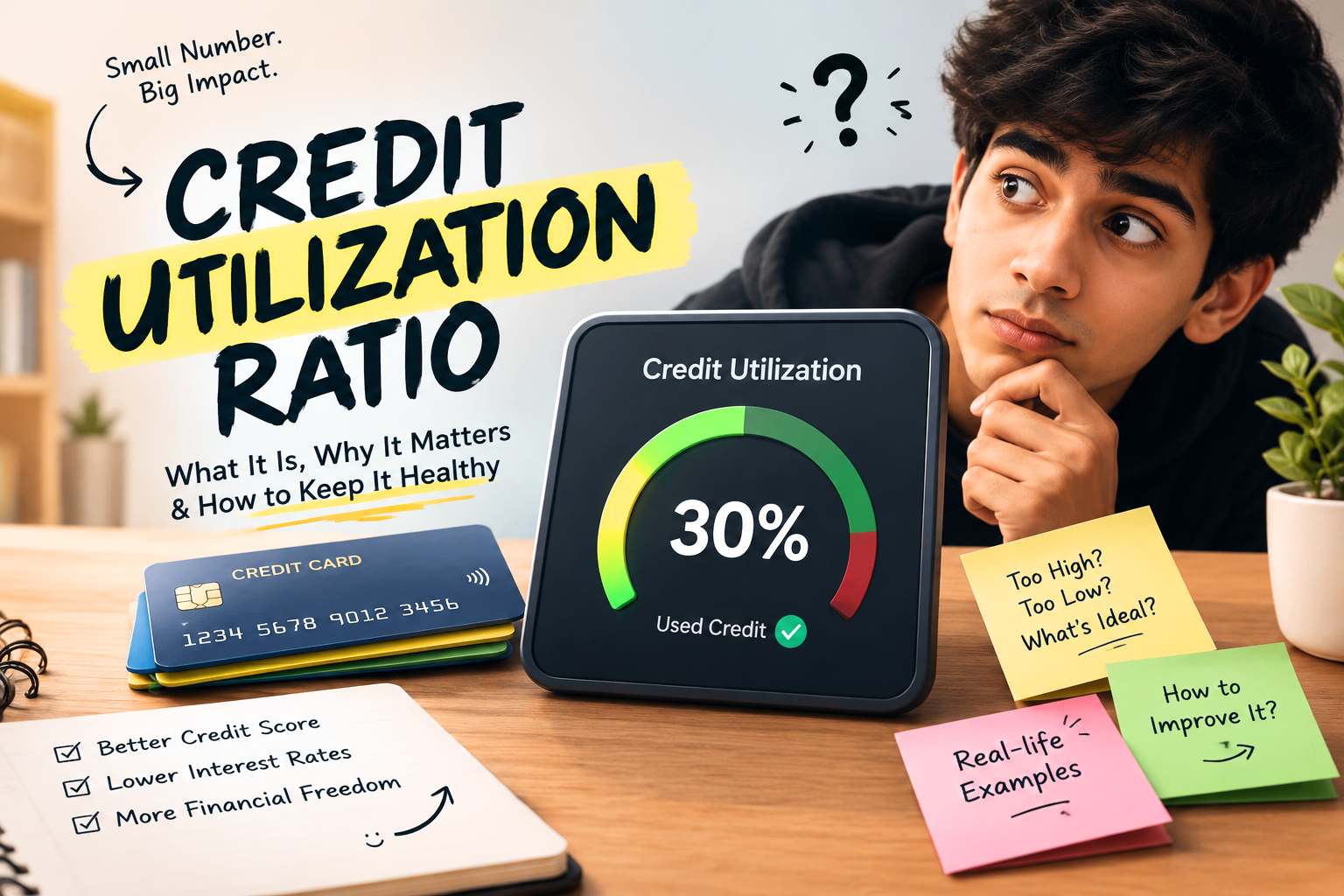
Credit utilization ratio measures how much of your available revolving credit you are using. It can influence your credit scores, but the math is simple: divide a reported card balance by its credit limit, then multiply by 100. This guide explains the formula, shows practical examples, and covers ways to lower utilization without creating new debt.
Quick answer: A $1,000 reported balance on a card with a $5,000 limit equals 20% utilization. Lower is generally better. However, 30% is not a magic line, and carrying interest-bearing debt does not help your score.
What Is a Credit Utilization Ratio?
Your credit utilization rate compares the balances reported on revolving accounts with their credit limits. Credit cards are the most common example. Unlike an installment loan, a revolving account lets you borrow, repay, and borrow again up to a set limit.
Credit scoring models may review both your overall utilization and the rate on each card. Therefore, a low total rate does not always cancel out a nearly maxed-out individual card. FICO includes revolving utilization within its broader “amounts owed” category, which represents about 30% of a typical FICO Score calculation. Your exact score impact still depends on your full credit profile and the scoring model used.
Credit Utilization Ratio Formula
Use this formula for one credit card:
Card balance ÷ Card limit × 100 = Utilization percentage
For example, suppose your card issuer reports a $750 balance and a $3,000 limit:
- $750 ÷ $3,000 = 0.25
- 0.25 × 100 = 25%
Your utilization on that card is 25%.
How to calculate overall utilization
Add all reported revolving balances. Next, add all corresponding credit limits. Finally, divide the total balance by the total limit.
| Account | Reported balance | Credit limit | Individual rate |
|---|---|---|---|
| Card A | $500 | $2,500 | 20% |
| Card B | $1,200 | $6,000 | 20% |
| Card C | $0 | $1,500 | 0% |
| Total | $1,700 | $10,000 | 17% |
In this example, $1,700 divided by $10,000 equals 17%. Still, calculate every card separately because scoring models can consider both individual and overall usage.
What Is a Good Credit Utilization Rate?
The Consumer Financial Protection Bureau says experts generally advise using no more than 30% of your total credit limit. Yet 30% should work as a practical ceiling rather than an ideal target. Lower reported usage may support stronger scores, although no single percentage guarantees a particular result.
You also do not need to carry a balance or pay interest to build credit. In fact, the CFPB recommends paying card balances in full each month when possible. That approach can control interest costs while keeping debt manageable.
Consider these ranges as educational guideposts, not universal scoring rules:
- 0% to 9%: Very low use. Some scoring models may prefer a small reported balance over every card reporting zero, but you never need to pay interest for that to occur.
- 10% to 29%: Below the widely cited 30% guideline.
- 30% to 49%: A sign to review balances and limits, especially before applying for new credit.
- 50% to 99%: High usage can signal financial pressure and may weigh on scores.
- 100% or more: A maxed-out or over-limit account can create serious cost and credit risks.
Why Your Statement Balance Matters
Your credit report usually shows the balance most recently reported by the lender. That figure may differ from the balance you see when you open your banking app today. Many issuers report around the statement closing date, although reporting schedules vary.
As a result, paying the full statement balance by the due date can prevent interest yet still leave a balance on your credit report. Suppose your statement closes with a $2,000 balance on a $5,000 limit. The issuer may report 40% usage even if you pay the entire statement by the due date.
If you plan to apply for important credit soon, review each issuer’s reporting pattern. A payment before the statement closes may reduce the balance that gets reported. However, keep enough cash for bills and emergencies. Do not drain your bank account merely to change a short-term utilization figure.
How to Lower Credit Utilization
1. Pay down revolving balances
Reducing card debt directly lowers the numerator in the formula. Start with the highest-rate balance if minimizing interest is your priority. Alternatively, targeting a nearly maxed-out card may improve that account’s individual utilization faster. Compare both approaches before choosing.
2. Make payments before the statement closes
An early payment can reduce the balance an issuer reports. This tactic works best when you already have money available. It should not replace paying at least the required minimum by the due date.
3. Request a higher credit limit carefully
A larger limit can lower the ratio if your balance stays unchanged. For example, a $1,000 balance equals 40% of a $2,500 limit but 20% of a $5,000 limit. Before requesting an increase, ask whether the issuer will make a hard credit inquiry. Also, avoid treating the new limit as permission to spend more.
4. Avoid closing an old card without a reason
Closing a card removes its available limit from your total. Therefore, your overall rate can rise even when your debt stays the same. Still, closing may make sense if a card has an annual fee you cannot justify, creates overspending risk, or no longer serves your needs.
5. Spread purchases without increasing total spending
If one card is close to its limit, placing necessary purchases on another card can reduce concentrated usage. This move does not lower overall utilization, though. It only changes the per-card distribution, so it is not a substitute for paying down debt.
Common Credit Utilization Mistakes
- Carrying interest to “build credit.” Paying interest does not improve utilization or create extra scoring points.
- Watching only the total rate. One highly utilized card can still matter.
- Using the current balance instead of the reported balance. Your calculation may not match what a scoring model sees.
- Applying for several cards only to increase limits. New applications can add hard inquiries and reduce average account age.
- Ignoring cash flow. A lower ratio is not worth missing rent, insurance, food, or other essential payments.
Credit Utilization Ratio Example Before a Loan Application
Assume you have $4,000 in reported balances and $10,000 in total limits. Your overall rate is 40%. You then pay $2,000 before the issuers report again. If the limits do not change, the new rate becomes 20%.
That reduction may help your credit profile, but timing matters. Lenders must report the lower balances before a score can reflect them. Moreover, lenders review income, payment history, debt obligations, loan type, and other factors. A lower ratio alone cannot guarantee approval or a particular interest rate.
Credit Utilization Ratio FAQ
Does 0% utilization hurt your credit score?
A 0% rate does not automatically damage your credit. However, some scoring models may award the strongest utilization points when a small balance appears rather than every revolving account reporting zero. You do not need to carry debt or pay interest to create reported activity.
How quickly can utilization change?
It can change after an issuer reports a new balance and the credit bureaus update your file. The timeline varies by lender and bureau. Therefore, a payment may not affect a score immediately.
Do installment loans count toward utilization?
Credit utilization usually focuses on revolving accounts. Mortgages, auto loans, student loans, and personal loans use fixed repayment schedules, so scoring models generally evaluate them differently.
Can closing a credit card increase utilization?
Yes. Closing a card can reduce your total available credit while your other balances remain unchanged. The CFPB notes that this can increase utilization and potentially lower a score.
Should I keep every card below 30%?
Staying below 30% on each card and overall can be a useful starting goal. Still, lower is generally better, and scoring models do not use 30% as a universal cliff. Focus first on on-time payments, affordable debt reduction, and avoiding unnecessary interest.
Bottom Line
Your credit utilization ratio offers a quick snapshot of revolving debt relative to available credit. Calculate both per-card and overall usage, check the balances actually reported, and treat 30% as a guideline rather than a guarantee. Most importantly, never carry interest-bearing debt only to influence a score.
Continue learning through our credit card guides, review the Zarvis guides library, or learn how to compare savings accounts in our high-yield savings account guide.
Editorial note: Zarvis provides general educational information, not personalized financial, legal, tax, or credit-repair advice. Credit scoring formulas vary, and no action guarantees a score change.