


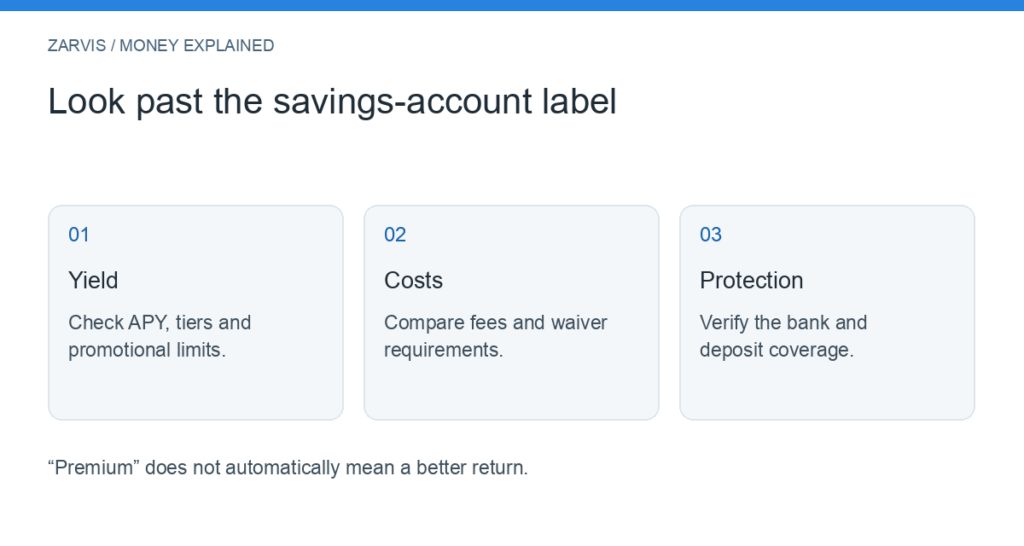
A premium savings account is not automatically better than a high-yield savings account. Treat both names as a starting point, then compare the actual APY, fees, balance requirements, access rules, and deposit protection.
“Premium” may describe a bank’s relationship package or a particular account tier. “High-yield” emphasizes the rate. Neither label tells you how much interest you will keep after fees, or whether the account fits the way you use your savings.
If your question is simply “what is a premium savings account?”, the useful answer is: read the bank’s specific product terms. Do not assume the name guarantees a particular rate, benefit, or insurance limit.

Check which premium savings terms you qualify for
An advertised rate may depend on a minimum balance, linked checking account, qualifying activity, or a temporary promotion. Ask which rate applies to your expected balance, not just the largest number on the landing page.
Use this side-by-side checklist:
| Feature | Question to ask |
|---|---|
| APY | Is this the ongoing rate, a promotional rate, or a balance-tier rate? |
| Monthly fee | Is it unavoidable, or can you reliably meet the waiver conditions? |
| Balance requirement | Does dropping below a threshold change the fee, APY, or both? |
| Access | How do transfers, withdrawals, and cash deposits work? |
| Linked accounts | Must you maintain another account with its own costs? |
| Insurance | Which insured institution holds the deposit, and how is ownership recorded? |
Our guide to comparing high-yield savings accounts provides a broader shopping checklist.
APY is useful, but fees can reverse the result
APY expresses annual interest growth with compounding under the account’s stated assumptions. It is not a promise that a variable savings rate will stay unchanged for the next year. The CFPB’s APY calculation rules explain the disclosure framework.
Consider two fictional accounts and a $5,000 starting balance:
| Illustration only | Account A | Account B |
|---|---|---|
| APY, assumed unchanged for one year | 4.00% | 3.75% |
| Interest on the starting balance | $200.00 | $187.50 |
| Monthly maintenance fee | $10 | $0 |
| Annual fees | $120 | $0 |
| Interest minus fees | $80.00 | $187.50 |
The higher APY earns only $12.50 more in interest, while its fees cost $120. Under these assumptions, Account B leaves you $107.50 ahead.
These are not current bank offers. The illustration assumes no deposits or withdrawals, unchanged APYs, and fees paid separately so they do not reduce the interest-bearing balance. It excludes taxes. If fees come directly out of savings, the interest calculation also changes.
Put a dollar value on premium savings benefits
A premium account might include a service you use, such as a particular transfer benefit or access to a wider banking package. Ask what that feature saves you in a normal year.
Do not count a waived service fee as valuable if you would not otherwise buy the service. Also review the linked account’s requirements. Avoiding a savings fee is not a saving if it causes a larger checking fee elsewhere.
For a smaller balance, even a modest fixed fee can consume much of the interest. For a larger balance, tiered rates and insurance arrangements deserve more attention.
Make sure emergency money is reachable
Savings has a job beyond earning interest. If this is your emergency fund, find out how long a transfer to your everyday checking account normally takes, whether transfer limits apply, and what happens on weekends or holidays.
Do not assume a savings account includes a debit card, branch withdrawals, or unlimited external transfers. Check those features directly with the provider.
Our emergency fund guide can help you separate the amount you need from the account you choose to hold it.
Verify deposit insurance, not just a logo
At FDIC-insured banks, eligible savings deposits are covered subject to the applicable rules. The FDIC’s standard limit is $250,000 per depositor, per insured bank, for each account ownership category.
Opening a “premium” account does not create a new ownership category. Deposits you hold in the same category at the same bank are generally combined for coverage purposes. A money market mutual fund is also not the same product as an insured money market deposit account.
If you use a credit union or a financial app, verify the relevant insurer, underlying institution, and coverage conditions rather than assuming bank rules apply unchanged.
A premium savings comparison should use the balance and services you expect to maintain. If the qualifying conditions would force you to hold money somewhere you do not want it, include that trade-off in the decision.
Choose by the terms, then revisit them
Keep the fee schedule, rate disclosure, and account requirements. Recheck the account if the rate changes or you stop meeting a waiver condition.
The better choice is the account whose net return, access, and requirements work for your actual savings balance—not the one with the more impressive name. For the basics, read how high-yield savings accounts work.
This is general US financial education, not a recommendation for a particular bank or account.
Questions to ask before moving your savings
Is an introductory APY enough to choose an account?
It is only part of the comparison. Check how long the offer lasts, which balances qualify, and whether the rate changes after the promotional period. A high advertised figure may apply to only a small balance tier. Compare the terms that apply to your actual deposit, not the largest percentage printed on the page.
What if a monthly fee can be waived?
Count the fee as a potential cost unless you can comfortably meet the waiver conditions. A required balance can tie up cash you need elsewhere, and a missed condition may trigger a charge. Read whether the bank measures a daily minimum, an average balance, or another requirement. Those are different tests even when the dollar threshold looks similar.
How should I check access to emergency money?
Review transfer methods, processing times, external-account verification, and any account-specific limits. Try a small transfer before depending on a new account for an urgent bill. Interest matters, but so does having money available when a repair or unexpected expense arrives. Keep the comparison grounded in how you actually use the account.
Does the account name establish deposit insurance?
No. Identify the bank holding the deposits and verify its insurance status. If a nonbank app is involved, read the arrangement and any conditions for coverage carefully. Different brands can use the same underlying bank, which matters when checking combined balances. Do not assume that opening another differently named account automatically creates a separate insurance limit.
Before opening a savings account, write down the APY, monthly fee, waiver conditions, transfer access, and the bank holding your deposits. Keep this note with the account disclosure so you can recheck the terms when a promotional period ends.