


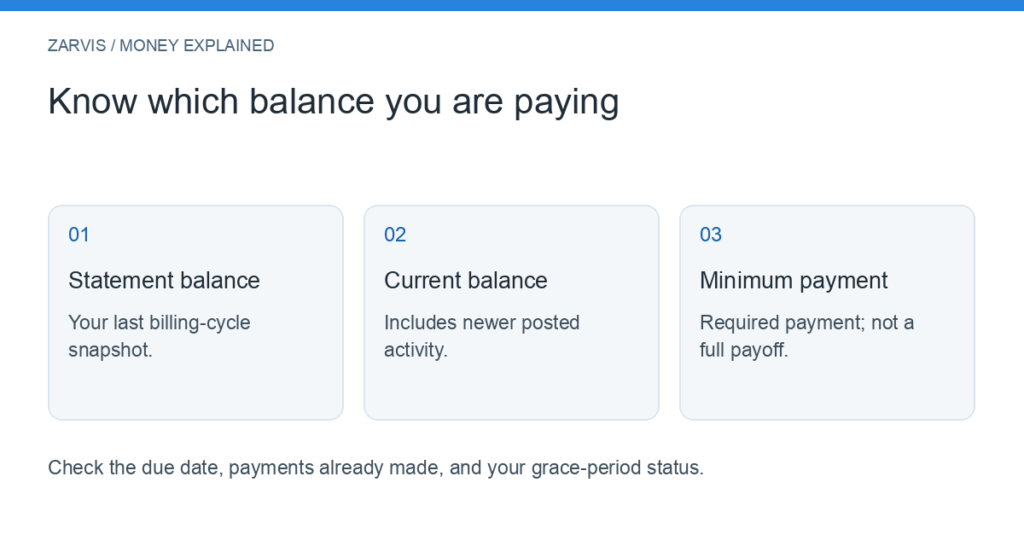
Statement balance vs current balance is a timing question: one reflects your last bill, while the other includes newer posted activity.
Your credit card app says your statement balance is $800, your current balance is $1,050, and your minimum payment is $35. Which number matters?
For ordinary purchases, paying the remaining statement balance by its due date generally avoids purchase interest if your card offers a grace period and you have maintained it. The current balance includes newer activity, some of which may belong to the next bill. The minimum is a different number: it is the smallest required payment for that statement, not an interest-free payoff amount.
Those distinctions matter more than which payment button appears first in the app.

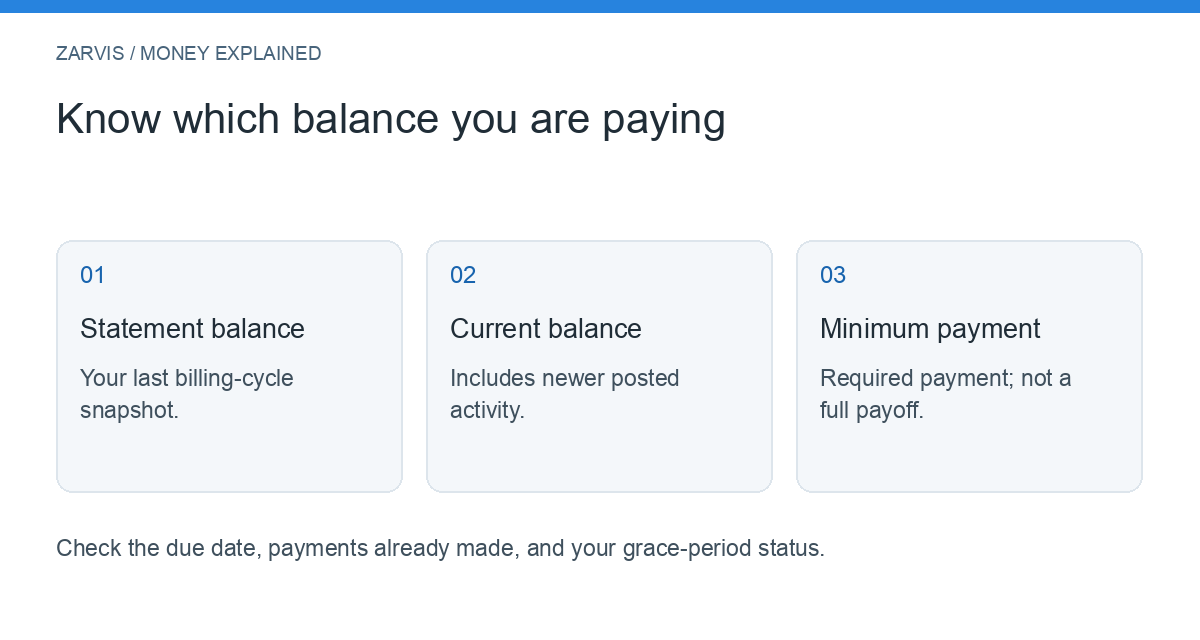
Statement balance vs current balance: three amounts to recognize
| Amount | What it tells you | What to check |
|---|---|---|
| Statement balance | What you owed when the billing cycle closed | The due date and any payments already applied |
| Current balance | Posted account activity since then, including payments and new charges | Pending transactions may be shown separately |
| Minimum payment | The required minimum for the statement | Paying only this amount can leave interest-bearing debt |
The original statement is a historical document. Its printed balance does not change because you make a payment later. Your app may separately show a “remaining statement balance” or “remaining amount due.” Use that updated payment information rather than paying the original amount twice.
Capital One’s explanation of statement and current balances describes the same timing difference. Exact labels and payment options depend on your issuer.
Statement balance vs current balance: a worked example
Suppose your statement closes on June 5 with an $800 balance, due June 30. You make another $250 in purchases after June 5. Before any payments, the current balance is $1,050, assuming no other activity.
If you pay $800 by June 30, those newer $250 in purchases generally belong to the following statement. You do not automatically have to pay all $1,050 by June 30 to preserve the purchase grace period.
Now suppose you already paid $300 toward that $800 statement. With no other adjustments, $500 remains to cover it. Check how the issuer applied your payment, particularly if you have separate promotional balances, installment plans, or transactions carrying different APRs.
This is a simplified illustration, not a description of every card agreement.
When paying the statement balance is not enough
The important condition is the grace period. The Consumer Financial Protection Bureau explains that cards are not required to offer one, although most provide one on purchases.
If you carried a balance, you may have lost that grace period. Paying a statement in full does not necessarily eliminate interest that accrued after the statement closed. Ask your issuer for the amount needed to pay off an interest-bearing balance and the requirements for restoring the grace period.
Cash advances generally do not receive the same purchase grace period. Promotional offers and deferred-interest arrangements also need their own review. Our credit card interest guide explains why transaction type and timing affect the bill.
Should you pay the current balance instead?
You can, if the money is available after covering essentials and upcoming bills. Paying newer posted purchases early can free up available credit and reduce the balance that may later be reported to credit bureaus.
But the payment due date and the reporting date are not necessarily the same. Paying the current balance does not guarantee a particular credit score or a zero balance on your credit report. For the calculation, see our credit utilization ratio guide and utilization calculator.
There is also no need to carry interest-bearing debt just to use a credit card. Interest charges are a borrowing cost, not a credit-building requirement.
Set up autopay without losing track
Choose the payment option deliberately. “Minimum payment,” “statement balance,” and a fixed dollar amount can produce very different results.
- Confirm which balance autopay will collect and on what date.
- Keep enough money in the linked checking account.
- Check whether a manual payment changes the scheduled automatic withdrawal.
- Review the statement for unfamiliar charges and confirm that the payment posted.
If you cannot afford the full statement, paying at least the required minimum on time can help avoid late-payment consequences, but interest may continue. Our minimum-payment guide explains that trade-off. If even the minimum is out of reach, contact the issuer promptly rather than assuming a smaller payment satisfies the bill.
When comparing statement balance vs current balance, check payments already posted before choosing an amount. The original statement and the app’s remaining amount due may show different figures for a legitimate reason.
The practical rule
Start with the due date and the remaining statement amount, then check your grace-period status. Use the current balance to understand newer spending, not as a substitute for reading the statement.
This guide provides general US financial education, not personalized financial or credit advice. Your card agreement controls the terms that apply to your account.
Payment questions worth checking before the due date
What if a refund appears after the statement closes?
Look at the issuer’s updated amount due rather than subtracting the refund yourself and assuming the minimum has disappeared. A merchant credit can reduce the account balance, but how it affects a required payment depends on the account and timing. If the app still shows a minimum due, ask the issuer what payment is required. Keep the refund confirmation until it posts.
Should I pay a pending purchase?
A pending authorization is not necessarily the final charge. A restaurant tip, hotel deposit, or canceled order can change what eventually posts. Use the issuer’s posted balance and payment options; do not build a payoff calculation around a transaction that is still pending. Also leave enough cash for bills that will leave your checking account before your next deposit.
Does autopay remove the need to check the bill?
No. Confirm the selected payment amount, the bank account, and the collection date. If you make an extra payment manually, check whether that changes the automatic withdrawal. Review the payment after the due date as well: a scheduled instruction is not the same as a successfully posted payment. Contact the issuer promptly if a payment is returned.
What information should I have when calling the issuer?
Have the statement closing date, due date, original statement amount, and any payments or credits posted since closing. Ask for the remaining amount needed for the statement, whether you currently have a purchase grace period, and whether residual interest may appear. Those account-specific answers are more useful than a general rule about always paying one balance label.