



A balance transfer credit card lets you move a balance from another card — usually for a transfer fee — onto a card offering a lower promotional interest rate for a set intro period. Whether it saves you money depends on arithmetic, not the headline rate: the fee, the length of the intro period, and the fixed monthly payment you can actually sustain must together retire the balance before the promotional rate ends and the regular APR begins.
Quick answer: Add the transfer fee to the balance, divide by the number of months in the intro period, and that is the payment required to clear the debt in time. In the hypothetical example below, a $6,000 balance with a 3% fee needs $515 a month for 12 months at a 0% intro APR — and would cost roughly $720 less in interest and fees than staying put, if every payment is made as planned.
Key Takeaways
- A balance transfer moves debt; it does not reduce the amount you owe, and the transfer fee is added to what you must repay.
- The transfer fee is commonly a percentage of the amount transferred, often with a minimum dollar fee.
- Intro periods are fixed windows. When the window ends, any remaining balance is charged at the card’s regular APR, which is disclosed in the offer terms.
- The required payoff payment is: (balance + transfer fee) ÷ intro months.
- A balance transfer only helps if your payment clears the balance in time; a leftover balance at a high regular APR can erase the savings.
- New purchases on a transfer card can complicate payoff, because they may be charged at a different APR and affect how payments are applied.
How a Balance Transfer Works

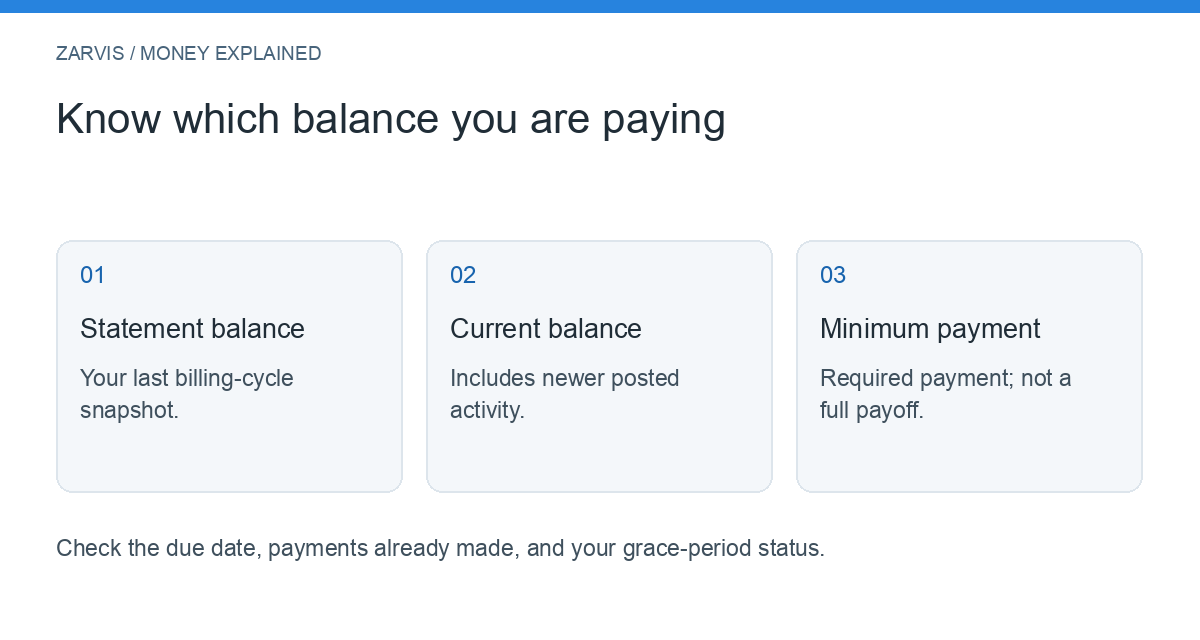
You request the transfer when you apply or during an eligibility window in the offer. The new issuer pays the old account directly, which can take days or a few weeks; keep making at least the minimum payment on the old card until the transfer posts, or you risk a late fee there.
The Consumer Financial Protection Bureau (CFPB) cautions consumers to read balance transfer terms carefully, including the fee, the length of the promotional period, the APR that applies afterwards, and whether the promotional rate covers purchases as well as transfers — these are separate rates and separate clocks on many cards.
You generally cannot transfer a balance between two cards from the same issuer, and the amount you can transfer is capped by the credit limit you are given, which you may not know until after approval. Approval and any specific offer are never guaranteed; they depend on the issuer's review of your application.
The Payoff Math, Step by Step
Step 1 — Add the fee. Transferred balance × fee percentage = fee. Balance + fee = true amount to repay.
Step 2 — Divide by the intro months. True amount to repay ÷ number of intro months = monthly payment needed to finish in time.
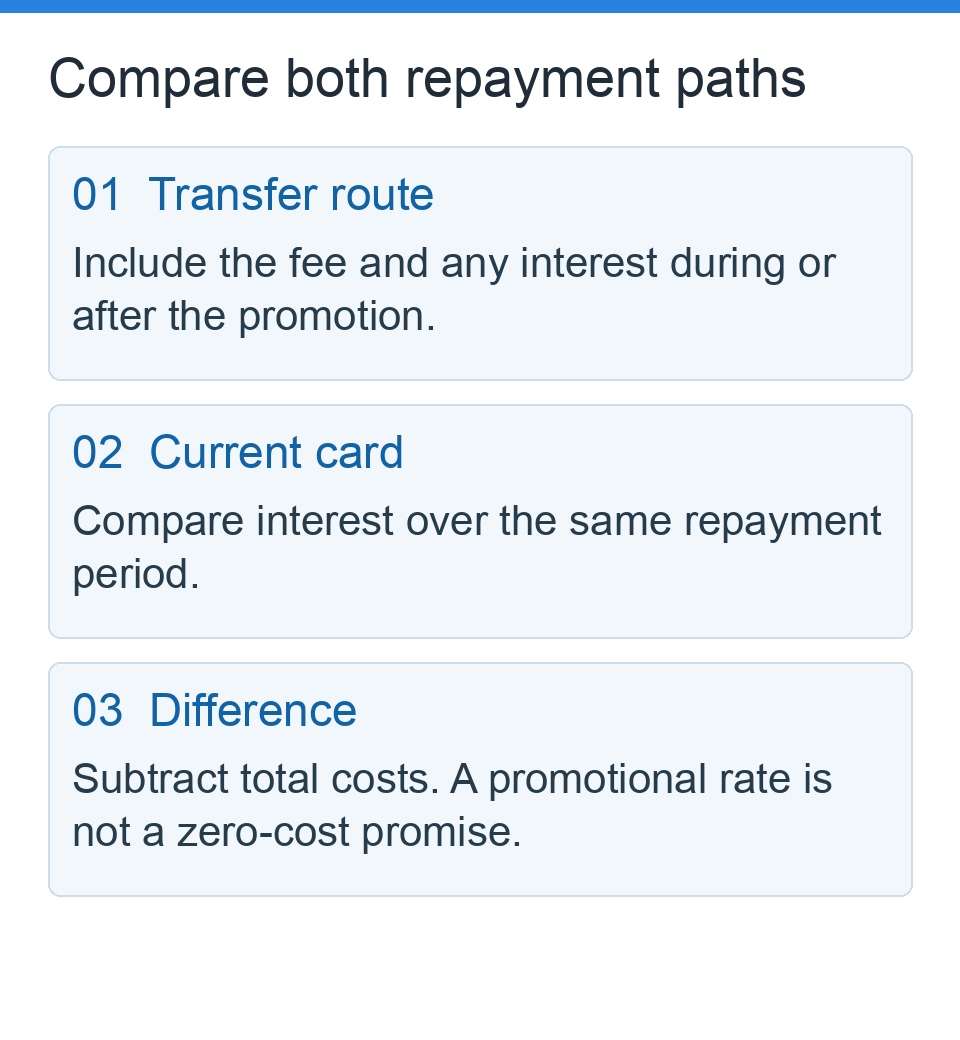
Step 3 — Compare with staying put. Estimate the interest you would pay on the current card under the same monthly payment. If the interest avoided is comfortably larger than the transfer fee, and the payment from Step 2 fits your budget for the whole period, the transfer has a plausible case.
If the fee eats most of the avoided interest, or the payment is unrealistic, it does not.
Worked Example: $6,000 Balance, 3% Fee, 12 Months
The following is a hypothetical example with clearly labelled assumptions. It is not an offer and does not describe any specific card.
Assume:
- Current balance: $6,000 at a hypothetical 24% APR
- Transfer offer: hypothetical 0% intro APR for 12 months, 3% transfer fee, then a regular APR applies to any remainder
- You can pay $515 a month, every month, with no new purchases on either card
The transfer fee: $6,000 × 3% = $180 Amount to repay on the new card: $6,000 + $180 = $6,180 Payment needed to finish within the intro period: $6,180 ÷ 12 = $515 a month
Staying put instead: Paying $515 a month against $6,000 at a hypothetical 24% APR would clear the balance in about 14 months and cost roughly $900 in interest.
| Route (hypothetical assumptions) | Monthly payment | Time to clear | Approx. interest + fees |
|---|---|---|---|
| Stay at 24% APR | $515 | ~14 months | ~$900 interest |
| Transfer: 0% intro for 12 months, 3% fee | $515 | 12 months | $180 fee, $0 intro interest |
| Difference | — | 2 months sooner | ~$720 saved |
A larger fee changes the picture but may not reverse it: at a hypothetical 5% fee, the fee would be $300 and the required payment would rise to ($6,000 + $300) ÷ 12 = $525 a month , saving roughly $600 against the same staying-put estimate.
The decision is sensitive to both the fee and the payment — run your real figures through the three steps above rather than relying on any example.
Where Transfers Go Wrong
Paying too little each month. If you paid $400 a month in the example instead of $515, you would still owe $6,180 − (12 × $400) = $1,380 when the intro period ends. That remainder then accrues interest at the card’s regular APR, which could be as high as, or higher than, the rate you left. Set the payment from the formula, not from habit.
Counting the fee as free money. The fee is charged immediately. If you transfer and then move the balance again, repeated fees compound the cost without reducing principal.
Adding new purchases. Purchases may sit at the regular purchase APR while your payments are applied according to the card's allocation rules. Under federal rules, payments above the minimum generally go to the highest-APR balance first, but the minimum portion can be applied differently, as described in your agreement. Keeping the transfer card free of new spending keeps the payoff plan simple.
A card you use daily might be better kept separate — and check its annual fee still makes sense if it is a fee card.
Missing a payment. A late payment can end a promotional APR early on some cards, in addition to fees and credit reporting consequences. The CFPB notes that promotional terms are governed by the card agreement; assume a missed payment puts the whole plan at risk, and set up autopay for at least the fixed payoff amount.
Ignoring utilization during the move. The new card may report a high balance relative to its limit while the old card still shows its balance during processing, temporarily raising overall utilization. See our credit utilization ratio guide for how per-card and overall figures are calculated.
Waiting too long to act. The intro clock starts as the offer terms specify — often from account opening or the first transfer within a set window — not from when you feel ready. Confirm the deadline for completing a transfer at the promotional terms, and the exact date the promotional APR ends.
A Pre-Transfer Checklist
- Write down each current balance, its APR, and what you pay monthly.
- From the balance transfer offer, note the fee percentage and minimum, intro length, the date the intro ends, the regular APR afterwards, and whether purchases share the intro rate. Verify all of it in the offer’s terms, not in advertising.
- Do the three-step math for your real numbers, and test a payment you can sustain in a bad month, not just a good one.
- Decide where new spending goes — ideally not on the transfer card.
- Set autopay for the fixed payoff amount, and calendar the intro end date.
- Keep paying the old card until the transfer visibly posts, and keep records of both accounts.
Frequently Asked Questions
Does a balance transfer hurt my credit score?
Applying involves a hard inquiry, and a new account can change the average age of your accounts and your utilization in both directions: a new limit can lower overall utilization, while a concentrated balance can raise the new card's per-card utilization. Effects vary by profile, are often modest for a single application, and are not guaranteed to be positive or negative.
Paying the balance down is the factor most within your control.
Can I transfer a balance from another card at the same bank?
Generally no. Issuers commonly prohibit transfers between their own accounts. The restriction and any other excluded debt types are listed in the offer terms.
What happens if I cannot pay the balance off in the intro period?
The remaining balance is charged interest at the card’s regular APR from the end of the intro period, at the rate disclosed in your agreement. The transfer may still have saved you interest compared with staying put, but the saving shrinks as the remainder sits at the regular rate. The payoff payment formula exists to avoid this outcome.
Is the transfer fee charged interest?
The balance transfer fee is added to your transferred balance and is typically subject to the same promotional APR during the intro period, as your agreement describes — which is why the payoff math in this guide treats balance plus fee as the amount to clear. Verify this treatment in your own terms.
Can I transfer more than I owe, or transfer other debts?
You can only transfer up to the limit and transfer allowance the issuer sets, and eligible debt types are defined in the offer terms. Transfer amounts that exceed what the issuer allows may be reduced or declined, so request an amount based on your actual payoff figure, including any interest that will accrue before the transfer posts.
Do not confuse a transfer with a cash advance

Before using a card to access cash, check whether the transaction is actually treated as a cash advance rather than a promotional balance transfer. Our cash advance fee guide explains why the applicable fee, APR, and grace-period treatment matter. Confirm the classification and terms with the issuer before proceeding.
Bottom Line
A balance transfer is a tool for buying time at a lower rate, at the price of an upfront fee. It works when the math works: fee added, total divided by the intro months, and a fixed payment your budget can hold for the entire period, with no new spending on the card and no missed payments.
It fails quietly when the payment is set by habit instead of the formula. Run your own three-step calculation with the verified terms of any offer you are considering, and compare it honestly with simply paying more on the card you already have.
Editorial note: Zarvis provides general educational information, not personalized financial, legal, or tax advice. All rates, fees, intro periods, and dollar figures in this guide are clearly labelled hypothetical illustrations, not offers or descriptions of any specific card; actual terms vary by issuer, are subject to approval, and must be verified in the offer and cardmember agreement before you apply or transfer a balance.
A balance transfer does not guarantee savings, approval, or any credit score outcome.
Sources
- Consumer Financial Protection Bureau: Credit cards — balance transfer terms and what to check. https://www.consumerfinance.gov/consumer-tools/credit-cards/
- Federal Trade Commission: Credit and debit cards — consumer advice. https://consumer.ftc.gov/articles/credit-debit-and-charge-cards
- Consumer Financial Protection Bureau: How do I get and keep a good credit score? https://www.consumerfinance.gov/ask-cfpb/how-do-i-get-and-keep-a-good-credit-score-en-318/
- myFICO: Amounts owed and credit utilization. https://www.myfico.com/credit-education/credit-scores/amounts-owed