



A car loan rate is the interest rate a lender charges you to borrow money for a vehicle, expressed as an annual percentage rate (APR) when fees are included. The rate you are offered is not a single market price.
It is a personal price, set by the lender after weighing your credit profile, the loan term, the amount borrowed, and the car itself — including whether it is new or used.
Two buyers can finance the same car on the same day and pay very different amounts — one a few thousand dollars of interest, the other two or three times as much — even though the monthly payments look similar. Understanding what moves car loan rates helps you compare offers on total cost, not just on the payment a salesperson shows you.
Quick Answer
- New-car loans usually carry lower rates than used-car loans, because the vehicle is worth more, is easier to resell, and sometimes qualifies for manufacturer promotions.
- Your credit history and credit scores are usually the largest single factor in the rate you are offered.
- Longer terms often come with higher rates and always produce more total interest if the rate is the same, because you borrow for more months.
- This guide uses clearly labelled hypothetical examples only — not current market rates, which vary by credit profile, term, vehicle age, and lender. Verify any real offer with the lender.
Key Takeaways
- Compare APR and total interest, not just the monthly payment.
- A small rate difference becomes a large dollar difference over 60 or 72 months.
- Used cars are cheaper to buy but often more expensive to finance per dollar borrowed.
- Improving the factors you control — loan size, term, down payment, and the accuracy of your credit reports — matters more than chasing an advertised rate you may not qualify for.
What a Car Loan Rate Actually Pays For
A lender pricing an auto loan is pricing a risk: that you will not repay, or that the car securing the loan will be worth less than the balance if it is repossessed and sold. The rate is the price of that risk, plus the lender’s cost of funds and a margin. Three parts of an offer are often confused:
- Interest rate is the cost of borrowing the principal, stated as a percentage per year.
- APR includes the interest rate and certain lender fees rolled into the loan, so it is usually the better figure for comparing two loan offers.
- Total interest is the dollar amount you will actually pay over the full term if you make every payment on schedule. This is the figure that shows what a rate really costs you.
A loan can have an attractive rate and still be expensive if the term is long or the amount borrowed is large. Conversely, a slightly higher rate on a much shorter loan can cost less overall. That trade-off is the central theme of this guide, and it is why our related guides on 72-month car loans and used-car loan rates
focus on total cost as well as the rate.
Why New-Car Loans Usually Cost Less Than Used-Car Loans
Lenders generally charge less for new-car financing for practical reasons:
- Collateral value is clearer. A new car has a known manufacturer price and a predictable resale path. An older car may have hidden mechanical problems, accident history, or a value that is hard to verify, and it starts from a less documented value.
- Manufacturers subsidize some new-car rates. Promotional APRs on new models usually require strong credit and may require giving up a cash rebate instead, so they are not automatically the cheapest deal. Compare both options on total cost.
- Used cars are older by the end of the loan. A five-year loan on a six-year-old car ends when the car is eleven, and the lender’s collateral is weaker throughout.
None of this means a used car is a bad purchase. A used car with a higher rate can still cost far less overall than a new car with a lower rate, because the amount borrowed is smaller. The example below shows both sides of that comparison.
Worked Example: Same Loan Size, Different Rates
Assume a hypothetical $30,000 loan for 60 months in both cases. These rates are illustrations, not market quotes.
| Scenario | Hypothetical APR | Monthly payment | Total of payments | Total interest |
|---|---|---|---|---|
| New car | 6% | $579.98 | $34,799.04 | $4,799.04 |
| Used car | 9% | $622.75 | $37,365.04 | $7,365.04 |
The used-car loan costs $42.77 more per month and $2,566.00 more in interest over the term, on exactly the same amount borrowed. That gap is the price of the higher rate alone.
Now reverse the comparison the way real shopping works. If the used car costs less, you might borrow $20,000 instead of $30,000. Even at the higher hypothetical 9% APR for 60 months, that loan costs $415.17 per month and $4,910.03 in interest — for a much smaller debt. Rate matters, but loan size matters just as much.
Before you sign, run your own numbers with our auto loan calculator and compare at least two real offers side by side.
How Credit Affects Your Rate
Lenders typically review your credit reports and one or more credit scores, along with income, employment, and existing debts. Borrowers with a history of on-time payments, low credit card utilization, and older, stable accounts usually qualify for a lender’s lowest rates. Borrowers with missed payments, recent defaults, or very little credit history usually pay more, if they are approved.
Using the same hypothetical $30,000, 60-month loan:
| Credit scenario (illustration) | Hypothetical APR | Monthly payment | Total interest |
|---|---|---|---|
| Strong credit profile | 5% | $566.14 | $3,968.22 |
| Weaker credit profile | 12% | $667.33 | $10,040.01 |
The weaker-profile loan costs about $6,071.79 more in interest . No guide can tell you which tier you will fall into — lenders use their own criteria — but the gap explains why checking your credit reports for errors, paying on time, and reducing card balances before you apply can be worth real money.
The Consumer Financial Protection Bureau (CFPB) recommends shopping for a loan the way you shop for the car: get quotes from more than one lender, compare APR and term together, and do your rate shopping within a short window.
Other Factors That Move Your Rate
Loan term
Longer terms spread the balance over more payments. Lenders often charge higher rates for longer terms, and even at the same rate, a longer term produces more total interest. Our guide to 72-month car loans works through that math in full.
Down payment, vehicle, lender, and income
A larger down payment reduces the amount borrowed and the lender's exposure if the car's value falls; it can improve approval odds and always reduces total interest. Some lenders also set maximum age or mileage limits for used cars, or charge more for older vehicles.
Banks, credit unions, online lenders, manufacturers' finance companies, and dealership-arranged financing can all price the same borrower differently — a dealership may present a monthly payment rather than an APR, so ask for the APR, term, and total amount financed in writing.
Finally, even with a good score, a payment that takes too large a share of your income can lead to a higher rate or a denial.
How to Compare Real Offers
- Get preapproved by a bank, credit union, or online lender before visiting a dealer, so you have a benchmark APR.
- Ask every lender for the same term, then compare APR and total interest — not the payment alone.
- Check whether a low advertised rate requires a short term, a large down payment, or giving up a rebate.
- Read the estimate for fees, prepayment penalties, and whether the rate is fixed or variable. Most auto loans are fixed, but confirm it.
- If you already have a loan and your credit has improved, review whether auto loan refinance could reduce your cost.
Put competing offers on the same footing

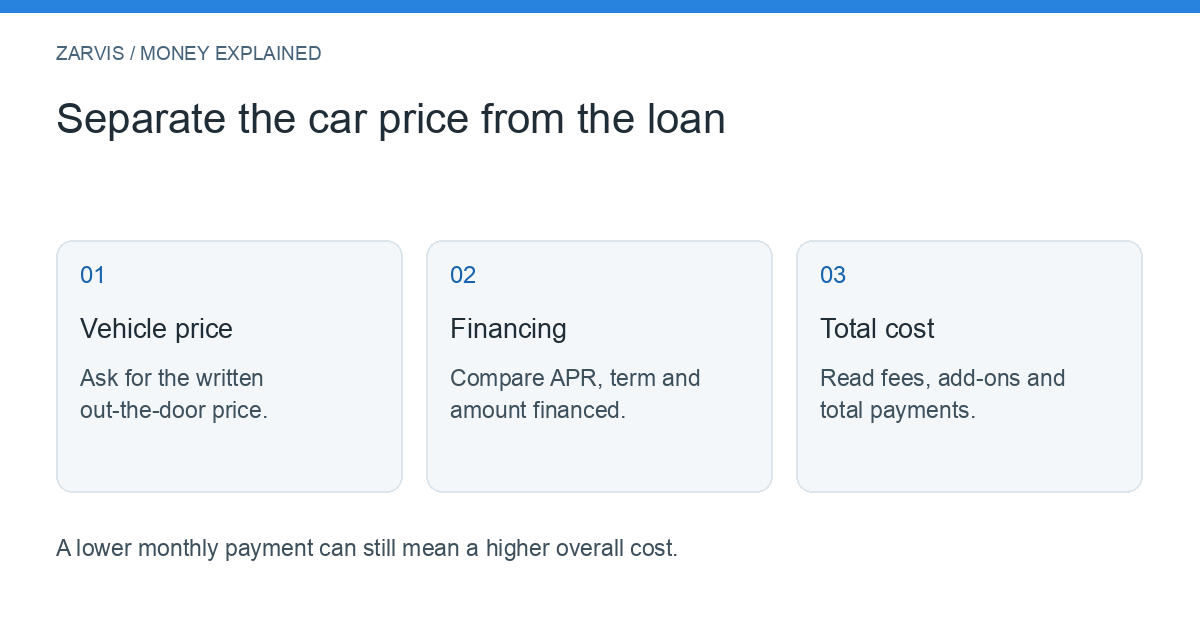
Before visiting a dealership, use our car loan preapproval checklist to record the quoted APR, loan term, amount financed, vehicle restrictions, expiration date, and any required conditions. A conditional offer may change after the lender checks the vehicle and application.
Compare the written out-the-door vehicle price separately from financing. A longer term can lower the payment while increasing total interest, so a payment-only comparison can hide a more expensive loan.
Car Loan Rates FAQ
Is a lower APR always the better loan?
Only when the term and amount are the same. A lower APR over a much longer term can cost more in total interest than a slightly higher APR over a shorter term. Compare APR, term, and total interest together.
Why are used-car loan rates higher than new-car rates?
Lenders view older vehicles as riskier collateral: values are less predictable, mechanical condition varies, and the car will be older still when the loan ends. Manufacturer promotions on new cars can widen the gap further.
Can I get a car loan rate with no credit history?
It may be possible, but options are often more expensive. Some lenders consider income, employment, and down payment, and a co-signer with established credit may help — but a co-signer becomes legally responsible for the debt.
Does checking my rate hurt my credit score?
A lender’s hard inquiry can affect a score slightly. Scoring models generally treat multiple auto loan inquiries within a short shopping window as a single event, which is why the CFPB advises concentrating your loan shopping rather than spreading applications over months.
Can I negotiate my car loan rate?
Indirectly, yes: bring a competing preapproval and ask the dealer or lender to beat it, and negotiate the car’s price, which reduces what you borrow. No lender has to match an offer, and no rate is guaranteed until it is in a signed agreement.
Bottom Line
Car loan rates are personal prices set by your credit profile, the term, the size of the loan, and the car itself. New cars usually finance for less per dollar borrowed; used cars usually cost less to buy. The only fair comparison is APR plus total interest on the same amount and term. Use hypothetical math to learn the mechanics, use our auto loan calculator
to test your own figures, and verify every real rate, fee, and term with the lender before you sign.
Editorial note: Zarvis provides general educational information only, not personalized financial, legal, or tax advice. The rates in this article are hypothetical examples chosen to show how loan math works; they are not current market rates, quotes, or predictions. No loan approval, rate, or term is guaranteed.
Rates, fees, eligibility rules, and provider terms change, so always verify important details directly with the relevant lender or financial institution before making a decision.
Sources
- Consumer Financial Protection Bureau: Auto loans — consumer tools and guidance on shopping for a loan, comparing APR and term, and understanding total cost. https://www.consumerfinance.gov/consumer-tools/auto-loans/
- Federal Reserve: Consumer Credit (G.19) statistical release. https://www.federalreserve.gov/releases/g19/
- Federal Trade Commission: Consumer advice on dealer financing, APR, and contract terms. https://www.ftc.gov/